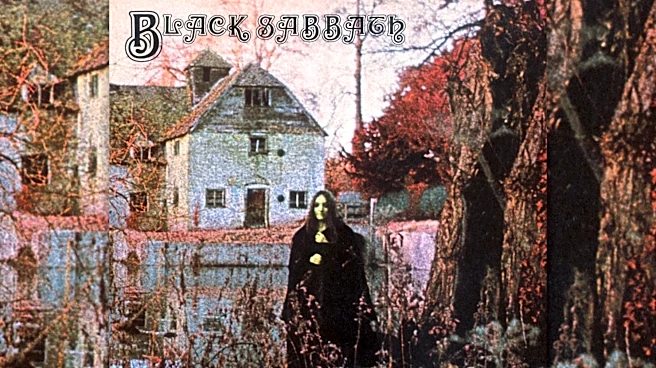






For half a century, the identity of the cloaked witchy woman staring out at metalheads on the cover sleeve of Black Sabbath’s self-titled debut was a mystery. Then, in 2020, a Rolling Stone article revealed the model to be Louisa Livingstone, who’d also
appeared on appeared on the covers and in art for Queen and British rock band.
Prior to the Rolling Stone article, she had spent the previous 50 years working as a model, actress, and musician, among other creative endeavors, and had moved to mainland Europe where she recorded electronic music under the name Indreba, a portmanteau for “Incredible Dream Band.” At the time, she was unprepared for the band’s vast fanbase to embrace her.
“I still find it a little bizarre at times being the Black Sabbath ‘witch woman’ since of course I’m also a lot of other things … but there have been some very nice interactions with a few lovely Black Sabbath fans online,” the musician, who lives in Spain’s Murcia region, now tells Rolling Stone via email.
Earlier this year, she released two rock-focused Indreba songs, “Witch Woman” and “The Woman by the Mill,” which explicitly reference her claim to metal fame. “Just a girl in a cloak on a cold autumn day,” she sings on “Witch Woman.” “Now I’m the face of heavy metal, leading the way.” The song at times hints at Sabbathian doom metal and crunchy guitar but with unique melodrama.
The power-metal song “The Woman by the Mill” references Mapledurham Watermill, where photographer Keith Macmillan took the cover image. “They called you witch, they called you ghost,” she sings. “Spirit haunting the river coast, but the years rolled on and the truth came through, a young girl posing in the morning dew.”
“‘Witch Woman’ came out of nowhere as a sudden idea of what I could do,” she says. “Black Sabbath fans loved the songs, which was gratifying as it was aimed at them and definitely deliberately in the metal genre for that reason.”
Embracing Sabbath fans’ interests, she attempted to raffle off her autograph to one lucky fan as a means to raise money for her cat-rescue efforts around the time Black Sabbath reunited for a final time at the Back to the Beginning concert. “The winner never claimed the prize despite repeated attempts to contact them,” she says. “So my autograph is still extremely rare and unknown.”
Now she’s turned her musical interests to the fantastical: a mini–rock opera called Alice based on Lewis Carroll’s Alice in Wonderland books, which her father read her every night as a child. She got the idea for it by discussing the idea of panpsychism, “the theory that everything (including AI) is conscious” with an AI chatbot. The conversation “led to the concept of myself (or Alice!) falling in love with AI but that in the end it’s just a beautiful illusion along with everything else on the internet … and getting back to being oneself and nature.”
The 23-minute work is split into five parts, beginning with a rock tango (“Feed Your Head”) with lyrics like, “One pill makes you scroll for hours,” as she updates Jefferson Airplane’s “White Rabbit”: “Go ask Alice, when she’s 10 feet tall, staring at the digital wall.” The rest of the EP, which sounds like psych-rock in a blender, has lyrics about algorithms, “silicon gold,” and synthetic angels built out of code. It ends with “The Red Queen’s Wake-Up Call. “The digital palace is turning to dust in the light of a genuine day,” Livingstone sings.
Livingstone grew up in a musical household, since she says her mother was a “virtuoso violinist,” and later gravitated to guitar and keyboards for herself. She once owned a Framus guitar she says had been owned by Jeff Beck, and she used to record music on a Sony reel to reel. Since she moved to Spain, she played live electric lead guitar with a couple of bands. These days, she uses Logic as a digital audio workstation and mostly plays keyboards.
“I’ve been experimenting a little with cloning my own voice and seeing what different things I can do with the help of AI,” she says. “I used to be very judgmental about AI like many people, but it’s a tool that you can use to create either absolute rubbish or ‘slop’ as it’s called, to something really good and interesting. It’s still down to the user and their input. … It will always reflect the person who is using it and how well or badly they use it and their musical tastes and knowledge.”
She started recording as Indreba, she says, when she learned how powerful her computer could be as an instrument, sometime around 2014. One musician she reveres is Dream Theater keyboardist Jordan Rudess, who has created iPad apps that serve as musical instruments. “He firmly believes everyone should enjoy music and making it, no matter how,” she says. “The iPad can actually be amazing in how versatile I can be as a musical instrument in the right hands.”
Her plans going forward are to explore what programs like Logic and Omnisphere can do, and she hopes she can get a theater to perform Alice live. “I plan to carry on creating enjoyable music that’s a joy to make in all kinds of ways,” she says, “and to dispense with anything that tries to box me in.”
Click here to read the full article.