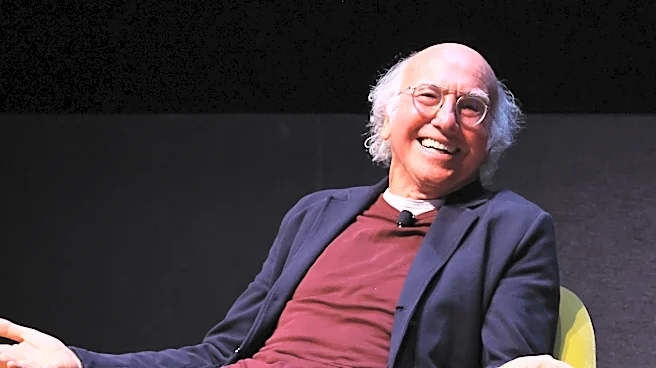









It will surprise no one that Larry David was incredulous when he learned someone wanted to write his biography. In fact, he sent the book’s prospective author, Blake J. Harris, the bluntest possible email in August 2020: “There are far better ways to spend
your time. [T]here’s nothing interesting about me and there’s no interest in me. That’s not being modest. It’s the truth.”
We know about this exchange because it is fittingly quoted in the prologue of Emperor of Nothing, the first authorized biography of David, which arrives Oct. 20. David participated fully in the book (conceding to Harris, “Oh Jesus. If we must”), while also featuring extensive interviews with his family, friends, and countless collaborators. And despite David’s assertion that there’s “nothing interesting” about him, the book offers a fascinating deep dive into the life and career of one of the funniest and most innovative comic minds of the past 50 years.
Here are 10 highlights from the book.
1. David Bombed the First Time He Tried Stand-Up
While trying to make it as an actor, David accompanied a friend one night to famed comedy club the Improv and figured he ought to try his hand at stand-up. In fact, David was so confident, he tried to convince the club’s owner Budd Friedman to let him go on stage that night. Friedman obviously declined and pointed David to some smaller clubs more appropriate for first-timers.
So, one night in 1972, David took the stage at Gerde’s Folk City in Greenwich Village. His set, such as it was, consisted largely of impressions, and it was a disaster. “My material was abysmal,” David says. “I had no idea what I was doing.” He adds, “One of the mistakes I made was talking to the audience as if they were my friends… But the difference, I soon realized, was that my friends liked me. And the audience, they did not!”
2. David Wrote a Movie That Never Got Made, but Inspired an Array of Future Bits
By 1983, David was an established, but unemployed comedian after the sketch show he wrote for, Fridays, was canceled. So he wrote a movie, Prognosis: Negative, about a young man who’s unable to commit to a relationship with any woman. After learning his ex is terminally ill, the guy tries to win her back seeing it as a rare chance to show he can settle down, but without having to worry about it being forever. (The script was leaked online for the first time earlier this year.)
In some Hollywood circles, the script was a hit, with Rob Reiner and Richard Dreyfuss both showing interest. But a formal deal never materialized, especially as David chafed at possible rewrites that might make the dark comedy more marketable. “That was always something that I hated about movie scripts,” David says. “The idea that characters are supposed to go on some big ‘journey’ and learn all these ridiculous ‘lessons’ along the way. I mean, I don’t know anybody like that! Whose life is like that?”
While Prognosis: Negative was never made, the title became a running gag on Seinfeld. And David repurposed other bits for Seinfeld and Curb, like getting banned from a fruit stand, pretending to hold an elevator door open, and lying about volunteering for the Big Brother program.
3. David’s Relationship With Jerry Seinfeld Confounded Their Comedy Peers
David and Jerry Seinfeld met on the stand-up circuit in the mid-Seventies and immediately hit it off. So much so, they started meeting up for “bounce sessions,” where they riffed and fine-tuned their material. “We liked each other’s stuff,” David says. “Also, our acts were so different that you never had to be concerned that you might be giving suggestions you’d want for yourself.”
But their differences were so pronounced that, for years, many people in comedy couldn’t understand their relationship. One unnamed comic says he’s “still surprised at the simpatico” between them, describing Seinfeld as “a guy that guys like us made fun of. Sure, he was a great comic. But I would say to Larry, ‘He’s a guy who washes his dick after sex!’ You know, he was that guy.”
Another comic, Bill Scheft, says the people who poked fun at Seinfeld still respected his craftsmanship (and were probably a little jealous of his success). He also theorizes that David and Seinfeld gave each other exactly what the other lacked: “You had one guy — the consummate pro [Jerry] — who never stormed offstage in his entire life, and another guy who did nothing but. So they were an odd pair. But that’s what made them valuable to each other. Larry gave Jerry an edge. And Jerry made Larry more easily accessible.”
4. David Hated the Seinfeld Pilot
The pilot for Seinfeld was a dud. It tested poorly with audiences and was buried by NBC with a July 5, 1989 airdate, after which the network declined to pick it up. (It was later saved by NBC exec and longtime show champion Rick Ludwin.) One other person who didn’t like the pilot: Larry David. “I hated the pilot,” he says. “Hated it.” And his reasoning was also classic David: “[T]here were other hands in it besides ours.”
Specifically, David chafed at the contribution of Gary Gilbert, who was brought in by production company Castle Rock to be showrunner and help rewrite the script. (Gilbert was later ousted.) But David also says that, when the pilot was being filmed, he kept seeing things that didn’t seem “right,” and his efforts to suggest changes to the director were rebuffed.
David was so down on the pilot, he remembers saying goodbye to Seinfeld and figuring he “wouldn’t see him again for another couple years.” (As for Seinfeld himself: “I remember [watching the pilot] and thinking, ‘Boy this really worked pretty well.’”)
5. David Threatened to Quit Seinfeld Over Network Notes About Jerry and Elaine
Before Seinfeld was formally picked up for a third season, Seinfeld, David, and the rest of the creative team met with NBC brass to discuss the show’s future. David was told ahead of time to keep his mouth shut, which he managed to do even as the execs pitched a “tweak” to the relationship between Jerry and Elaine: They should date and get married.
Afterwards, Larry threatened to quit if they were forced to make the change. “I didn’t want to leave the show,” he says. “But I just didn’t want to do the show that NBC wanted me to do. If I was going to do it, I couldn’t… I couldn’t have people telling me what to do. Otherwise it wouldn’t be worth it.”
Luckily, no one else liked the idea either, including Seinfeld, who said he’d quit, too, if David left. Ultimately a third season was ordered and, David says, “I never had any trouble again after that.”
6. David and Seinfeld Never Fought — Except About One Incredibly Stupid Thing
David and Seinfeld’s working relationship was always rock solid. “Larry and I never had any fights,” Seinfeld says. “We never had any really bad arguments while working on the show.”
Well, except one. It was while tinkering with the script for the Season Four episode, “The Visa,” in which Kramer gets the chance to attend a New York Yankees Fantasy Camp. At one point, shouting erupted from David and Seinfeld’s shared office, and fellow writer Jon Hayman was called in to settle a dispute: Which former Yankee player sounded funnier in the script, Hank Bauer (David’s choice) or Moose Skowron (Seinfeld’s)?
Hayman says he did his best to be diplomatic: “I tried to weasel out of it and I say, ‘Moose Skowron will get the bigger laugh. But Hank Bauer is funnier to people like us, you know? It’d be funnier to real Yankee fans.’” Ultimately, the fight proved pointless anyway as Seinfeld and David figured out how to get both Bauer and Skowron in there.
7. David Agreed to Be on Hannah Montana Because His Daughters Were Huge Fans
Scroll through David’s acting credits and one inevitably leaps out: A 2007 episode of Miley Cyrus’ breakout Disney show, Hannah Montana. David plays himself in the scene, trying and failing to get a table at a fancy restaurant, only to watch Hannah walk in and get seated immediately. It was shlock-y, and would’ve been an easy enough ask to turn down, but Hannah Montana showrunner Steve Peterman knew David’s daughters, Romy and Cazzie, were fans and said they could appear alongside him.
“Basically, do I do this terrible thing to make my daughters happy? Or…” David jokes.
Not only did David agree to the cameo, he even rearranged a conflicting Curb shoot to make it happen. “I think part of what made it so special, is that my dad decided not to have kids on Curb because [as he used to say], ‘Kids aren’t funny!’” Romy says. “So it was really cool to be [in a scene] with him and to sort of show the world: Larry David has kids and he’s a great dad!”
8. Seinfeld Convinced David to Buy a Porsche, Which He Promptly Returned
Seinfeld has long been a car collector with a particular affinity for Porsches. And as Seinfeld became a sensation, the star managed to convince David it was time to upgrade his ride.
At the time, David was still driving “a beat-up old car,” according to Seinfeld writer and producer Alec Berg. So the showrunner of TV’s number one comedy acquiesced and, in 1995, bought a green Porsche 911 coupe. Immediately, David knew it wasn’t for him. “Like if I’d go to a restaurant, I would park two blocks away and walk,” David says.
David returned the car after a week. As Berg tells it, the Seinfeld writers asked what happened, and David said “while he was stopped at a traffic light, he saw his reflection in a building that had plate glass windows. And what he saw was a ‘sad bald man sitting in a green Porsche, trying to look like he was cool.’”
David traded the car in, took the financial hit, and ultimately turned the experience into the Season Seven episode, “The Cadillac.”
9. David Never Watched Seinfeld After Leaving the Show
David decided to leave Seinfeld after its seventh season. The show continued without him for two more seasons, but David had no interest in watching — and still doesn’t. “I’ve seen many scenes [over the years],” he says. “But not one [episode] in its entirety.”
David did return on several occasions, however. He famously wrote the show’s series finale, and there were numerous episodes that required him to reprise his voice-only role as New York Yankees owner George Steinbrenner. The experience, David admits, “was uncomfortable and a little awkward. I didn’t feel right. I didn’t like doing it. It’s like… leaving my children and another father coming in.”
Not that David resented Seinfeld for continuing the show. “Just because I stopped didn’t mean that he had to stop. If anything, he should have been the one to resent me. I left. I just couldn’t bring myself to watch it. It was painful.”
10. David Wrote Season Four of Curb Your Enthusiasm Before Asking Mel Brooks’ Permission to Feature The Producers
From the outset, David was adamant that, to make Curb Your Enthusiasm, he would be allowed to write an entire season before the show went into production. (And those “scripts,” of course, weren’t traditional scripts, but intricate outlines that the actors would base their improvising on.) For Season Four, David thought it would be fun to have his Larry character star in Mel Brooks’ Broadway adaptation of The Producers.
“I knew I needed to get Mel’s blessing to do it,” David says. Nevertheless, it wasn’t until after he’d finished writing the season that he arranged a lunch with Brooks and his writing partner, Thomas Meehan. “The whole show’s been written [at this point],” David says. “So if he says no, I’m completely screwed.”
Luckily, Brooks said yes, and appeared in several episodes of the season himself. “I’m pretty good at talking people into stuff,” David quips.
Click here to read the full article.