





Rebellions begin with long, slow accumulations of kindling, followed by a spark. In the case of England’s Peasants’ Revolt in 1381, the firewood was a combination of a pandemic known as the Black Death, which decimated half of Europe’s population but
was especially fatal for citizens living in poverty; a regent, King Richard II, whose inexperience and over-reliance on bad-actor advisors resulted in regime-wide corruption; and heavy taxation rates (that benefited the aristocracy, naturally) needed to pay for an unpopular war with a foreign country.
The spark was an incident in the rural town of Brentwood, just outside of Essex, when a royal official attempting to collect taxes by force was violently attacked. The populist rage would spread to a number of different counties throughout Britain, and result in a massive march on London. Spoiler alert for those who don’t have medieval history books on hand: It doesn’t end well.
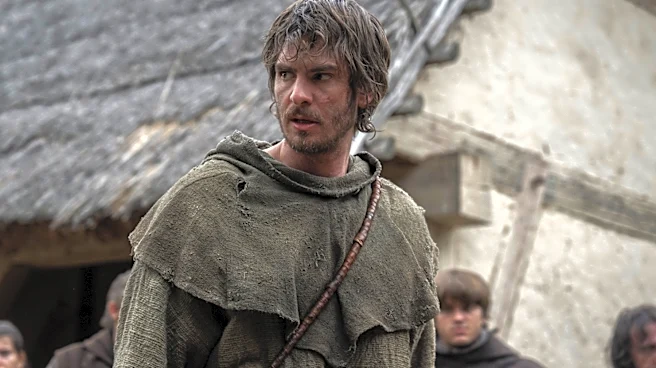
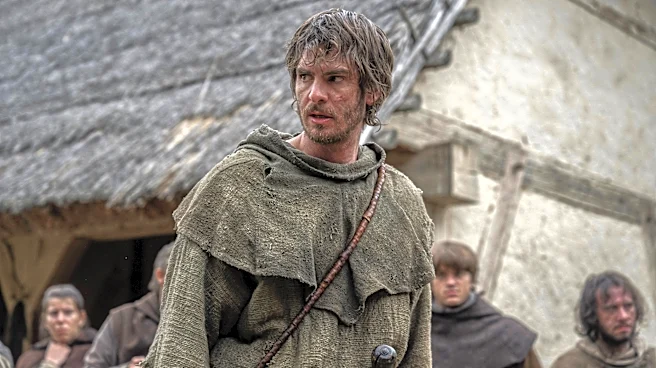
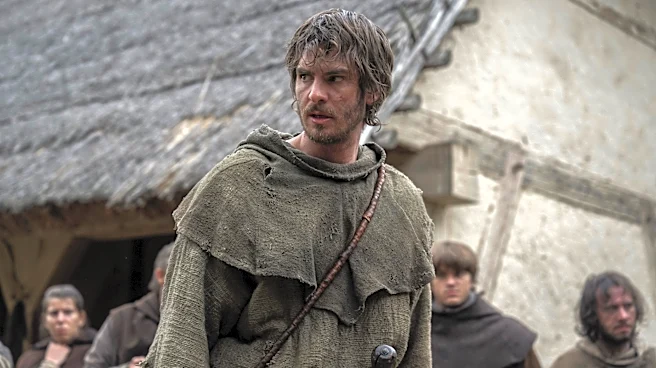
All politics are personal, and The Uprising, filmmaker Paul Greengrass’s jittery, visceral re-imagining of what would eventually become known as “the Great Uprising,” zooms in on the perspective of one man in particular. He’s a farmer, still mourning the loss of his family from the plague, and who goes by the name of his profession: Ploughman. As played by Andrew Garfield, who has always excelled in giving great grief-face, he’s a haunted soul barely scraping by on his less-than-meager earnings. Ploughman is present at the scene where more lucre is being demanded of the poor and state-sanctioned goons are reveling in vulgar displays of power. It is he who cries, “Enough! ENOUGH!” It is he who is struck by a guard, and he who strikes back, inspiring the melee that follows.
And it is the Ploughman who not only sends the beaten official back to the King’s palace but joins others who are ye olde mad-as-hell and shan’t take it any more! Men such as the radical activist and holy man John Ball (Jamie Bell) and Wat Tyler (Shogun‘s Cosmo Jarvis), the official figurehead of the rebellion. And fellow radicalized citizens such as the young women named Alyce (Thomasin McKenzie), who’ve also taken up the cause and march from Canterbury to London, where they hope to confront their cowering boy king (C’mon C’mon‘s Woody Norman) face to face.
Meanwhile, back at His Majesty’s HQ, Richard II’s mother, a.k.a. the Countess (Katherine Waterston), and several of the Lords Appellant who actually run the country, are fretting over how to deal with this inconvenient populist movement. Eventually, Treasure Hales (Tom Hollander, extra snivelly) and Archbishop Sudbury (Game of Thrones‘ Stephen Dillane) enlist the help of the city’s mayor to help quash this rebellion once it lands on their doorstep. It’s worth noting that the great Johnny Lee Miller plays this politico like a mustachioed hard man, radiating a 150-proof thuggish menace that adds immeasurably to the chaos and tragedy that follow. To put it in Trainspotting terms: Imagine Simon, Miller’s character from Danny Boyle’s era-defining romp, was genetically fused with Begbie. You wish he had thrice as much screen time.
A former journalist turned writer-director, Greengrass has long specialized in making action movies that play like disaster films (The Bourne Supremacy, Green Zone), and disaster films that play like action movies (Captain Phillips, United 93, The Lost Bus). It’s the shadow of his 2002 breakthrough movie, Bloody Sunday, that hovers over this kinetic, you-are-there history lesson the most; a nerve-shredding dramatization of the 1972 human rights protest in Derry that resulted in a massacre, it felt like you were watching a news report rather than a recreation. That same sense of immediacy, urgency, and burbling dread is present here, if not quite as potent as his earlier work. Yet all of those prowling and shaking cameras, darting in and out of stirred-up crowds and among blood-lusting troops, drops you into what can only be described as an immersive take on a tale torn from centuries-old headlines.
You don’t need to have studied Advanced English History 106 to sense that a slaughter lurks just around the corner, and that what may seem like a victory for those who try to stand up for their rights might actually be an endgame. Nor do you have to be jaded or easily prone to eye-rolling to murmur “Hmm…” when, courtesy of a fast-forward coda, The Uprising reveals itself to be a stealth origin story for a certain prominent folkloric figure. The name of this legendary character of stage, screen, and literature is never officially spoken, to which we can only sigh in relief, and how legit this notion is has become a point of contention between marketing departments — but there is indeed historical precedence for what Greengrass is footnoting in the film’s final flipped bird to the powers that be.
What’s more interesting than that particular guessing game, however, are the blatantly obvious parallels Greengrass is drawing by returning to this story right here, right now. It’s hard not to see both Occupy Wall Street-ers and Jan. 6 deplorables in the movie many, many sequences of angry mobs and agitated everday people pushed past their limits. Listen closely, and you’ll note a throwaway line about Flemish immigrants “stealing your jobs” that’s spoken by folks looking for scapegoats. Something in the perpetual vox populi is being tapped into by the film’s chronicle of a revolution under fire, a recurring suggestion that history doesn’t repeat so much as rhymes. “No Kings” is not a new sentiment. This story of oppression, protest, political violence, and populist uprisings is over 600 years old. It could not feel more relevant or timely.
Click here to read the full article.