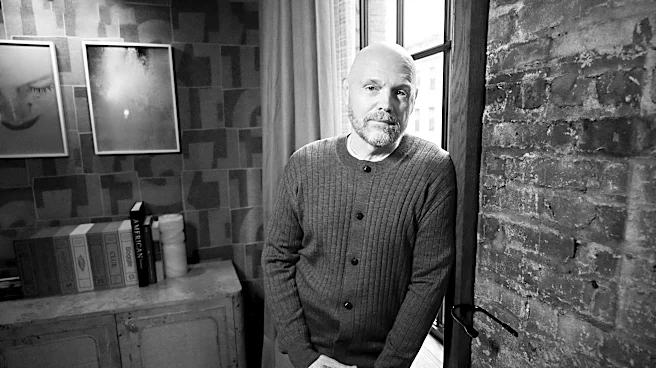






Bill Burr would like to make one thing crystal clear: He never wanted to be “the angry guy.”
Oh, the legendary stand-up knows that he has a reputation as someone who can rage with the best of them. His unparalleled ability to vent his spleen onstage and on his twice-weekly
Monday Morning Podcast, which Burr started way back in 2007, has long fueled his popularity. “Believe me, dude,” the 58-year-old comedian says, “I can blow my top like anybody. I can still lose my shit. I’ve got 50-something years of practice of that.”
But Burr has been working on himself a lot over the past few years. And while there is no shortage of things that still make him mad — social media, tech billionaires, your everyday displays of blatant hypocrisy, the whole left-versus-right thing — he has finally mastered the art of anger management, as well as letting go of a lot of the pain behind it. Part of this change was spurred by a mind-blowing mushroom trip Burr took in the early 2020s, which he memorialized in his seventh comedy special, Live at Red Rocks. Part of it was the result of therapy, which Burr has credited with saving his life. Part of it involves his loved ones and realizing that he had accidentally become the very person he vowed to never be.
And part of it, as Burr will confess during our hour-plus conversation, was an unexpected moment of clarity that happened when he was preparing for his role in The Social Reckoning, writer-director Aaron Sorkin’s return to the world of Facebook, some 16 years after he helped give the world The Social Network. Burr’s character, a composite of several longtime investors, is worried that Mark Zuckerberg (played with characteristic intensity by Jeremy Strong) isn’t taking a whistleblower and a series of Wall Street Journal exposés seriously enough. Coming on the heels of his turn in the all-star Broadway revival of Glengarry Glen Ross last year, it’s a great example of both Burr’s facility as an ensemble player and his ability to parlay his comic persona into a legitimate acting career. But there was an added benefit: A spontaneous crying jag while rehearsing lines prompted Burr to finally address decades’ worth of issues and become a much happier version of himself.
Yes, Burr still blows gaskets — but on a scale of one to 10, he’s no longer “coming in at an eight because someone got my dinner order wrong.” Yes, Burr is still hilarious — probably more than he’s ever been, both in his own estimation and gauging by the dozens of record-breaking, sold-out shows he’s played everywhere from Boston to London to Greece. No, he hasn’t lost his edge, even if he knows he’s lost some fans who expect him to be a misanthrope 24/7. But as he’s been touring his latest stand-up hour around the U.S., he’s now dedicated to countering the divisiveness he believes is tearing this country apart. Enough with the angry guy. “I want to be the meet-in-the-middle guy,” Burr says.
The Social Reckoning is not a follow-up to The Social Network, exactly. But it’s Aaron Sorkin, it’s about Facebook …
Yeah, it’s about a whistleblower that was working at Facebook. When it started to go sideways, she reached out to somebody at The Wall Street Journal, which caused all of this internal strife with the company. It put some information out there that people needed to know. Social media platforms are [still] new. We’re just seeing the fallout of them now. It started off as fun and silly, and then it got monetized, and then it just got evil.
One minute you’re using it to talk to an old high school buddy. The next, somebody’s being dragged before Congress to talk about why Instagram is evil for teenage girls.
That is kind of what happened. The internet’s this crazy place. I don’t understand why you can’t say curse words on TV, but you can post whatever you want on the internet, and there’s no rules of libel or slander and all of this stuff. And now with AI, everybody is just like, “Well, you know, it’s here … so you just have to deal with it.” It’s weird.
Who asked for this AI wave?
Nobody. Nobody wants it. That’s the thing. Maybe CEOs want AI because they don’t want to pay anybody. They’ve never wanted to pay anybody. But we’re too busy yelling at each other about red ties and blue ties, so we don’t realize we’re on the same team.
So if you’re in an ensemble with an actor who’s maybe got a certain process, a certain way that they need to kind of get into a scene …
[Laughs.] Uh-huh.
“You learn the most through the failure of bombing.”
How do you work with somebody who needs to approach things in their own specific way?
Everybody’s got a process. And if their process starts spilling over to your cup, you gotta let them know that doesn’t go in this cup. You go drink your shit over there. Whatever the fuck you need to do.
Why are you laughing? It’s like you think I’m referring to someone in particular.
You know what? I’m going Henry Hill. “I’m just listening.” I’m just listening [laughs].
The Social Reckoning is getting into this stuff that you’ve been talking about in your act for the past few years — the lack of accountability, how the media works, the way tech is taking control of our lives. Did this seem like a natural extension of what you’ve been doing onstage?
It’s way deeper. You know, I’m a stand-up. I’m joking around. But we live in a world where if somebody tells their version of the truth of what’s going on, it’s like they’re trying to escape Russia in the Eighties. It’s insane. [Facebook] is an American company that seems to function like the CIA, which is really sort of indicative of you’re doing something wrong.
I mean, if you look at the response to the Luigi [Mangione] thing. It wasn’t “Maybe we need to look at what we’re doing if it makes some crazy person do this.” [Healthcare executives’] response was to take their faces off of the internet and get security. It’s like, “You don’t think you need to examine this? You’re just the CEO of a business. Why do you need this level of security?”
Even just touring as a comic, I’ve seen it change. It used to be we hated the Russians. Now it’s like, Texas hates California, California hates Texas. These people hate Florida. Everybody hates New York. It’s like, “Guys, same teams. We’re on the same teams here.”
Right!
I was talking about that ICE stuff onstage, talking about my people, white people. We’re not nearly as upset as we need to be, because we don’t see ourselves going into the van. I go, “Who do you think’s going in the van next?” And this guy in the crowd yells, “Liberals!” And I go, “Did you just say liberals?” Like, dude, you’re literally talking about half of your team. They’re gonna work their way back to you eventually. People think they’re in the in-group. They think they’re gonna get under the mountain or get on the spaceship. You’re not. They’re using you, and they’re making you not like me, and they’re trying to make me not like you.
Part of the impetus to start working on yourself came from an acting gig, right?
Yeah, this acting gig. The Social Reckoning role.
“You’re gonna get punched. and it’s gonna hurt. But you take the hit and you get back up.”
As my therapist would say, let’s hear more about this.
I was in my hotel room, getting ready to do this big scene the next day. I got about a page and a half in, and one of the lines was my character was disappointed, probably in the Mark Zuckerberg character. I said the line, and it made me choke up, like I was gonna cry. But it didn’t serve the scene. The scene was not at that emotional level. I was thinking, “What is this?” So I stopped myself, because that’s what you do as a guy. You’re not allowed to cry.
So then I went back to the top. I went through it again — and the same thing happened. And then I started freaking out, being like, “I’m gonna, like, emotionally lose it, I’m gonna look stupid, and they’re gonna fire me.” Some actors think if you’re crying that’s good. Well, not if it doesn’t call for it. It would have been bizarre. I literally just went, like, “OK, what is this?”
What was it?
It’s almost like when you’re on mushrooms and you get an answer. For some reason, I got an answer, and I realized the way that I was raised, like 99.9 percent of my emotions were sort of shamed away. “That’s not what a man does.” I had basically three emotions. I navigated my life with laughing, being angry, or not giving a fuck. Everything else I just had in a vault.
But when I act, these characters feel emotions that are in the vault. So I’ve got to go in and get them, and then what happens is, like, a cry from 50 years ago sees the light and tries to run out. I had to sit there in this hotel room and cry for five minutes, and I didn’t even know why. Then the next day I went down and I did the scene, and it was totally fine. I realized, “OK, in my life I have the door closed. I need to open the door.”
How did you start opening the door? It’s exactly what you’re talking about in your most recent special, 2025’s Drop Dead Years, where sad men are only allowed to have, like, two emotions.
Yeah, that was the beginning of me starting to acknowledge other feelings. I will tell you what’s fucked up about my last special.
Go ahead.
I thought that bit saying, “Why is the Ku Klux Klan still legal? Why is it that in those groups, the Proud Boys and all of them, there’s the white privilege where you can join a terrorist fucking organization?” I was thinking I’d get a lot of shit for that from racist people. Nothing. It was more people going, [mocking voice] “Do you think there’s a lot of sad men, Bill?” No one wanted to talk about the dangerous topic.
All of these years we watched [people] not do the right thing with a lot of other [countries], and now it’s happening here, and that’s why so much of the world’s like, “Well, yeah … you fucking deserve it.” But I think that we’re going to get on the other side of it.
“This is not a battle of left and right. This is the working man vs. robber barons.”
You do?
Yeah, because the one thing I think people agree with on all sides is that people don’t want to live in an oppressive, not-free society, which is what we’re going towards. Just the amount of surveillance that they have on you and I — like, we’re not John Gotti in a social club. They have this level of surveillance on us, not because of what we’re doing but because of what they’re doing. Like, why the fuck do you need to know that I just went to 7-Eleven and got a Big Gulp? I got to walk around like Joe Pesci and [Robert] De Niro in Casino now, talking to my wife in my fucking driveway? Like, what are we doing here?
So what do you think it’s going to take for a change to happen?
I don’t know. It would have to be a fucking bloodbath. It would be like Braveheart, except everyone was wearing Lululemon shit.
Behind every massacre is a man in a suit, they say.
Yeah. Or a robe.
Let’s go back to that anger thing. So, how soon did this happen after you had taken that first big mushroom trip, which you said helped kind of open things up?
Yeah, the mushrooms helped me realize how fucked up I was. If you’re not feeling 99 percent of your feelings, how do you know that you’re sad or you’re depressed or whatever? So, the first time I took mushrooms, as they were coming on, it was the normal giggly sort of thing. And then, all of a sudden, this profound sense of sadness washed over me. So I left the room, and I was in this dark room, just, you know, having a bad trip. I started thinking about the people in my life. I’m like, “Is it my wife? No, I love her to death. Best thing that ever happened to me. I know it’s not my kids.” I just kind of went around, and then I finally ran out of stuff. And then the answer came: This is how you felt growing up. I was like, “Oh. Yep.”
That’s heavy.
Right? That bothered me. After that … I wasn’t really drinking at that point. But for like six weeks, I didn’t smoke a cigar. I didn’t do anything. I just wanted to work on myself, which is why I think that mushrooms are the best. It’s the only drug I’ve ever done that didn’t make me want to do more of it. It made me want to fix myself.
It’s funny, it’s such an East Coast thing: [Tough-guy voice] “Hey, man, don’t go out to West Coast and lose your edge.” What, don’t start enjoying my life? Don’t be a chill person to be around? In comedy, there’s this big thing of “Don’t get happy, you’re not going to be funny!” And it’s the exact opposite.
How so?
You can have access to all these emotions that you can add into your act, and you can revisit topics that you were looking at through the lens of anger and rage. This whole journey of being a comedian is when I stopped doing this and started doing a little more of that. Like, “Hey, Bill, maybe chicks aren’t psychos. Maybe you’re bringing something to the party, you know?” [Laughs.] My whole view on women is changed now. I look back on all of the dumb shit that I said, it had nothing to do with how I felt. I wanted to be married. I wanted to have kids. I just didn’t know how to do it. So what did I do? I blamed what I wanted. It’s stupid. I missed out on a lot of good times, being that brooding guy with this three-quarter Donnie Brasco leather jacket, hiding in the corner.
Only Nixon could go to China, and only Bill Burr can get guys to go to therapy and deal with their shit.
I know a lot of angry people that like my comedy. I want to tell them, “Look, if I can get on the other side of it, anybody can, because I was a first-ballot lunatic.” I didn’t want to be the angry guy.
Really?
My whole career, it’s “Oh, you’re the angry comic.” It was always embarrassing to me. Anger was embarrassing because it reminded me of my dad, who had no control, and I used to always be like, “I’m not going to be like him.” And what happens? You’re doing exactly what he was doing. So I always felt shame. Then that would make me hate myself, which made me go darker, which made me get angrier. I didn’t know how to get out of it. It was just this spinning-down thing.
When you started to lose the anger, were you afraid you had gotten rid of your creative fuel?
No, I felt liberated. Before, it was like, “You’re going to write a song on this piano — but you can only use these notes.” As opposed to, you can use the whole piano now. The best thing that happened to me, in terms of learning, was becoming a comedian. Because you learn the most through the failure of bombing. You can learn other things faster by just going into the same mindset.
When did you last bomb?
Oh, recently. I was in Vegas, and I opened with that Luigi shit. Oh, my God! That ate a big dick. And then — this is what’s good about getting on the other side of my emotions. So it didn’t work, and rather than judge them and blame them, I went, “All right, I get it. You came to Vegas, you’re blowing off steam. I get it. I was wrong. I came out too hard. So … how’s everybody doing?” [Laughs.] And then, like, they were all laughing because I did, I came out guns a-blazing.
Yeah, bombing never goes away. If you’re continuing to try new jokes and push yourself, it’s a part of it. It’s like boxing. You’re gonna get punched, and it’s gonna fucking hurt. Even if you win. But you take the hit and you get back up.
You’re raising a son now, right?
Yeah. I’ve got a daughter and a son.
So how are you helping him avoid some of that “men can’t cry” shit?
I just let him be who he is. I let my daughter be who she is. And then I just go, “Hey, a little too much of this or that, guys! Ease up.” I expose them to all different kinds of music and sports and stuff, and I see what they gravitate towards. My wife is amazing with that. I learn a lot by watching her. And it helps that I remember what it was like to be a kid. To be scared, to not be listened to, and all of that awful stuff. I learned how to be a really good father by not doing what I saw. I remember the first time I felt it was working was when my daughter, who was probably two at the time, there was something that was upsetting to her. I was sitting on the stairs, and I said, “Well, come over here and talk to me about it.” And she walked over, and both of us just held each other’s hands. It was like … [Starts crying.] Sorry.
That’s all right. I don’t know what your growing-up situation was necessarily …
It was the exact opposite of that.
It must have made you feel good to have an organic connection like that with your kid. That’s huge.
Yeah! Yeah, it is. I mean, it’s funny, because my kids are not afraid of me at all, which I love. But then sometimes when I’m going, “Dude, I’ve told you three times, go to bed,” they’re still just doing a dance, thinking I’m joking around.
Are your kids funny?
They’re hilarious. They roast me. Like my daughter one time, I was like, “How are you still up? Go to bed. Come on. I’ve asked you like 10 times.” I said, “This isn’t fair.” And she just goes “Life isn’t fair.” I was like, “Shouldn’t I be telling you that?” And she comes back with: “Yeah, well, you didn’t.” I was like, “Well, I lost that one” [laughs]. They’re good kids. They’re emotionally intelligent, and you know, kind of everything I’m not.
Is there an itch that acting scratches that stand-up doesn’t?
Yeah. The collaborative thing. I really like working with other people and seeing what they’re gonna do. I like hearing other actors say a line and thinking, “Wow, I never would have thought to do it that way.” I’ve gotten better just watching the choices, and to see somebody fearless as an actor. The way I gravitated towards a fearless comedian, to then be like, “OK, what is being fearless as an actor?” And then seeing that, and it’s the same thing. Like, “Oh, that’s like some Dave Attell stuff, but in the acting world.”
How did doing Glengarry Glen Ross on Broadway for a four-month run make you think differently about acting?
It combined stand-up and acting. In stand-up, I say the thing, you guys react positively or negatively. I get immediate feedback, and silence is bad. On a set, silence is a good thing. If somebody doesn’t come up to you after a take, that means you did a good job. With theater, there’s feedback. And when you’re with the other actors, you’re seeing how everyone else does it and how it changes every night. It made me love theater. I was a typical sports guy. I thought theater was Cats. It’s like, I don’t want to watch a bunch of people dressed like fucking felines.
I never read plays growing up. That was for the kids that got beat up. I was trying not to get beat up in high school. So I went back and I read a bunch when we were doing Glengarry. Sam Shepard plays and The Motherfucker With the Hat. Just great stuff that made me want to do more of it.
I hear there’s a revival of Cats. You might want to look into that.
No [laughs].
You started your podcast before Joe Rogan and Marc Maron started theirs, right?
Before they eclipsed me, you mean? “Bill, didn’t you do a podcast before those other guys became vastly more rich and famous than you?” [Laughs.] Yeah, I was there early. I still just do it into my phone. It’s just random thoughts. I don’t have guests a lot. I got into this to have fun, and I felt when you took it to the next level with a studio, employees, guests, it became a job. Not saying I would have done what Rogan and Maron did. I just kept it my way out of laziness.
When did you feel like you first found your voice as a comic?
I feel like I’m finding it now. Before, that was Traumatized Me. Fight-or-flight mode, alopecia, losing clumps of hair and shit. I was a fucking mess. That tropey sad-clown thing. How many years was I going to go up there and take out my childhood on the crowd?
When you were doing press for Drop Dead Years, you talked about how the country is divided and you wanted people to feel like they could find common ground at your show. How’s that working with the hour you’re touring now?
Oh, it’s been really fun. I just did a casino gig, and it was a really MAGA crowd, and my opener was a joke making fun of Trump, and half the room laughed, and then the other half really enthusiastically booed. So I was able to go up there, and just by what I was talking about, make it what I think it’s about.
What’s it about?
This is not a battle of left and right. This is the working man versus this new era of robber barons. So I just was saying we got to stop these nerds with apps. They keep fucking over the working man. But then I was able to make fun of Trump, and they’re still laughing. And then I go, to the left, “Well, you know, you can’t laugh at them. You elected Joe Biden. I mean, both of these guys should be in a fucking home.” Like, we both kind of fucked up here.
How are you judging success now?
A lot of liberals don’t like me and a lot of conservatives don’t like me, which makes me feel like I’m doing something right. The extremes on both sides are pretty vocal, but I feel like the people in the middle aren’t like these butt-hurt idiots. I travel everywhere. Eighty-five percent of people are cool. They can listen to somebody. “Oh, that’s how you see it. OK, cool. You want to get a sandwich?”
Let’s end on something less fraught. How did you get into flying helicopters as a hobby?
I got into reading about the Federal Reserve, and I’m like, “The dollar could collapse at any moment. I live in L.A. I can barely get out of this city in two hours when it works. What happens when the shit hits the fan?” Up and out was the easiest way.
So this is your version of a mobile panic room?
The thing about a panic room is once you go in it, you can’t get the fuck out of there. The thing I like about a helicopter … I can put one gallon of fuel in there, maybe take off and fly the pattern. But I still have to come back. I have nowhere to go. There is nowhere to go. You should stay and fight. All these fucking people moving to other countries. It’s just, like, that’s not what you do. You stay and fight.
Entertainment editor DAVID FEAR has interviewed Francis Ford Coppola, Daniel Day-Lewis, Leonardo DiCaprio, and more for Rolling Stone.
PRODUCTION CREDITS
Grooming by EVY DREW. Photo assistance by GRACE TROUTMAN. Location: LUDLOW HOUSE
Click here to read the full article.