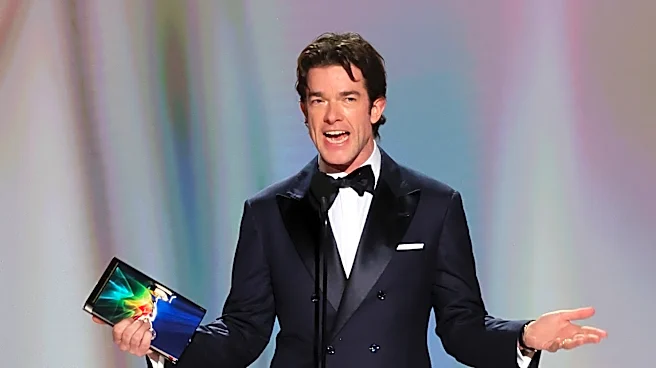










Talking to John Wilson is, in some ways, a lot like watching his documentaries. In his somewhat nasal, Long Island-tinged voice, Wilson walks through the mundane, offering simple observations that also contain profound insight into the world around him.
He starts on one topic, then takes a left turn — an “exit ramp,” as he’s called it — onto a different subject entirely, before winding back to his original point, but with some kind of comparison or deeper meaning at the ready.
He’ll say things like, “If you spend enough time with anyone, something’s going to happen. Something happens to everyone every day.” Or, “There’s a lot of examples of people needing structure and order imposed on their lives as a way to make sense of the chaos of endless possibility around them.” Or, “I think rejection and disappointment can be the greatest motivators of all sometimes.”
Of course, some things about an IRL chat with Wilson are different. In conversation, he doesn’t frame everything in the second person, talking things out in a hypothetical “you.” Also, when talking to him — over Zoom, at least, as I did — you can see his face, and the expressions that he makes, something he largely keeps out of his work. Lastly, his thoughts aren’t punctuated by clips of everyday life that he recorded himself, a practice he describes as almost a compulsion, in a way that both illustrates what he’s saying and often juxtaposes it with the ordinary madness of life.
Together, though, all those elements — the philosophical thoughts, the dry commentary, the contrasting clips, the everyman nature of his narration — are what have made Wilson’s documentary work so compelling, gaining him scores of fans, a hit HBO show, and a new movie, The History of Concrete, out Sept. 18.
After starting with short films he made on a nothing budget in the early 2010s, Wilson launched How To With John Wilson in 2020, and it quickly took off, each episode ostensibly covering a tutorial of sorts before the exit ramps start piling up. “How to Recycle Your Batteries,” from Season Two, for example, starts with a search for a place in New York City that will accept used lithium batteries, before diverting to subjects like reincarnation, sanitation-worker safety, dangerous-toy recalls, the free section on Craigslist, the Christmas movie he made in high school, Nazi flags, smuggled taxidermy, radioactive waste sites, and sex-offender housing, before somehow returning full circle to batteries, all in less than 30 minutes.
The History of Concrete, which premiered at Sundance earlier this year, plays like an extended episode of the show. But without guardrails of the 30-minute format, the “leapfrogging from one subject to another,” as Wilson puts it, takes on a new, more ambitious form. “I did genuinely pitch the movie as like a pretty standard documentary about concrete, with the caveat that it would take different twists and turns, like the work usually does,” he says. Still, he quickly ran into problems. “I pitched it to A24, and they were like, ‘Oh, so sorry, we already have a movie about concrete that’s coming out with soon.’” The idea of there being two movies about concrete in the first place is baffling to me; Wilson, on the other hand, seems baffled that such a situation would stop a studio from greenlighting a project. (Ultimately, the film was picked up by indie outfit Bronxburgh and Josh Safdie’s Central Pictures.) “That’s like saying you can only have one action movie or rom-com in a calendar year,” he says. “It’s ridiculous.”
As Wilson explains in the film, The History of Concrete came about because of a crack in the foundation of the apartment building he owns in Ridgewood, Queens. “Most people would just call a contractor when the foundation to their house is compromised, but I decided to get a few books about concrete and try to understand it on a more molecular level, to figure out why this stuff fails to begin with,” he says. He started ruminating on “the idea of endless cycles of renewal,” he explains. “I wanted to spend time investigating whether or not cyclical behavior is something that we do as a primal impulse, that keeps us occupied — like, productive or something — or if cyclical behavior was a crutch that we need to break free of.”
This investigation into concrete, as well as our cyclical behavior, took him to some surprising places. For one, a class on how to write Hallmark movies — sure, it was the only class the Writers Guild was offering at that time, but he managed to find some pretty deep connections. “I think Hallmark movies are an example of our cyclical patterns of entertainment consumption, and how we like to tell and watch the same stories over and over and over again,” he says.
There’s the Self-Transcendence 3,100 Mile Race, an annual event in Jamaica, Queens, founded in 1997 by the late spiritual guru Sri Chinmoy, in which participants run around the same block for 52 days straight. The film also sees Wilson take trips outside of New York — to Rome, to see the oldest concrete building in existence, which blows the movie’s initial budget; to Las Vegas, for a concrete industry convention; to Los Angeles, another concrete town, where he happened to be going since his show was nominated for an Emmy; to Ohio, for a week-long stay near the oldest concrete road in America. (Though the road is short and not in great shape, it does afford him the discovery of a business that preserves the tattoos of dead loved ones.) There’s a very quick interview about filmmaking (and concrete) with Sopranos star and Ridgewood regular Michael Imperioli, and a longer interview with a guy who cleans gum off sidewalks professionally. Each segment builds on his understanding of concrete, but also on his understanding of the world around us. “I like to pick subject matter that’s extremely hard to make funny,” Wilson says. “That’s the kind of challenge that really gets me out of the house. And when people tell me that I can’t do something, that only turns up the burner.”
About halfway into the film, an executive tells Wilson that a lot of documentaries these days focus on musicians, so why doesn’t he try to center his new movie around one of those? He looks around unsuccessfully for a while before coming across Jack Macco, one of the film’s most indelible characters. “I was out filming potholes one day, waiting for one of them to crater, and [they] never did,” Wilson says. Feeling defeated, he decided to swing by a liquor store. There, he met Macco, who was giving out free tequila samples. “I started talking to him, and conversation came really easy, and he seemed really open. And I think that’s usually a good indication that this is someone I want to spend time with. It turned out he was in a band, and we ended up spending the next year and a half together.”
Wilson follows Macco to gigs at dive bars in Long Island and festivals in Montauk, discussing life, passion, and loss, while occasionally taking shots of leftover promotional liquor. Though these segments don’t really touch on concrete, per se, they provided him a counterbalance to his own outlook. “I was constantly in a spiral of self-doubt throughout this entire process, and the fact that [Jack] never doubted his career at any point and just was more into the kind of thrill and the personal satisfaction that he got from just performing, no matter how bad the gig was, that was a quality that I felt like I was lacking. The optimism that he had was infectious.”
Much of the film, like Wilson’s other work, is centered around offbeat, unexpected clips that he captures with his Sony FS5. In watching Concrete, one might assume that he has some kind of advanced filing system, a way to quickly find footage of, say, a full-grown man playing a tiny toy piano on the street, or a beer can that somehow attached itself to the side of a shelf in a DIY venue several years ago but never fell down. In fact, no such system exists. “I was just shooting every day and going home and putting all the footage into a single sequence that was in chronological order,” he says. “Then, I would take selects of all my favorite material, and put it all into a single sequence with no organizational principle. Anytime I had writer’s block, I would just scrub furiously back and forth through that, and it would spark something, because it’s like, ‘Oh, that’s a great shot. I don’t want to lose that. I need to put it in something, or else it’s gonna just get lost in a hard drive.”
His work, he explains, is the antithesis of what the creator class films with cell phones, a phenomenon he half-jokingly calls “a plague” on the city. “They’re filming their face in the middle of an environment,” he says. “They’re putting themselves in the center of something, and I just find it to be such a waste of an image. It all feels identical to me.”
The impetus behind the shots changes their meaning. “A lot of what they’re making, they’re trying to promote something,” he says. “Sometimes when I’m filming something, it almost doesn’t compute [to other people] that I’m not promoting something, it’s just a home video, more or less. Because it’s just not something you really see as much anymore.”
Maybe, then, the work isn’t so much a project, but a lifelong mission, an analogue rejection of video being the medium of instant gratification. “It’s a practice that never really has a stop or a start,” he says. “I’m constantly recording without knowing what it’s for, and I think that’s really important — to not know why you’re doing what you’re doing. Because just following your instincts and intuition about what you just think is naturally interesting is cool.”
Click here to read the full article.