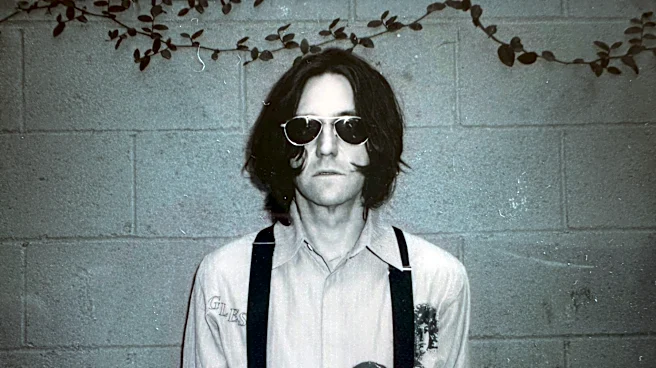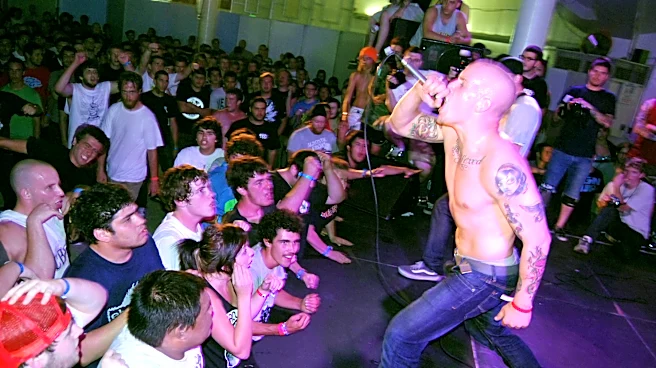




Almost 20 years ago, Baltimore’s Trapped Under Ice released their first demo — a record that would sow the seeds, in many ways, of modern hardcore. After all, it launched the career of one of the genre’s most dynamic frontmen, Justice Tripp of Angel Du$t,
and once featured Turnstile‘s Brendan Yates on drums.
Now, the story behind the creation of that demo has finally been told — via the upcoming book “Intent to Distribute: Twenty Years of Flatspot Records,” out Feb. 5, 2027. The book, written by journalist Fred Pessaro, contains exclusive photos, artwork, and interviews with bands that the label launched, including Tripp, Backtrack, Terror, Speed, End It, and Scowl. Rolling Stone has the first excerpt, about TUI’s demo, below.
“When you spend so much time doing something, you’re usually focused on what’s next. You’re putting out the next record, planning the next campaign, working on the next show,” says label co-founder Ricky Singh. “You don’t always stop to look at everything that’s happened along the way. Making this book gave us an opportunity to do that. It’s a collection of people, bands, friendships and experiences that have shaped Flatspot over the last 20 years.”
Adds co-founder Che Figueroa-Rodriguez: “Throughout the last 20 years there has been a lot of blood and sweat and the driving force that carried us through every era of the label was that same passion we had when we started.”
That passion will be on full display at an anniversary show on Feb. 6 at New York’s Webster Hall, featuring performances by Trapped Under Ice, Breakdown, End It, Raw Brigade, Iron Mind, and Frothing Mad.
The Breakdown and Outburst demos in ’87. Beyond’s Dew it! and Turning Point’s demo in ’88. Merauder’s ’93 demo. All signs point toward Trapped Under Ice’s 2007 demo being named in the same breath as some of these legendary early efforts. Depending on the era, it’s quite possible that the record known as FSR02 could go down as the single most important hardcore demo of all time. Flatspot Records proudly released this five-song monster on vinyl after witnessing its creation in Joe Mitra’s basement so many years ago, and it has remained a crucial part of the catalog ever since. The record, initially paid for in stolen goods and later pressed with drug money, proved to be not only a major landmark for hardcore in the Mid-Atlantic, but for the genre writ large, causing a monolithic shift in sound and style.
No one, especially TUI vocalist Justice Tripp and Flatspot founder Che Figueroa, could have predicted the sea change that these songs would put into motion. But now with hindsight, it’s hard to argue the depth and breadth of influence caused by this gang of kids from one of the most dangerous cities in America — the waves in the water are still being felt. We sat down with Tripp to discuss what circumstances surrounded the demo and just how a bunch of “bad kids” ended up creating such seminal work. What follows is the story of Trapped Under Ice’s early days and everything that came with it, from rodent-infested homes to cocaine bricks to fights with tasers.
Trapped Under Ice was created from the ashes of Nick Fury. What was the genesis of the band?
Nick Fury’s big creative impression was that we were a teenage straight edge band, but we were all reaching the age of 20 and our interests shifted. So me, Sam [Trapkin], and Ben [Esparza] decided to try something different and we were set on doing heavier music. The creative ideas came out of lifting sessions — me and Sam would lift in his hot garage and we only had one CD for the player: State of the World Address by Biohazard. I think we decided that the band should sound like us in our underwear, sweating, listening to State of the World Address.
As far as influence, I hear classic NYHC like Breakdown, Killing Time, Crown of Thornz…
Breakdown and Crown of Thornz, yeah. Madball was a subtle influence, so I would say maybe some of that Killing Time is through their influence on Madball. We always get Outburst, too, but I think when people think of them, they’re hearing Breakdown or the similarities between the two. I don’t think I even heard Outburst until we put out the TUI demo.
How did you arrive at the band name? Does it come from the classic Metallica song?
It was Sam’s idea and at the time, it wasn’t consciously because of a Metallica song. We didn’t know that was the source of inspiration until the first time we saw it on a flyer and thought, “Makes sense, Sam’s a Metallica freak.” Also, I was writing lyrics before we had a name and there was a theme of “this is cold” and “that’s cold.” So when the name came about, it was like, “Oh, this fits the lyrics. We’re gonna run with that.”
Did “Stay Cold” exist before the name Trapped Under Ice?
“Stay Cold” was an early song we wrote and actually, I do believe that was before we had named the band. We hadn’t recorded the song yet, but we had that song written for a while before we recorded it for the EP that came out later.
So you did the demo before you started playing shows?
Yeah, we wanted to make sure we had music out before actually doing it live.
What were the details of recording the demo?
We recorded the demo in our friend’s basement — Joe Mitra’s Wired Wrists Studio. I remember we recorded and the snare drum sounded kind of crazy. So he was like, “I wanna try this,” and we’re all young and learning stuff. We didn’t really know what we were doing and were all experimenting in our own ways, and Joe ended up tweaking the snare drum. At the time, it didn’t bother me too much — I was like, “Oh, it’s weird.” I didn’t really know or care or think too much — it was just “is there a mosh part that makes me feel something?” After the vinyl came out, a friend of mine said, “I’m really sorry about that snare.” He thought I was upset about the drums and I was like, “Oh man, is something wrong with it?” As time goes on, you become more familiar with what things are supposed to sound like, but I think the snare is one of those things that makes it special. It has this alien sound where people are like, “Wow, these guys are from another planet.”
So you guys are recording the demo — clearly, you’re very young. How did you pay for the recording?
We were definitely bad kids at that time and he probably charged us like $500 bucks to record the demo— probably $100 a song or whatever. We didn’t have that at the time, so we would just do shit that kids did — rob people and stuff. That’s not cool. I feel like at that time, we got into going to parties and if the vibe was cool, we were cool and then if it wasn’t, we were robbing people that were mean to us. And we basically funded recording that way: stole stuff from somebody’s house and the things we stole paid for our demo. You know, I’m surprised we never got locked up or killed or something.
How did “Soul Vice” come about? Was it originally an intro?
So when I wrote that song and riff, I remember thinking I wanted it to be an intro, so it’s structurally not like a verse and a chorus. I just wanted a cool riff that sounds like Breakdown, that fucking hits you with the mosh part.
Lyrically, I wanted to be kind of vague, but I think it’s like a cool summary of my family life, which was a little crazy, and I had just moved out — I was actually 17. I was learning to deal with living on my own and adulthood and having anxiety problems and then I was kind of thrown into a world where I didn’t have a support system. It was just me and my friends. I didn’t feel like I had anybody I could depend on. I was learning about loss, people dying around you, and just trying to process all these feelings at once. And now all these adult things are being thrown at me and I can’t deal with them all at once.
“Reality Unfolds” is such a good example of a certain thing that TUI does musically where you basically just tell Sam to write something fun. He always does this — overnight he’s like, “Hey, I wrote this last night,” and it’s what “Reality Unfolds” became.
Did Sam come up with some of the vocal cadences or did you do that?
So, I do a lot of that but that’s one thing I like about Sam. He’s very producer-minded. A lot of times he can come up with a whole song musically and then I’ll riff on it but he’ll say, “I like when you did this,” or “Can you do that here? I don’t like this.” And he’ll give me fun challenges like, “I like this word, what if you put this word in the song somewhere?” I think he’s a really aware person.
I met Sam at a young age, and he’s from a different area and could observe me really well. He was really conscious of my voice, my accent and the way I talk. I don’t think I talk like a lot of people, especially before I started touring a lot — hearing my voice and accent in a microphone and being like, “Oh, I sound like Baltimore trash.” So he would play off of that and be like, “Hey man, can you say this word in the song?” I’d be like, “Why do you want me to say that word so bad?” And then you hear it — it’s because he thought it was funny I say it that way. He would always play off my accent and I think that’s a funny early TUI thing.
If you think about how those songs are structured, there are many parts where the music drops out and there will be a short vocal solo — it’s a very pop song approach. TUI’s got a lot of that. Where do you think that came from?
Yeah, I love that, man. Those are moments that we were obsessed with, and at first we were like, “We should do that in every song.” Biohazard has a couple of those moments. A great example is on “Punishment” where he’s like, “I question, not me…” — that whole section. Another one is “March of the Damned” by Integrity where Dwid says, “Father! Take me back!”
That’s another thing that producer-minded Sam really emphasized — people love relating to music through the vocals. It’s what we all sing along to. I think there’s a more direct reference for that one: “Big Kiss Goodnight.” I showed him this riff I wanted to use and just like with “Reality Unfolds,” Sam came in the next day with “Big Kiss Goodnight” entirely written. My part was the simplest, dumbest riff on the whole record and he just made this crazy song. That includes the part where everything rings out and “you just say some cool-ass shit.”
How did the original cover for the demo come about? Was that originally intended to be a promo photo?
Kind of? We knew we wanted a promo photo and there’s these bands we loved that were big scary guys. I think we went into it knowing that we weren’t big and scary. We couldn’t compete with the Fury of Five promo photo or the Box Cutter promo photo or Madball. We weren’t intimidating people and we took the photo as seriously as possible because we were referencing the stuff that we love. But the idea that we were acting like that was funny. It’s weird because I remember people were really upset like, “These guys think they’re so tough.” That’s the whole point — we’re not and that’s why it’s cool.
We just wanted it to be a cool statement of “here’s the promo photo, that’s the cover.” I remember Sam making the logo for that and I think it has icicles coming off it. We knew that was stupid — we’re not hiding around it. Self-aware is a good way to put it.
What’s the house that you guys are sitting in front of?
It’s on Clinton Street in Highland Town at a house I lived in — me and a couple of friends. It was kind of the hangout spot. Some old Polish family that I knew used the house for storage and there was no hot water or heat or air conditioning. It was really sad. There were holes in the floor, so Baltimore-sized rats lived with us. The homies would come over and crash or go out and be debaucherous and that was where you all met after the fight breaks out or after the police get called. The neighborhood at the time was mainly El Salvadorans, who were really cool neighbors to have. I think they appreciated and supported our little active bad kid lifestyle.
What was the deal with the limited cover for the test press?
We had the limited cover that was like a brick of cocaine and it said Trapped Under Ice written in lines of cocaine. When Che told me we could do that, I was like, “Oh, we can get like baking powder or something to do that with.” Che was like, “We could just use this,” and he pulled out a brick of cocaine. And then he did it, it looked cool and I was like, “That’s fucking sick — nobody else has that.”
One of your early members, Daniel Klipa, is the son of Daniel Higgs, the legendary artist, tattooer and member of Lungfish. How did you link with Klipa to form an early version of TUI?
I think we recorded before he actually started practicing with us. He played the first shows that we did. Klipa was a local guy who grew up in a white trash neighborhood and just did white trash shit. The only hardcore he was aware of was Hatebreed and Icepick, so we were like, “We can convince him to do this by telling him it sounds like Icepick.” Every day with Klipa is like 20 stories. One day we went to practice and we called him and he said, “I moved to Florida.” He got kicked out of Florida for stealing purses, so the next week when it was time to practice, he was back in Maryland so he practiced with us. He’s a character, like out of a movie.
You talked about debaucherous evenings that started on Clinton Street. Give me an idea of what one of those might entail.
There was a group of people that we were feuding with and I remember one night we found out that they were all squadded up somewhere, so we called all the boys. When Klipa got to my house, he walked across the street to the El Salvadoran family that we’re friends with and spoke to them in fluent Spanish, which none of us knew he could do. They gave him some beers and five bucks. He told them that he was really broke and needed gas to get somewhere to fight these guys, so they gave it to him. We drove to go fight these guys, found them and fought. So when we came back to the crib, the neighbors were like, “What happened? Did you beat their ass?” They were really excited about it.
Things definitely got a little out of hand and went further than anybody anticipated a couple times. Sometimes weapons got used, and at the time our weapon of choice was tasers. Everybody had tasers because we thought it was funny — if you tase somebody, sometimes they would pee themselves. And that was funny to be like, “Hey, we made this guy piss his pants and that’s how we won the fight.”
What were some of the early shows for TUI?
So I think the first show TUI played was a Ruiner show. Van Damage was a band in Pennsylvania and at the time, we would play with them a bit. Down to Nothing would invite us to play with them. And then a lot of local shows, like one a week for a long time. We were thinking we’re just gonna do a Baltimore show or two and then we kept getting asked to play out of the state, which was really exciting. When you’re a kid, you don’t have any intentions of leaving the state. I think Lemoyne, Pennsylvania, would have been our first out-of-state show. Brockton, Massachusetts, was also an early adopter of Trapped Under Ice.
It’s kind of also the time when Title Fight was becoming a real band. So we played a show in Wilkes-Barre with Title Fight. It was crazy. I remember thinking, people really like this band — they’re gonna do really well. They obviously exceeded whatever I thought they would do. Later, I became aware of a new band called Bad Seed that was just the members of Title Fight with the exception of another friend or two. And it was very much similar in influence to Trapped Under Ice. They’re all a little younger than us and from what they told me, they were like, ”Oh, you can make music like that and people are into it?” So they started Bad Seed. They were a band that we would play with a lot in the beginning, too.
For those early shows, did you have enough material to play in addition to the demo? Did you have any covers that you’d play?
We had a cover of “Last Breath” by Hatebreed that we would do sometimes. We’d also do a little Metallica medley, “Street Fight” by Breakdown. I think that’s it. Our set was songs from the demo and then one of those.
Let’s talk about the Baltimore and D.C. scenes around the time of TUI’s ascension. What was it like then? Definitely much smaller, I’d imagine, but there were several bands from the area like Gut Instinct and Next Step Up.
Between Virginia and Maryland, D.C., and Baltimore, there were so many different waves that were happening. Desperate Measures was really important to our friend circle. They were one of those bands that made it feel cool to be from Maryland, which wasn’t the coolest thing. I always say Slumlords was really cool because they were one of those first bands to be a Baltimore band. There were a couple bands from Baltimore, but nobody was wearing it like that. And I think that was big with TUI — we wanted to be a Baltimore hardcore band. We’re gonna put Baltimore on our merchandise and make it a cool thing because it really never was cool.
Honestly, I think Stout is the most important band in Baltimore hardcore history. So you got Gut Instinct, which is a little more traditional hardcore and influenced a lot of early hardcore bands. And then there was Next Step Up, which is more of the groovy thing that really influenced bands like Hatebreed. And then Stout was like, the next level and evolution of heavy music where it just sounds demonic and experimental on some level. But it’s like, hardcore dudes who really like Pentagram and are trying to see how hard they can make music. Definitely a big thing that TUI took from.
In hardcore, there are a lot of vocalists, but not many front people. Most vocalists lack that certain kind of “pied piper-ism” you possess. What are the qualities that make a good front person? Who were your pied pipers?
I appreciate that, thank you. So, the obvious one that people caught before I did was Ezec from Crown of Thornz. He is such a character. He’s not bluffing one bit. That’s just who he is and you can’t turn it off. When I was a kid I was like, “I wanna be a unique individual,” and he’s one of the first people to turn me on to individuality in the context of heavy music. He doesn’t follow any of the rules.
I feel like there were two bands who were singing about their feelings, Crown of Thornz and American Nightmare — two bands from different generations. That’s one of the things people really loved about American Nightmare and made them a unique and very artistic band. I think neither of those bands were particularly focused on being heavy in the way that TUI was. I think our unique angle was to be like, “I got my feelings hurt by this girl“ or “I’m feeling abandoned by my father” on a song with a riff that sounds like Madball. But the ultimate lesson as a frontman in rock & roll music is Iggy Pop. That’s my number one. There are more obvious examples too, like Prince is really important to me.
When we first started playing, I remember Sam asking me about the way I moved onstage, shaking my hips and stuff. He was like, “I don’t know if that fits the vibe,” and I said, “That’s why it’s cool.” And to his credit, Sam might not always understand what I’m doing, but I’d explain myself and he’d be like, “Let’s run with it.” I’ve always done that — I always wanna get on stage and be flamboyant and a spectacle. I wanna move in a way that makes you uncomfortable. That’s not just hardcore music, that’s rock & roll music. I wanna engage and challenge people.
When the demo came out, it was kind of seismic — it really reverberated throughout the scene. When did you start to notice that the reaction was bigger than “pretty good for a local”?
So Trash Talk is the first band to bring TUI out on a U.S. tour. We had just a demo out at the time, so it was kind of a risky thing for them. They were so successful and they stood up for us. They were like, “It’s gonna be this band. It doesn’t matter if they draw or not, this needs to happen.” And I remember they were beefing with their agent at the time. He was like, “I got this band and they have the numbers,” and they were like, ”We don’t give a fuck about the numbers.” It was really cool and humbling to have people I admired riding for us. So when we went out I thought, “We just fucked their tour up.” But every show was just insane.
When we played the Che Cafe in San Diego, Patrick Kitzel sent us 200 Stay Cold 7-inches — it had just come out. We sold all of them that night. The show was sold out and it was crazy. I don’t even know if that venue holds 200 people, but we sold 200 records. The guys who ended up becoming Take Offense were there and they were going wild. And then we played L.A. and people I looked up to who played in cool bands showed up, particularly like Jeremy Bolm from Touche Amore and Luis from Alpha & Omega. It’s still a lot of the same people I see when I go to L.A. and that’s insane.
Click here to read the full article.