


Historians chronicling the decline and fall of humanity will have any number of key moments to point to as the beginning of the end. But a handful might single out an innocuous meeting at the University of Toronto in 2003. A 17-year-old named Ilya Sutskever
— born in Russia, raised in Israel, and a citizen of Canada — walked into the office of Professor Geoffrey Hinton. The latter ran the college’s Computer Science department; the former is intrigued by the teacher’s lectures on neural networks. Impressed by the student’s hyper-intelligence and keen grasp of the concept, Hinton offers to take the teen prodigy to lunch. They will eventually create a network known as AlexNet, which will bring the pair and their partner Alex Krizhevsky to Silicon Valley. Remember the road paved with good intentions, and where it leads to?
Or they may be tempted to focus on a different fuse-lighting that occurs after Sutskever appears at a conference in Montreal, when he begins being courted by a charismatic Stanford dropout. This young entrepreneur thinks that the computer scientist with the thick accent and the inability to lie is on to something with this whole “artificial general intelligence” thing. They, too, will co-found their own tech-industry pet project, with help from an eccentric South African billionaire. The venture-capitalist hotshot is Sam Altman. The name of their business is OpenAI.
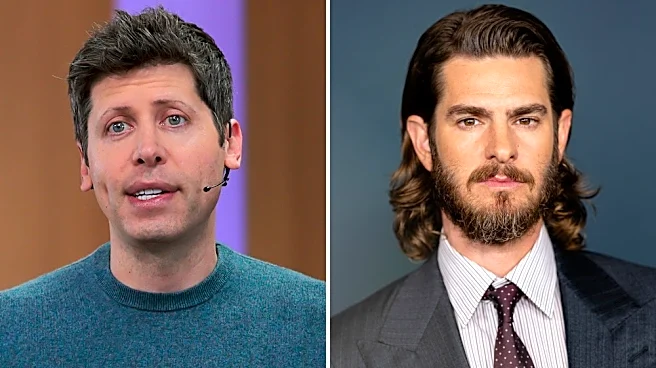
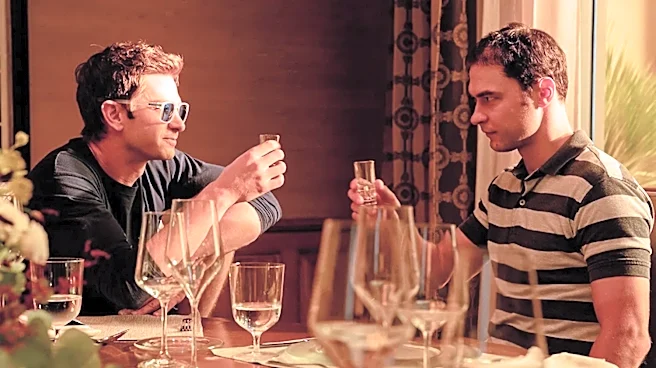
Both of these scenes show up in Artificial, director Luca Guadagnino and screenwriter Simon Rich’s recounting of the A.I. boom’s rise that plays like a series of downward-spiral snapshots. The first establishes the angel on Sutskever’s shoulder, a mentor who prioritizes safety in development and the sanctity of the human race. The second allows the devil to slide into his DMs, utilizing a seduce-and-destroy approach that will eventually lead to Sutskever becoming OpenAI’s resident Chicken Little and the tech industry’s conscientious objector. As played by Anora‘s breakout star Yura Borisov, the great Shakespearean actor Mark Rylance, and Andrew Garfield in full pinky-to-lip bad-guy mode, Sutskever, Hinton and Altman are the trinity at the center of this dark ensemble comedy doubling as a tragedy: the “Godfather of A.I.,” the son, and the holy terror. Two of them kept issuing warnings about slowing down and avoiding existential free-falls. One of them grabbed the wheel, hit the gas, and gleefully pointed the car right toward the cliff.
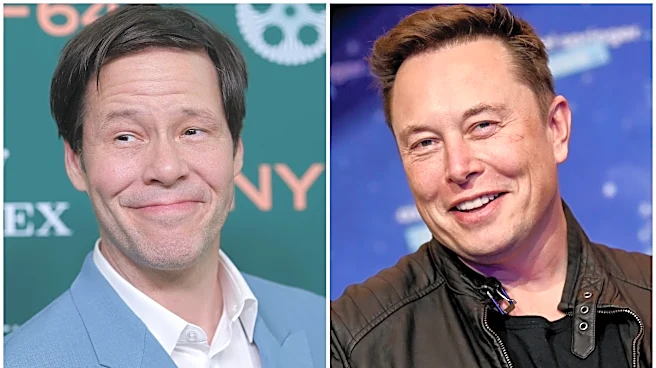
This is cinéma du doomscrolling at its funniest and its doomiest, generating the sort of laughs usually experienced by those strolling toward the gallows. A who’s who of pioneering engineers, Silicon Valley oligarchs, and simpering corporate toadies show up, some to be roasted and others to be pitied. The Studio‘s Ike Barinholtz plays Elon Musk as part Bond villain and part grimacing buffoon; Monica Barbaro lends OpenAI’s Chief Technology Officer Mira Murati an air of quiet dignity, then lets that quality deflate out of her like a sputtering balloon; Cooper Hoffman’s take on board chair Greg Brockman is best described as one long, perpetual “Come at me, tech bro!” Zosia Mamet, Jason Schwartzman, Chris O’Dowd, Billie Lourd, and Will Price flit in and out of the picture, some trying to act of the voices of reason and others cheering on the madness. Who needs long-term caution when there are so many short-term riches to be had?
Artificial keys into that industry mantra and expands upon it, identifying this notion that tech billionaires feel they deserve to run the world — because if they aren’t so brilliant and deserving, how did they become tech billionaires? — as something that’s now toxified everything around us. Guadagnino only occasionally lays the style on thick, as when he borrows a slo-mo–celebration bit of business from The Wolf of Wall Street; mostly he lets the script and the performances do the talking, especially once the movie concentrates on the moral showdown between Sutskever and Altman. (To say that the filmmaker has got his groove back after the flaming trainwreck that was last year’s After the Hunt would be putting it mildly.)
You can imagine the consensus forming around Borisov not only being the heart and soul of the movie but also being the smartest get in terms of casting; as with Anora and the equally wonderful Compartment No. 6(2021), he makes great use of a knack for channeling both woundedness and a sensitive-yet-steely demeanor. His Sutskever is socially awkward and childlike in his literalness, yet morally sound — the last dying beacon of hope for moderation among the “Feel the AGI!” fervor. “Prometheus was not afraid of fire,” one character informs him. “He didn’t have to make a deal with Microsoft to bring it to humanity,” the computer scientist replies.
I have no idea what folks will think of Garfield’s take on Sam Altman, a now-ubiquitous figure who often seems like a caricature of Silicon Valley nerd-regent in real life. It’s a wild swerve of a performance, opting for a simmering Machiavellian schemer hiding beneath a consistently polite surface at some moments and someone you might call “Campy Sam” at others. Daring, for sure. Damning? It’s an interpretation that falls just south of over-the-top, but still risks being a stereotype. Your mileage may vary. It’s certainly easy to see how the charm offensive and slippery approach to the truth that characterized Altman during his company’s ascent could be so beguiling for collaborators and investors, and how that same quality could be weaponized following a corporate coup organized by Sutskever. That entire ordealis presented in detail, a backstage drama in miniature that treats the boardroom soap opera as the last chance to keep Pandora’s box shut. Altman is eventually reinstated as CEO. Sutskever is cast out of paradise. Cut to: that dire hand-wringing from less than a month ago.
Speaking of backstage drama: You might also recall that Artificial was supposed to come out under the patronage of a different Borgia, and that its original backers decided to help Guadagnino & co. find a new home for it. Thankfully, Neon stepped in, the movie was able to secure a last-minute world premiere at the New York Film Festival, and you can already hear the drums beating for a well-deserved awards-season campaign. There was a sense of urgency that informed all of the gratitude when the director and cast sat for a post-screening Q&A, with Guadagnino reminding folks that artificial intelligence is a human story as much as it is a tech parable, and Rich stating that he intended his script to be a warning. He prays someone will pay attention. The fear that we’re past the point of no return animates the movie’s sense of currency and its refusal to smooth over anxieties. It feels all too attuned to our desperation not to share in it. You’ll laugh, you’ll cry, you’ll scream into the void.
There was one extra gift that Guadagnino and the festival had in store, however, for those lucky enough to be at the very first public screening. A piano and a vibraphone were conspicuously loitering onstage. After bringing out the cast and crew members before the film, the director called out for composer Damon Albarn. The former Blur singer and current frontman for Gorillaz then stayed behind after everyone left and sat down behind the piano. A fellow musician stepped behind the vibraphone, and a children’s choir marched out. They then performed “The Saddest Song,” a gorgeous number about uncharted seas and “submarines in the dark” that Alabarn wrote for the film.
We were about to watch a movie about folks dedicated to making artificially intelligent, totally autonomous machines a reality, and what that might mean for our not-so-distant future. But this amuse-bouche of live music, performed by real people in real time and a real space, before a real crowd, felt reassuring in the most profound way. This is what human beings can do. We can engineer our own extinction. But we can also create magic out of thin air.
Click here to read the full article.