

Jonathan Taplin reached out during the summer of 1976, 10 days into the shooting of New York, New York . He’d reconnected with the Band. The guys were planning an all-star farewell concert on Thanksgiving at the Winterland Ballroom, the promoter Bill
Graham’s San Francisco venue. Marty had obviously moved well beyond the concert documentary phase of his career, but might he consider filming the proceedings?
Not long after, Taplin recalled, he and Robbie Robertson visited Marty at his office on the MGM lot. “He was living a very crazy existence,” Taplin said. “First off, he was having an affair with Liza Minnelli. And yet his wife, Julia Cameron, was around on the set all the time. So he was constantly ducking out. He had a dressing room on the MGM lot that had a day bed in it. It was very, very weird. It was insane. And they were all doing so much coke.” Steve Prince (“a kind of hangout guy, driver, bodyguard, and coke dealer”) had firmly become “part of the entourage” by that point, Taplin added. “He was the guy who would stand outside of Marty’s trailer on the set of New York, New York and bar the door.”
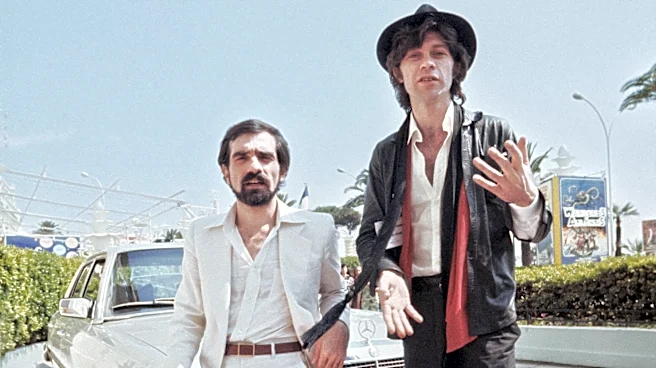
Later Robbie met with Marty over dinner at the Mandarin, an upscale Chinese restaurant in Beverly Hills, at the time a novelty. In an auspice of their future partnership-in-crime, each man brought along his wife and girlfriend, in Marty’s case Julia and Liza, in Robbie’s his wife Dominique Bourgeois, a Québécois journalist, and her friend Geneviève Bujold, the actress. Marty, the music fanatic, held Robbie somewhat in awe: They were the same age, but Robbie had joined the Band at sixteen and had been woodshedding with Dylan when Marty was still an anonymous film student struggling to complete his second short. Robbie took note of Marty’s intense gaze that night, given a slightly devilish cast by his dark Vandyke beard. Later he would say, of possible directors, that Marty “was the only person that knew enough about the fucking music and grew up on it just like me, and was basically just as much a punk as the rest of us. He could relate to the whole fucking thing.”
After dinner, they hit On the Rox, an after-hours bar on Sunset Boulevard, upstairs from the Roxy nightclub, which had become a clubhouse and discreet drug spot for hard-partying celebrities like John Lennon, Jack Nicholson, and Harry Nilsson. They started talking about documenting the concert “on a small level, maybe just video or 16mm,” Robbie said. Marty knew United Artists and the producers of New York, New York would never allow him to moonlight on another film, even a documentary, simultaneously. Then again, hadn’t John Huston managed to sneak off for big-game safaris during the filming of The African Queen? Couldn’t Marty slip away with a film crew over Thanksgiving weekend, when the New York, New York production would be on holiday anyway, not to shoot an elephant but a simple rock concert? As Robbie revealed the guests he’d invited to perform — Dylan, Muddy Waters, Van Morrison, Joni Mitchell, Neil Young — Marty stopped pretending to fight. What the hell would the studio do, fire him?
Seeds of the pair’s drug buddydom were also sown that night. Robbie and Marty had been “sneaking in and out of the bathroom as if we all had weak bladders,” Robbie said. “Trying to be very proper.” At a certain point Marty, who seemed to have a nasty cold, asked if anyone had nasal spray. Robbie gave him a look, unsure if he was cool or not, then decided to risk it. “This might help clear it up,” he said, producing a vial of coke a friend had just palmed him. Marty shook his head. “I’ve got that. I just need some Afrin or something.” He’d actually meant nasal spray. Neither man would be so basic as to quote the ending of Casablanca, but come on. The beginnings of beautiful friendships aren’t so common they should pass unnoted.
Production paused for Thanksgiving break, and as planned, Marty went up to San Francisco to film the Band’s Last Waltz concert. A director in a more reasonable frame of mind (unclouded by cocaine megalomania) might have thought, Okay, I’m already contractually bound to complete the biggest feature film of my career, and I’m technically sneaking off to work on this other dubious project, so I should probably keep things relatively low-key. Robbie had initially suggested simply shooting in 16mm, after all. Instead, Marty storyboarded the entire production in advance based on the set list (timing shots down to specific lyrics and instrumental passages), convinced set designer Boris Leven to dress up the Winterland Ballroom with props from the San Francisco Opera, and brought along seven cinematographers (including László Kovács, Michael Chapman, and Vilmos Zsigmond, who would go on to DP Michael Cimino’s The Deer Hunter) to film the entire thing in 35mm, which had been Kovács’ idea. “Can the cameras even shoot that long?” Marty had asked. “You won’t know unless you try,” Kovács said.
During much of the postproduction of New York, New York, Marty had also begun crafting a cut of The Last Waltz. Everyone involved agreed the 35mm footage of the show looked amazing, in this case Marty’s big swing had paid off, they had something, and he glimpsed a shot at redemption for having been fired from Woodstock all those years ago — he would make the greatest concert film of all time! They had too much, in fact, the concert having lasted over six hours — multiply that by seven cameras — but also, somehow, not enough: Robbie Robertson realized the concert had failed to represent a pair of key influences on the Band, country music and gospel. (The original concert had been “too lily-white,” the Band’s Levon Helm later said.) So the same week in May that Star Wars came out, Marty and the musicians reassembled on an MGM soundstage to record additional material with the Staple Singers and Emmylou Harris. Marty also filmed interviews with the members of the Band at Shangri-La, their studio in Malibu.
During a production meeting at the house on Mulholland Drive, Robbie and Marty discovered their personal lives happened to be falling apart in tandem. “You know, my wife threw me out, she left me, I have nowhere to go,” Robbie blurted out, admitting that he’d been crashing at hotels and occasionally at Shangri-La. In his posthumous memoir, he described the spontaneous confession as “embarassing,” given that Marty “came from a certain place and culture where you didn’t reveal personal things.” But Marty surprised him. “‘You could stay here if you want!’ He leaned in, speaking more quietly. ‘Julia just moved out. She’s gone. It’s just Steve and me.’”
A Hollywood bachelor pad! There was plenty of room, and such close proximity would be useful for any questions that might arise during The Last Waltz edit and sound mix. A splendid arrangement. How could it possibly go sideways? “It didn’t take but a day or two to fall into this process,” Robbie said, with his Canadian accent pronouncing the “pro” like someone talking sports. “We were like animals sniffing around for the trail, and hit it real quick, and it went into this thing kind of automatically. Those other voids that had been there in our lives were totally consumed. You couldn’t think of anything else but what was going on. It was very urgent, boom boom boom, one after the other, in, out, people in, people out, this movie, this studio, music, film, just full steam ahead.”
Full steam ahead. He’s being intentional in his vagueness because so much of their friendship revolved around things friends knew better than to discuss outside the inner circle, because in real life Marty and Robbie had become more than friends, they’d become drug buddies, which is a different kind of friendship, it’s a conspiracy — you and your mate versus the straight world, constantly on the make, constantly trying to figure out where to cop and who has what and where you might be able to duck into a toilet stall or back room or secluded corner table, and it all becomes incredibly serious and important-seeming but also? It’s pretty funny. So many squares wandering around with no fucking clue what you and your drug buddy are getting up to. You’re pulling one over on the world! And every so often, if someone does seem to have your number, there’s a pleasing bit of frisson, an unspoken moment of comity. Oh, you get it too?
The great drug-buddy duo of literature, drawn from real life and embellished in a way that felt hilarious and true to anyone who has ever been one, remains Raoul Duke and Dr. Gonzo — Hunter S. Thompson and Oscar Zeta Acosta — in Thompson’s Fear and Loathing in Las Vegas. Describing a work of art as being like “____ on acid” has been a tired formulation for at least three decades, but in this case it’s literal and straightforward: Duke and Gonzo were Laurel and Hardy, Abbott and Costello — choose your favorite slapstick pairing — on acid. Thompson fashioned his adventures in the mode of a classic comedy team, and Robbie and Marty, who had seen those pictures and almost certainly read Thompson, Marty having at one point considered directing a Fear and Loathing script by Larry McMurtry, carried on the tradition, only in their case they were Hope and Crosby on coke and Quaaludes.
Robbie soon began calling Marty “Maestro,” lovingly fucking with him, with his self-conception of his work as within the tradition of the Great Directors. But he also meant it.
In his memoir, Robbie dated the fateful production meeting to February 1977, about five months before Julia described retrieving her type- writer from the house she “shared with Martin” in her own book. Given the degree of drug and alcohol consumption in their respective scenes, neither narrator can necessarily claim the mantle of greater reliability. The public record, with its numerous examples of the Scorseses appearing together as a couple throughout the period in question, would seem to support Julia’s timeline. But given the history of Hollywood publicity machines manufacturing happy facades, it’s certainly not dispositive, what with so much riding on the success of New York, New York and the likelihood of studio preference for minimal drama surrounding the director of an already troubled production.
Another record of this period, previously undiscovered, comes via [longtime Scorsese collaborator] Mardik Martin, who spent a fair amount of time at the Mulholland house and, with the initial cooperation of Marty, Robbie, and other witnesses and active participants, later began work on a script about that mysterious nocturnal period of their lives, one in which Marty, most of all, descended into what can only be described as a kind of madness — engaging in multiple overlapping love affairs, consuming heroic amounts of cocaine, rarely sleeping, harboring (literal) messianic delusions, and in the end very nearly dying. Mardik’s unfilmed script (dated April 15, 1985) and notes capture those lost years in granular and intimate fullness. His writing practice incorporated extensive research, which for this script meant recording and transcribing hours of interviews with the cast of characters, including Marty, Robbie, Steve Prince, and Isabella Rossellini, who became Marty’s lover and eventual third wife. Famous people employ publicists to quash these sorts of stories, and Mardik’s fealty to reality in his scénario à clef ultimately contributed to the project’s demise. And so he filed his tapes and pages away, where they remained unseen until several years after his death in 2019. The material called back to seedy Hollywood tales of the past, this time with mountains of blow and a rock and roll soundtrack.
The unmade film had the perfect title: Mardik called his script Insomnia.
In the script for Insomnia, Mardik described the Mulholland house as “a large, unpretentiously luxurious dwelling, sparsely but tastefully furnished. Rare and beautiful movie posters dominate wall spaces.” Robbie had been touched by the spontaneity and kindness in Marty’s offer of a bed and soon enough settled into the screening room, a converted garage with a screen, projector, convertible sofa, and poster of Fritz Lang’s M. As roommates, he and Marty would eventually fall into a routine consumed by working and partying, the lines often blurry in a manner familiar to a touring musician like Robertson and more novel for an overscheduled motion-picture director, though Marty would prove a quick study. He was spending his days editing The Last Waltz at a production office at United Artists — they’d sold the film before its completion based on the quality of the concert footage — while Robbie bounced around various music studios handling production work on the soundtrack album and writing and recording a new suite for the film.
Marty being Marty, their parties on Mulholland involved not only drugs and women but marathon movie screenings. Home video had just come on the market, but Marty preferred to pick up film prints. At the studio, Robbie might receive a call from his new housemate excitedly detailing the double or triple feature he’d programmed for the evening, and oh, by the way, what time did Robbie think he’d be home? An hour, an hour and a half, something like that? An hour later, on the dot, the phone would ring again. Where are you? The food is ready! They’d both just ditched their families, but Marty had become the wife in a forties domestic comedy.
Not that Robbie felt henpecked. He adored what he took to calling their Odd Couple routine and looked forward to the nightly master classes.
Eventually they hung a sheet of paper in the kitchen for the jotting of titles to screen, their version of a chore list. Sometimes Marty would insist upon slogging through a trashy B-picture to reach a single extraordinary scene. Robbie’s tastes ran more toward the classical art film, surrealists and gloomy Swedes: Bergman, Buñuel, Jean Cocteau. Later, they would laugh, Marty told Mardik, about “how I’d invite girls to my house to watch movies and bore them to tears with endless conversation about films.”
To keep the dawn at bay for as long as possible, the vampires had Steve Prince, their Renfield, install special blackout blinds in the projection room and eventually throughout the entire house, a task Robbie said Steve approached as seriously as if he’d been placed in charge of the Manhattan Project. “From that point on,” Robertson wrote in his memoir, “most of our lives were lived in darkness.” If a movie was playing, no matter the time of day, the only light came from the screen. Geneviève Bujold told Women’s Wear Daily in December 1977 that she’d recently become acquainted with Marty through “a friend” and had been attending some of the late-night screenings, mentioning a double feature of The Uninvited (Lewis Allen, 1944), a ghost story, and Dodsworth (William Wyler, 1936), an adaptation of the Sinclair Lewis novel. The old projector made “so much noise even the neighbors can hear it squeaking,” Bujold said, and Marty would run “two or three films a night, one on top of another, whoosh.”
Whoosh! The drug scene at the Mulholland house “was more than you normally would see,” acknowledged Taplin, who wasn’t exactly naive, having worked with the Band when three of its five members had serious heroin addictions. “I mean, there were a lot of people taking a lot of cocaine at that time. That was the drug of choice at that point. It made people feel like they were the most genius people in the world. It was around. But Marty and Robbie’s situation was unusual.”
There may have been “a little tinge of an educational thing” for Marty as well, Robbie said, Robbie who’d been on the road since he was sixteen, at the tail end of the rockabilly era, when he started playing for Ronnie Hawkins, the Ontario-by-way-of-Arkansas wildman who told Robbie and the other future members of the Band he couldn’t offer much in the way of salary but promised they’d “get more pussy than Frank Sinatra.” Because they took drugs and grew out their hair and beards, the boys’ club of New Hollywood directors found themselves routinely portrayed as something akin to their musical heroes, but for the most part they were solitary, film-obsessed nerds. Disposable income and the license of quasi-bohemian artistry allowed them to inhabit a rock star–adjacent space. But it would take an actual rock star like Robbie to edify a relative novice like Marty when it came to the problems of fame, the privileges of celebrity, and how one might discreetly inhabit a life of excess without pushing away the spotlight. “He was always uptight,” Robbie said of his friend. “He couldn’t relax with the thing.” Robertson could speak in mobster code better than Marty himself.
By the time they moved in together, Robbie had recorded one of the great face-melting guitar solos of the 1950s (on Hawkins’s cover of Bo Diddley’s “Who Do You Love,” which Greil Marcus called “possibly the most menacing piece of rock ’n’ roll ever made”). He’d played guitar on Blonde on Blonde and been onstage with Dylan on the UK tour when the crowd yelled “Judas!” He’d drunk corn liquor with Sonny Boy William- son and played in Jack Ruby’s Dallas nightclub in 1963 (alongside a one- armed go-go dancer) a month before the Kennedy assassination. And he had already written “Up on Cripple Creek,” “The Night They Drove Old Dixie Down,” “Chest Fever,” “The Shape I’m In,” “Caledonia Mission,” “The Weight” —
He just grinned and shook my hand “No” was all he said
— songs that spoke to his generation while also sounding haunted and outside of time.
In the opening interview section of The Last Waltz, Marty sits stiffly in a sports coat and trim beard, asking questions he already knows the answers to and coaxing Robbie to speak in clippable sound bites. Robertson, meanwhile, in his brown leather jacket and unbuttoned canteloupe-colored shirt, comes across as relaxed and louche and doesn’t seem to take the exercise very seriously. Though in reality, of course, he’d been the driving force behind the concert and film. “Ask me that again,” he tells Marty at one point, leaning forward in his chair. As Marty repeats himself, Robbie’s eyes wander, and before the question is finished, he’s snatched a fly from the air, or pretended to.
Cool Robbie always marveled at the passionate intensity Marty seemed incapable of not bringing to every relationship. In general, Robbie, his latest date on his arm, was never sure what he might find back on Mulholland. Marty the mad Sicilian might be having a wild screaming match with one of his girlfriends. Robertson, per a transcript of one of his interviews with Mardik: “There will be glass flying and breaking and loud, crazy arguments. (Makes me think of so many but let him tell you about them.)” In any case, Robbie dedicated himself to giving his friend, as he put it, “an education of the road,” a primer in “how to deal with all of that and let the good times roll.”
But he also understood that for Marty, the evening could not properly begin until he got home, so eventually feelings of guilt about working so late would creep into his consciousness and he would begin making excuses to people in the studio before heading back up to the Hollywood Hills. “The food is ready” almost always meant pizza from Two Guys from Sicily had arrived, their best delivery option, substandard for New York but passable for Los Angeles. (“Disgusting,” Robbie said.) The movies might not start until two or three in the morning, Marty being, as Robbie once said, a believer in “the same thing Napoleon believes, that anyone who sleeps more than three hours a night is a fool.” An important caveat to the movie start time being everything had to wrap before the sun came up, for dawn had become “a scary thing” to the Maestro, it meant something ominous. “Ask him what,” Robbie told Mardik.
Dawn coming up, Marty said, “meant death.”
To Robbie it just meant he better get some sleep.
Excerpted from Just a Shot Away: Martin Scorsese’s Life in Film by Mark Binelli. Published by arrangement with Metropolitan Books, an imprint of Henry Holt and Company. Copyright © 2026 by Mark Binelli. All rights reserved.
Click here to read the full article.