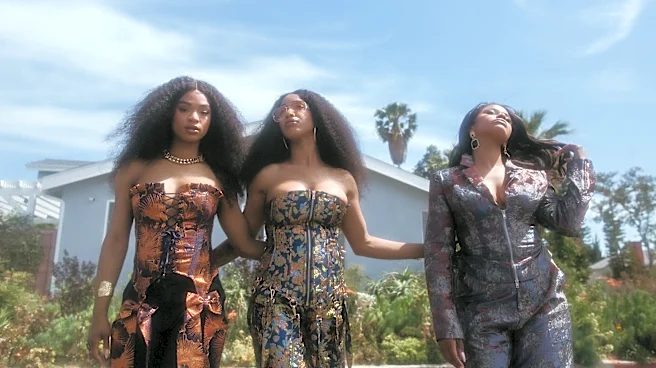






The Womack Sisters had a lot to get off their chest. As granddaughters of Sam Cooke and daughters of Cecil and Linda Womack, the three women are carrying on the legacy of classic soul and R&B. Nearly a half-century after that music receded from cultural
prominence, sisters Zeimani, BG, and Kucha Womack had been hustling in Los Angeles for more than a decade. They spent much of the 2010s hopping between meetings and short-lived engagements with assorted labels, managers, and agents, trying, mostly in vain, to convince the world that traditionally minded R&B was still worth sharing with the world. They’d financed much of this work of trying to prove themselves through side gigs, day jobs, and gig work. There was a lot of Uber driving.
So when they sat down to write their song “Chauffeur” last year, they found a clever way to talk about it all. The song is the forceful tale of a group finally taking the proverbial wheel after what felt like a lifetime of being told by others where — and how — they were supposed to drive. “We definitely have been told no,” says Zeimani Womack. “We promote and invest in everything we do because if you don’t, your dreams won’t come to light. You could be waiting on a label to believe in you.”
The song, she says, is about “getting in the driver’s seat.”
“Chauffeur” is the opening track of The Womack Sisters, the tour-de-force debut full-length album that represents a culmination of a lifetime of torch-bearing and struggling to be heard from a trio whose lineage reads like a who’s who encyclopedia of soul music.The Womack Sisters are the daughters of the R&B duo Womack & Womack (Linda and Cecil Womack), nieces to soul legend Bobby Womack, and granddaughters of, yes, Cooke (for those confused, Bobby Womack married Sam Cooke’s widow, Barbara, after Cooke’s death in 1964. Sam and Barbara’s daughter, Linda, eventually married her stepfather’s brother, Cecil). But despite their heritage, the group worked as backup singers, vocal arrangers, and behind-the-scenes songwriters struggling to be heard on their own terms for years before finally arriving at this moment.
Their debut record has already received attention and praise from stars like SZA, longtime friend Leon Bridges, and Jon Batiste, who enlisted the group to sing on his 2025 album Big Money.
“The Womack Sisters really found their own lane,” says Bridges, who befriended BG nearly a decade ago. “The perception is that they have big shoes to fill, but I think they’re carrying the Womack legacy beautifully. Soul music is a dying art, and it’s encouraging to see a resurgence happen. What the Womack Sisters are bringing is something the world needs right now.”
Beneath the throwback sheen, the record channels the group’s assorted influences, from Sixties girl-group pop to socially minded message songs to tender balladry to the raw, gospel-infused sibling harmony of the Valentinos, the Womack brothers’ pop group in the early Sixties.
“BG’s our Sam Cooke, she’s got that classical tone,” says Zeimani. “Kucha’s our Curtis Mayfield, the songs she writes are so deep. And me, I’m a Millie Jackson. I bring the nastiness. I’m gonna get you to take some clothes off. Together, I think we’re the perfect mix.”
The album is being released by Daptone, the label associated with Amy Winehouse and Sharon Jones that’s long become the remaining vessel for the type of throwback and reverent soul music the Womack Sisters always longed to make. But the group’s journey to finally releasing the album has been anything but straightforward.
There is a lightness, however, to the way the Womack Sisters present their story. They speak, movingly, of taking entire years off from their own music careers to become caregivers for their aging relatives Cecil and Bobby Womack in the early 2010s. During a recent interview with Rolling Stone, the three sisters conversed, indeed, like sisters: talking over one another, making each other laugh, and articulating their commitment to carrying forward their family’s legacy in a way that’s less loaded with pressure and responsibility and, instead, imbued with honor and purpose.
“I don’t feel like we’re trying to live up to anything,” says Zeimani. “I feel like we have what it takes and are finally in the position to produce the kind of music that I know our father would be so proud of.”
BG says their family name is a source of inspiration rather than a weight: “It’s never a burden.”
To say the Womack Sisters did not have a traditional upbringing would be to put it mildly. They grew up — three of seven siblings — on tour buses and in hotel rooms, greenrooms, and airplanes with their parents folding their children’s lives into their own for as long as they can remember (You can see the sisters as young girls on the cover of Womack & Womack’s 1993 album Transformation to the House of Zekkariyas, the youngest of the three, Kucha, being held as a baby by her mom, Linda Womack).
They lived all over the world: South Africa, Thailand, the United Kingdom, and the Caribbean, where their parents often recorded. Eventually, the sisters moved from backstage to the stage, performing with their parents and becoming an integral part of the Womack & Womack show.
“Theu used to tell us, ‘you’re a member of our group, too,” says Kucha, who adds that, to hammer home the point, their parents would give the sisters their own separate table to sign autographs after shows.
At a certain point, BG and Zeimani formed the group Ejyptsian Queen with another sister, and that group released an album in 2001. They had a series of formative early onstage moments: Opening for their parents in Scotland with TLC’s “No Scrubs;” singing an original song that riffed on Coming to America called “Sexual Chocolate.” Eventually, they all wound up in Los Angeles, moving there in the late 2000s on their own (Citing their upbringing as Jehovah’s Witnesses, the group declines to share their ages: “We just call ourselves timeless,” says BG).
But, to hear them tell it, they transformed from Egyptsian Queen (and added Kucha to the trio) in a moment of grief. Their father, Cecil Womack, died in 2013 at 65; in 2014, their uncle, soul legend Bobby Womack, died. That same year, the sisters became the Womack Sisters.
“The only thing we could do, because we couldn’t stop crying, was to try to honor and do something to make us feel closer to our dad,” says BG.
“That,” says Zeimani, “is when we decided to become the Womack Sisters.”
The next decade, however, was defined by trials, misadventures, and misunderstandings. Despite the rising popularity of throwback soul during the 2010s (look no further thanLeon Bridges’ 2015 debut album, or Chris Stapleton’s mega blockbuster “Tennessee Whiskey,” a repurposed Etta James riff), no one they encountered understood why three young Black women would be interested in singing and releasing music that sounded like it came from another time.
The Womack Sisters were told lots of things: To make music that sounded more contemporary, more “urban.” To be more pop. “They were like, ‘We might take you guys if you drop this whole soul/R&B thing,” BG says, recounting one of countless music industry interactions.
The group played ball as best as they could. They recorded an entire album of what BG refers to as a “Pussycat Dolls sound.” They released the retro pastiche song “Darling” in 2017, which seemed like it would be their moment, but that deal fell through. They eventually released an entire EP, 2022’s Legacy, but that finished product was the result of compromise: The group contends they were forced to re-record and re-mix the material, originally recorded in a more traditional style, with modern R&B production in order to have the songs released at all (Ingrooves, the company that helped release the record but has since been dissolved into a larger conglomerate, could not be reached for comment).
“It’s hard to do something different but go through the machine,” says Zeimani. “Because [the machine] has a group of things that they believe work, and if you don’t fall into that category…”
All the while, the group was working on vocal arrangements, songwriter for other artists, backup vocals, and unglamorous day jobs (including, yes, chauffeuring) to help pay the bills and fund their art. “A lot of people might get the impression that our lives or careers were funded,” says BG. “But we saw our parents hustle and [how they] put their own money behind their projects. Anything they wanted done, they didn’t mind getting their hands dirty and paying for it. We learned that from them.”
During this bewildering time, the group was introduced to Daptone Records’ Gabe Roth. They connected, and even wrote a song or two, but it would be years later until they were able to formalize a working relationship. The group immediately hit it off with the impresario who’d once helped shape Amy Winehouse’s sound. “He’s really a visionary,” says Zeimani.
After writing with Roth on the“If I Let You,” Roth began bringing the group songs he’d written that he thought would fit their sound. The last song written for the session was the one that summed up the group’s entire journey: “Chaffeur.” During sessions, Zeimani suggested, late in the process, that the song needed horns, unlocking the entire album’s sound (“We were like, ‘can we afford them?’” says Kucha).
In the studio, the group tried to channel their many musical influences (Fleetwood Mac, Bone Thugs-n-Harmony, Sade). But asked who their biggest sonic inspiration is, the trio does not hesitate.
“The Womack Brothers” they say immediately.
“Our uncle Curtis Womack inspires us so much when it comes to how we vocal arrange and add runs to different parts of songs,” says Zeimani. “We really do look to the Womack Brothers a lot, because it started with gospel, and the fact that they are able to transcend these emotions and bring that out of you, that’s what we wanted to embody and make part of our delivery, because it’s magical.”
The Womack Brothers (eventually, the Valentinos), were a group whose career would’ve likely jumpstarted had their primary mentor, Sam Cooke, not been killed in 1964 (Go listen to gospel-to-pop crossover magic of “Lookin’ For a Love”). But the Womack Sisters aren’t the only ones invoking the similarity. “They’ve done a great job finding that balance of paying homage to the past while still keeping it modern,” says Bridges,who was constantly compared to Sam Cooke when he released his retro-leaning debut . “Their harmonies are infectious.”
Sixty years later, the Womack Sisters are proud to be finally releasing their first collection of music that represents their lineage in the way they’d like it to be presented. They’re proud to be doing right by their family’s legacy, proud to be doing it on their own terms after so many years of being told by others how it should be done. Mostly, they’re just proud to be honoring their family.
When their mother, Linda Womack, who now lives in South Africa, first heard her daughter’s record, she was overcome with emotion.
“We weren’t there when she first heard it,” says BG. “But our little sister told her her reaction, and it was tears.”
Click here to read the full article.