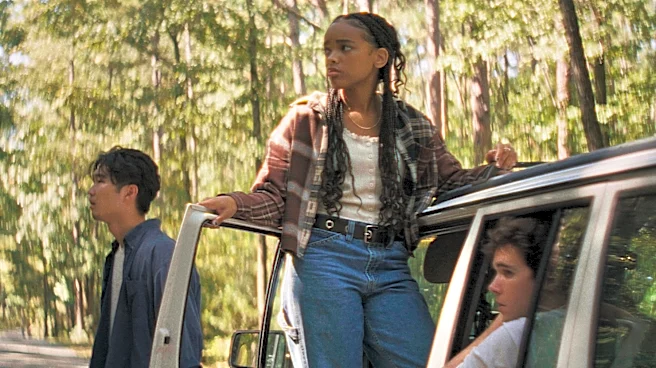






It was just supposed to be a short drive. That’s all — a quick jaunt from Point A to Point B, a chance to catch up and decompress after a hectic semester. School’s out, and Tyler (Mitchell Cole), a former member of the military, has offered to drive three
of his longtime pals — Fisher (Noah Toth), Day (Akira Jackson), and James (Phinehas Yoon) — home from college. Conversations range from meme prompts regarding the deadliness of hawks versus gorillas to summer internships. Everyone thinks James’ first-day-of-new-job outfit is giving “first communion drips” vibes. Everyone wants to know why Tyler broke up with his girlfriend. It’s all very kickin’ back, no big deal, twentysomethings style.
These old friends are so focused on their back and forth, however, that Tyler suddenly realizes that they’ve been on the same stretch of road in the middle of the woods for a while. He thinks he might have missed a turn somewhere a few miles back. So he turns the car around and starts driving back the way they came. Nada. Just the same tall trees, the same lush greenery, the same densely forested areas on either side of them. Tyler is so busy scouring the landscape for some sort of off-ramp that he almost doesn’t see the wall of foliage that seems to have mysteriously materialized in the middle of their path. The GPS on their phones seems to suggest this was the way they’d come earlier. But now their way is blocked. James gets out, starts looking around… .
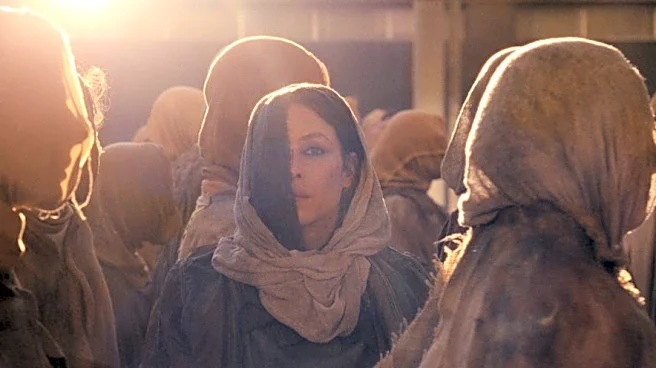
And the people, dozens of them, come streaming out of the woods, screaming for help, descending upon the lost travelers en masse. They all want to get inside. They all want help. One violently tries to pull Fisher out. Tyler manages to reverse the vehicle, pick up James, and get the hell out of the scrum. The foursome have no choice but to drive. They keep going. And going. And going.
This is the set-up for It Ends, the feature debut from 28-year-old writer-director Alex Ullom that mines that high-concept, lo-fi scenario for all its worth. A few basic rules are established in the first act: It takes roughly 90 seconds between the time they stop the car and the moment that folks come sprinting out of the woods, essentially attacking our heroes. The odometer keeps turning, but the gas tank seems to stay at a quarter tank no matter how long they drive. No one gets sleepy. No one gets hungry. They appear to be stuck in a loop, or maybe some sort of liminal space similar to that no-man’s-land nestled away in that furniture store in Backrooms. Both movies share more than a few qualities, notably the same love of infinite interzones and the same flavor of exponentially increasing existential dread. It’s a variation on a similar unease, more or less. A smart-ass could easily dub this film Backroads.
You can definitely a see a kinship with this endless road-to-nowhere road trip and its fellow Gen-Z horror entries, and in a perfect world, Ullom’s extraordinary riff on fear, loathing, and post-collegiate rootlessness would reap the same reception and box-office returns as Obsession and Backrooms. This modestly budgeted gem had been kicking around the festival long before this specific mix of genre and generational angst became a marketing hook, of course, and It Ends had proven to be a minor indie hit prior to either of those movies breaking major records. It was one of the first big breakouts on Letterboxd’s virtual video store, and attracted enough attention to get current tastemakers du jour Neon on board for a proper theatrical release — an excellent boon for the film, given Ullom’s penchant for both claustrophobic close-ups and long shots that emphasize a specific strain of purgatorial terror. Bring on the big screen.
But in the end, those kindred-spirit scary movies aren’t the biggest influence or best comparison for what It Ends is going for. That would be Jean-Paul Sartre’s No Exit — specifically that landmark play’s particular description of hell. Various possible explanations are floated about for the quartet’s dilemma, from some sort of collective drug trip to an ancient curse to karmic retribution (“I’m not perfect,” one of them admits in regards to that last option, “but this definitely seems like overkill.”) James, who seems to be wrestling with the issue of faith more than the others, thinks all of them might be dead.
No definitive explanation is forthcoming, because no definitive explanation is needed. The question soon goes from “who are these people attacking us and why do we deserve this and how do we get out of this loop” to “what happens next?” And that is when It Ends starts revealing its true intentions. Yes, the metaphorical heft is strong with this one, and a bit-too-on-the-nose line like “You are the reason you are suffering now” is a reminder that this is a first-time filmmaker feeling out his artistic sensibility in real time.
But it’s also a potent signifier that It Ends has more on its mind than jump scares. Ullom has joked that he’s trying to kickstart “hangout horror” as a subgenre, with the punch line being that he’s succeeded beyond his wildest dreams in doing exactly that. (Not to be confused with the movie’s actual punch line, a climactic visual gag that’s worth its weight in grim, choked-throat chuckles.) It turns out the fear of the unknown and the fright of being set upon by assailants for no apparent reason is nothing compared to the paralyzing terror of being trapped in routines and stuck in a rut. That’s definitely a particular Gen-Z bugaboo, given the world they’ve inherited. But you don’t have to be in your twenties to get chills at the idea that you may be destined to be forever going nowhere, with no salvation or end in sight.
Click here to read the full article.