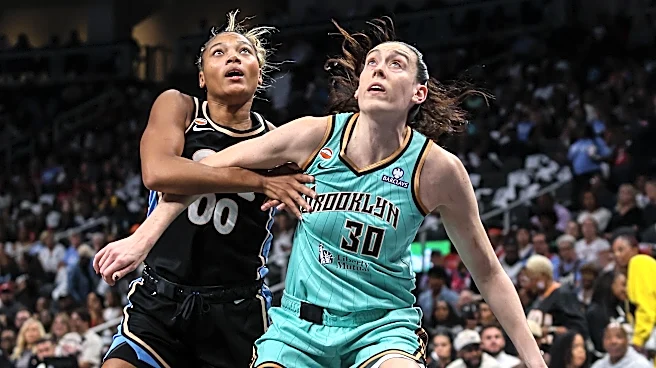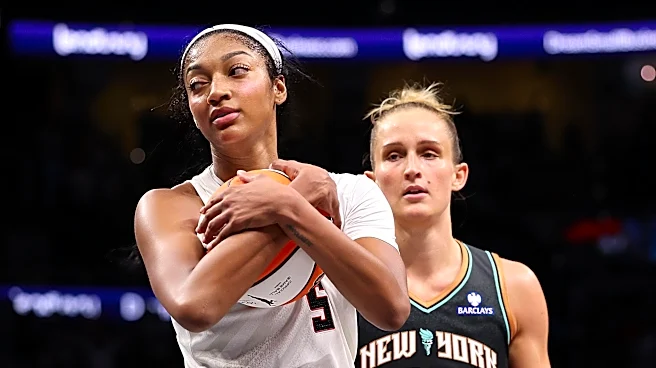




There are currently no open transgender players in the WNBA. But that hasn’t stopped trans rights from becoming one of the most divisive topics in women’s professional basketball.
While disputes around trans women participating in women’s sports have been
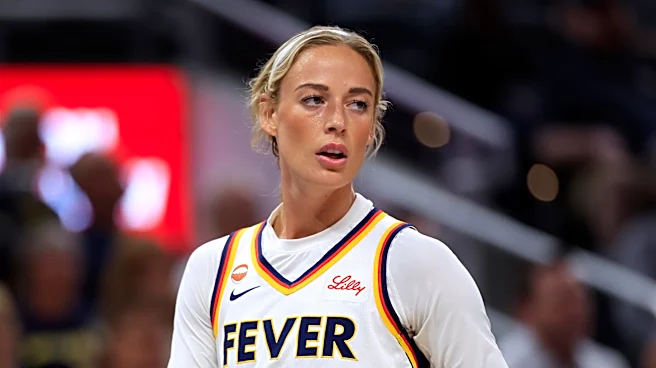
around for years, President Donald Trump’s administration has placed renewed national attention on the issue. In 2025, Trump signed an executive order that prohibited trans women from competing on women’s sports teams, prompting eligibility changes from major sports bodies like the NCAA and the Olympics. In July, Indiana Fever guard Sophie Cunningham brought the debate to the WNBA, telling ESPN trans women shouldn’t be allowed to play in the league. “I got a lot of negative feedback about me hating trans. And I’m like, ‘I never once said that,'” Cunningham said. “I want to protect young girls in a locker room, or young girls in sport who shouldn’t have to go against biological men.”
Her statement started a firestorm, one that’s only grown in the following months. There have been multiple rallies and protests outside of WNBA games, including fans inside arenas holding pro-trans and anti-trans signs. Minnesota Lynx coach Cheryl Reeve prominently wore a ‘Trans Kids Belong’ shirt during an August game. Former NBA player Enes Kanter Freedom kicked off a public crusade to get the WNBA to define their eligibility rules — i.e. update the wording to only accept “biological women” — by putting himself up for the 2027 WNBA draft; actions publicly praised by President Donald Trump. The controversy has dominated WNBA press rooms so much that the league formed a task force of general managers and team presidents who met in August to discuss trans athletes, but ultimately did not update any eligibility rules.
Online, the fight over the WNBA and trans rights has felt inescapable. Tweets about Cunningham, thinkpieces, and rebuttals have all swirled into an endless mass of controversy — one dominated by derogatory rhetoric, threats, and anti-trans memes. Now, in the midst of the WNBA playoffs, a new report from data analytics group GUDEA, shared exclusively with Rolling Stone, shows that the debate around trans rights in the WNBA might feel outsized online, but a small number of influencers, pundits, and posters are driving a large majority of the conversation.
GUDEA founder Keith Presley tells Rolling Stone that while it might feel like everyone online was talking about trans participation in the WNBA, there were only a handful of tweets that ever got more than 3,000 retweets. “If you take out the eight top posts, this [narrative] didn’t happen. Nobody would be talking about this,” Presley says. “When you look at what content was getting the highest inauthentic engagement, it’s more visceral, trying to get an emotional response. [This debate] was pushed for clicks.”
GUDEA analyzed 188,631 posts about the WNBA trans debate across 24 days, from July 20 to August 12. According to the white paper they wrote based on this analysis, close to 99 percent of all of the posts happened on X (formerly Twitter). Of all of the users sampled, 3.57 percent were considered “non-typical,” which means influencers, pundits, or aggregation accounts that post more than the typical user and have an outsized reach, either in following or views. But that small percentage produced 16.75 percent of all the identified tweets — above-average numbers for the typical Twitter debate.
Georgia Paul, GUDEA’s head of customer success, tells Rolling Stone that the online conversation’s domination by “non-typical” accounts is important because these individuals have the highest incentive to drive up engagement. Since Elon Musk’s purchase of the platform in 2022, the founder has publicly stated that his goal is to make the app’s algorithm — and people’s feeds — free of political bias and more equitable for conservative posters. Not only can people who pay for premium X subscriptions now make money off of their most popular tweets, but they’re prioritized in comment sections, driving their tweets to the top.
This means while the original “anchor posts” surrounding trans rights and the WNBA were based on factual reporting and first-person statements shared by WNBA players and officials, the conversation online has mainly revolved around retweets or reiterations of those original posts with increasingly inflammatory or false takes. This is where GUDEA noted the most “inauthentic” behavior. In comparison, topics that involve groundswells or are receiving authentic attention often inspire social media users to create their own posts that outperform inauthentic behavior. GUDEA’s data suggests the topic is being used online as engagement bait, which is how the conversation devolved so quickly into anti-trans memes, violent threats, and derogatory rhetoric.
“Sharing [a post] is one of the lowest-lift actions that you can take in a narrative. When we see that it’s just primarily people reposting an anchor post, it just shows that there’s just not true engagement on the topic. When people really get involved with something, they actually start generating their own content, and that’s when you see it spread into multiple networks,” Paul says. “This told us that it was a flash in the pan and then other accounts tried to take advantage of that flash to monetize.”
The report, however, isn’t evidence that people don’t care about the trans debate in the real world. Both Presley and Paul tell Rolling Stone that this kind of social media narrative only works when people have strong feelings about it on both sides. But GUDEA data suggests that the conversation on X has been driven with that goal in mind, using the hot-button issue to drive up engagement and attention, and making the debate feel larger than life in the process. Trans rights and the WNBA might be all over your feed, but there’s fewer people talking about it than it might appear.
“The primary motive for posting on the internet is no longer to have an opinion, a unique point of view, or add substance to the conversation. It is to make money,” Paul says. “You’re going to make money in these divisive ways because you’re tugging at real world conversations. Anger has turned into dollars for other people. The point is to sow division.”
Click here to read the full article.