








Putting a ring on it is a surefire sign of commitment — or at least a sign that someone’s looking for it.
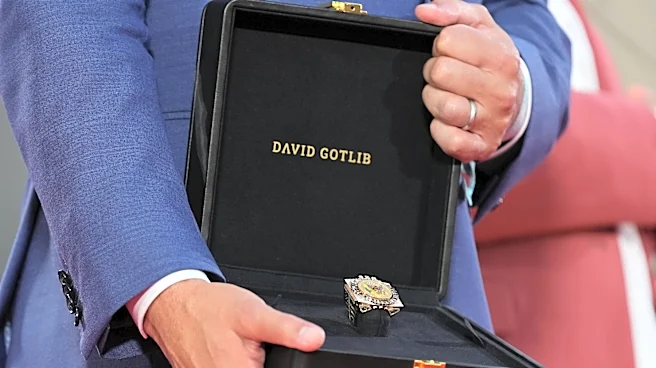
In late June, Antwerp World Diamond Center (AWDC) President Isidore Mörsel presented the American Ambassador to Belgium, Bill White, a massive diamond
and jewel encrusted ring — crafted by luxury jewelry designer David Gotlib — intended as a gift to president Donald Trump. The 18-karat gold paperweight of a ring features the presidential seal rendered in emeralds, rubies, and diamonds. A sparkling “250” sits at the top — a reference to this year’s celebrations of the anniversary of the signing of the Declaration of Independence. A diamond “T” superimposed on an American flag decorates one side of the band, while jeweled Superman shields with a “45” and “47” (references to Trump’s presidential terms) decorate two of the corners. The total gem count clocked in at 321 diamonds, 56 sapphires, 13 emeralds, and six rubies, and is conservatively valued at between $25,000 and $35,000.
It was, to many observers, a self-serving gesture. The Belgian diamond trade has been heavily impacted by Trump’s erratic tariff regime, and a nice little carveout would do wonders for one of the flagship industries of the European nation.
On July 24, they got it, when European diamonds were quietly granted an exemption from the latest wave of Trump tariffs. Not so quietly, though, that Senate democrats didn’t notice. Now, they’re asking questions. Amid the scrutiny, the AWDC is denying any connection between the gift and the tariff rollback, claiming in a statement to Reuters this week that “the discussion about U.S. import tariffs was entirely separate from (the gifted ring).”
The timeline, however, looks suspicious to lawmakers. “Time and time again, Donald Trump has doled out apparent special favors to corporations who try to woo him with flattery, shiny gifts — or both,” Senator Elizabeth Warren (D-Mass.) tells Rolling Stone of the new push from Democrats to dig up more information about the ring and AWDC’s dealings with the Trump administration. “This looks like cartoonish corruption — and I’ll keep pushing to hold Trump and these massive corporations accountable.”
Last year, amid his initial tariff frenzy, Trump placed a 20 percent import tariff on products coming into the U.S. from Europe — including luxury products and jewelry. Last September, the European diamond trade was granted an exemption from the tariffs. Things seemed fine, until the Supreme Court struck down the president’s tariff regime in February, prompting him to re-implement a 10 percent universal import tariff in retaliation, catching the European diamond sector off guard.
On June 28, AWDC presented the gift to Ambassador White. On July 24, less than a month later, the EU’s diamond trade was once again exempt from the latest wave of tariffs.
“The significance of the timing is absolutely relevant and crucial here,” Cynthia Brown, senior ethics counsel at Citizens for Responsibility and Ethics in Washington (CREW), tells Rolling Stone. “Government executive branch officials are required to consider what the appearance of the acceptance of the gift would look like.”
She notes that government officials, particularly ambassadors and other State Department employees, regularly receive extensive ethics trainings on the rules governing the receiving of gifts. “One of the factors that the Office of Government Ethics highlights is the timing of the gift. If they’re giving [you] a gift either right before you’re making a decision about tariffs or right after, that’s a gift that you are instructed to decline.”
Often, in order to avoid offending a head of state or other foreign dignitary by declining the gift, government officials will transfer the object to an independent institution — usually federally controlled — and essentially make it part of a national collection. The Smithsonian Institution and museum network is custodian to hundreds of historic artifacts that made their way into their custody as gifts to past presidents.
Gifts to presidents are (ethically at least) considered gifts to the nation, and are handled in all manner of ways to that effect. Two pandas, Ling-Ling and Hsing-Hsing, gifted to the Nixons after their trip to China, became beloved residents at the National Zoo; a 1,400-pound wheel of cheese gifted to Andrew Jackson was reportedly devoured in a public feast.
Presidents may keep gifts if they meet certain requirements, and are willing to pay their market value to buy them from the U.S. government.
Trump has, of course, trampled these rules and norms underfoot. The take-it-all attitude of the president towards the gifts he receives from foreign governments and private corporations has never been seen in the American presidency. “There has always been, in the ethics world, presumption that the effect of public opinion goes against taking gifts of this magnitude, especially, but also [this] quantity,” Brown explains.
She points to the $400 million jet Trump gleefully accepted as a gift from the Qatari government upon returning to office, which he is currently upgrading and retrofitting at the taxpayer expense into a personal Air Force One. He has said that he intends to keep it for himself after leaving office, despite making millions in taxpayer-funded additions to the plane under the guise of providing a more modern, cost-saving alternative to the older planes currently in use. “If a foreign country is going to offer us something like that, there are obviously national security concerns,” Brown adds. “There’s always been a very strong awareness that gifts from foreign governments and foreign businesses can be undermining American democracy, and so presidents, administrations, public officials, are not interested in walking that line historically. But this administration has been willing to do it and willing to look for exceptions and justifications to accept them.”
Democratic lawmakers, many of who are centering anti-corruption messaging in their 2026 midterm campaigns, have taken notice, and are laying the groundwork for oversight action should they retake either chamber of Congress in November.
This week, Sens. Warren and Richard Blumenthal (D-Conn.) issued an open letter to AWDC questioning the motives behind the gift.
“[T]he circumstances surrounding the European diamond industry’s exemptions raise troubling new questions about foreign corporate interests potentially buying special favors from President Trump with lavish gifts — or in the case of the gold ring, what appears to be a cartoonish bribe,” they wrote.
“At best, your decision to present a 321-diamond, 18-karat gold ring to President Trump amidst high-stakes tariff decisions creates the glaring appearance of impropriety. At worst, it reinforces that foreign corporate special interests can bypass standard trade policy and buy lucrative tariff exemptions simply by showering President Trump with shiny gifts,” they added.
The senators requested that AWDC provide information about the process to create the ring, its production cost, estimated value, any conversations with the Belgian ambassador and his team, as well as with members of the Trump administration. Their response was a denial of any improper intent behind the gift.
In the context of Trump’s open profiteering, it’s hard not to try and connect the dots. The president has raked in billions in personal profit since returning to the White House, and has made clear he’s just getting started.
Click here to read the full article.