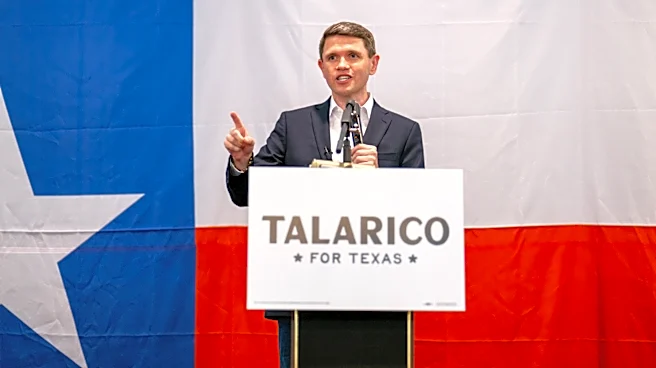


James Talarico is asking me if my hand is OK, and I’m trying to laugh it off. We’re stopped at the site of a collapsed water well in the craggy outskirts of Alpine, Texas. Behind us, the red and ochre
cliffs of Big Bend National Park glow in the late afternoon sun. Roughly an hour earlier I had — accidentally, I must stress — whacked a cactus while walking out of Talarico’s campaign rally in Marfa. This unfortunate encounter with some variant of a prickly pear resulted in a scramble to dig a pair of tweezers out of my carry-on before racing after the campaign’s caravan to Alpine. I made a shoddy effort of removing the several dozen tiny, brittle spines embedded in my knuckles and fingers while bumping along a hilly dirt road to the site of the collapse — tossing the shards out the window along the way.
Talarico, his staff, and the local lawmakers who accompanied us to the well are generally covered from wrist to toes. Long-sleeve shirts — and in the candidate’s case, a blazer — jeans, and cowboy boots. The rattlesnakes that call the brush home won’t be biting their ankles, and Talarico’s smile as he inquires about my hand has a glint of “welcome to Texas” flashing through it.
It’s hot, my hand hurts, but it’s go or get left behind in these parts.
After examining the collapsed well, Talarico chats with Mayor Catherine Eaves, a petite former teacher with long brown hair and light, friendly eyes. Eaves was elected mayor of the 6,000-person town at the northern edge of Big Bend in 2022. An Independent, she is now shepherding her constituents through a bit of a crisis. The breakdown of the well, known as Roberts 3, plunged Alpine into Stage 4 drought protocol: no personal irrigation, no car washing, no street cleaning, no fountains, no refilling your pool. I have been here for less than 12 hours and there’s already a layer of fine dust sticking to my skin. With a tiny population and a limited tax base, the town is often dependent on state and federal funds for major infrastructure repairs, and pleas for assistance from distant Washington have gone unanswered.
Instead, the Trump administration is set to spend almost $2 billion to build a border “wall” that will run across Big Bend, ripping through the national park and cutting off large parts of the region from one of their major sources of tourist income. Alpine — the seat of Brewster County — has become the center of local resistance to the plan. The region reports the least amount of apprehensions along the Texas border, as the National Park itself is a natural cathedral of rough terrain, mountains, cliffs, canyons, and wildlife that can make the trek deadly for any unprepared traveler or border crosser.
“It makes zero sense,” Eaves tells me as we watch Talarico’s gaggle of staff, in constant orbit around him with shoulder cameras, phones, and vlogging equipment, set up for a quick shoot in the fading dusk. The two had just spent a good half hour discussing the collapsed well and the infrastructure needs of the region. “Everybody in this country should be pissed off. It’s our federal taxes. It’s everybody across the nation — and we’re handing it to contractors for something we don’t need — whereas, ‘Oh, you need drinking water? Figure it out.”
A few days later, as I flip through Instagram, I see Eaves again, in a reel posted by the Talarico campaign. “People in this Texas town can’t access water, not because there isn’t enough but because D.C. politicians have left them behind,” Talarico narrates — over some B-roll of a rattler meandering through the grass. “This is happening all over Texas. There’s always money for bombs, for bailouts and billionaire tax breaks — but never enough money to fix basic infrastructure and keep utility bills down.”
The situation is emblematic of the alienation millions of Americans feel from their elected officials — particularly at the federal level. Real problems in need of practical solutions are deprioritized or disregarded in favor of expensive political posturing and culture war cage matches. It’s sending voters into a political wilderness where neither party feels like an answer to their concerns. It’s in this space where Talarico hopes to carve out a foothold among voters — even if it means breaking with his party.
“We’re trying to do the opposite of fearmongering, the opposite of demonizing, and grandstanding. We’re trying to listen to folks down here about their needs,” Talarico tells me of his border tour. “This is the mistake of so many people and politicians, but also the media [make]. They flatten border communities to where it must all be about immigration. Well, there’s a lot of needs here. Border security is one of them. Immigration is one of them. So are jobs. So is education. So is health care. So is trade. If we’re going to actually serve border communities. We need to reach for all of that.”
The communities clustered along the Rio Grande and West Texas had for decades been a Democratic stronghold in a state obsessed with its cowboy conservative identity. Featuring a large concentration of Hispanic migrants and major trading ports with Mexico, the region is in many ways the land Democrats forgot, confident it would not waver, until it did. All but one of the Texas border counties swung rightward in the 2024 election — with several in South Texas voting Republican for the first time in decades. Those same counties have since become disillusioned with the president’s administration, but strategists continue to note hesitation from voters to fully re-embrace the Democratic Party. Talarico sees winning over these communities — from the Franklin Mountains, down the Rio Grande to the barrier island of South Padre — as critical to his bid to defeat his MAGA Republican Ken Paxton and realize one of the long-coveted fantasies of national Democrats: a senator from Texas.
“Democrats took these regions, took this whole area for granted,” Talarico tells me nearly 400 miles of driving later, seated in the dining nook of the black campaign RV that serves as mobile headquarters for him and his staff. The “Frontera” border tour took him to small towns like Alpine, Del Rio, and Eagle Pass — as well as the major land ports of El Paso, Laredo, and McAllen. “And the fastest way to lose an election is to take people for granted,” he says, adding that part of his approach to retail politics in general is to “have some humility, and not feel like just because I have a ‘D’ next to my name, I’m entitled to anyone’s support.”
In his view, much of the national media and political class view politics as an “intellectual exercise” without real-world stakes.
“They’re participating in politics like we were watching the World Cup,” he says, most often as spectators cheering for their own team. “But for those of us who live here, like this is life and death. So many of these issues are literally life and death, we have to live with these policies […] we’ve got to fix this problem because people are suffering, and my job is to help the people that I’m seeking to represent.”
At a press conference in Sanderson, Texas — in the back courtyard of the charmingly preserved-in-60s-amber Desert Air Motel — Talaraico announced his immigration and border security platform. Opposition to the construction of Trump’s border wall through Big Bend and a surge in the hiring of immigration judges read like standard fare for progressive Democrats, but proposals like arguing for more Customs and Border Patrol agents and more funding for immigration enforcement surveillance tech might make the left clench its jaw.
Talarico is flanked by a bipartisan coalition of local law enforcement officers and former CPB agents. Sheriff Thaddeus Cleveland, a Republican who spent 26 years working as a Border Patrol agent, is tall, tanned, and keeps a handgun holstered to his hip. “We only have 600 people [in Sanderson],” he tells me after the presser. “We don’t have crime. What we deal with mostly is border security.”
Often, it’s rescuing a lost migrant who has been wandering the desert and mountains — a natural border barrier much harder to traverse than a bollard wall. Tragically, it’s regularly doing body recovery for those who were not found in time. In regions where the population is spread thin and funds for law enforcement and emergency services are stretched to their limit, the steady supply of good-paying federal jobs with benefits, and a budget to back them up, is a lifeline for towns like Sanderson, but it’s not enough of an investment to fix the very real issues affecting West Texas: volatile water infrastructure, a collapsing agricultural sector, a struggling electric grid, the threat of invasive pests like New World Screw Worm, and a border economy trying to claw its way out of Trump’s tariff slump.
The growing consensus in the region is first that the Biden administration failed to adequately respond to the issues at the border — both in the practical sense and by allowing Republicans to twist the political narrative almost beyond recognition — and second that Trump’s return to office, with his tariffs and hardline national anti-immigration crackdown, has been its own scourge on the region.
“The immigration system, border security, is a prime example of the government not working,” Talarico tells me. “The Big Bend border wall is an example on the right of the government not working, being inefficient and wasteful of taxpayer dollars. So I just want to pursue things that are actually going to work, and I listen to those border sheriffs — the Democrats and the Republicans and they all say we would be much better off if we had these Predator B drones to detect human movement on the border, rather than a wall that’s going to desecrate one of the most sacred parts of the state, ruin the natural habitat, and and hurt local businesses.”
Talarico’s campaign has been relentlessly committed to prioritizing local media, outreach, and interest. In many ways, the campaign is openly broadcasting a disinterest in making Talarico a balm for national Democrats struggling to regain their ideological footing after an electoral implosion under former Joe Biden and Kamala Harris. Solving the intra-party war of the political left does not interest him so much as winning as many small battles as possible for the people of Texas.
This doesn’t mean he isn’t setting lofty goals should he find himself in the U.S. Senate. “We have to be very honest about where we failed as a party, and then try to try to bring back the parts of our legacy that reflect us at our best,” Talarico says, reminiscing on the almost mythically ambitious — and successful — Great Society programs of Texas son Lyndon B. Johnson.
“When Democrats get power, too often it’s nibbling around the edges. It’s cautious, and people want transformational change. People aren’t interested in incremental change anymore, they want to take this broken system and change it fundamentally. And I think we are trying to live up to that scope,” he adds. “When we get power, we’re going to actually use it to make a real difference in your life [and] if we don’t do that next time voters trust us with the keys, I don’t know what the future of our party holds.”
Talarico at one point suggests that prospective candidates “actively shouldn’t” cater to the priorities of the national party, which itself seems directionless and eternally confused by its own voters. “Maybe it’s just pragmatism, and maybe a focus on people rather than worldview or philosophy or ideology; those are abstract, and at least my experience, and those don’t neatly always align with what’s happening in the real world,” he says.
The real world, or at least the real Texas, does seem to be turning out for the campaign. The tour encountered overflow crowds at multiple stops. Where Talarico’s team couldn’t upgrade to a bigger space, like in Del Rio, Talarico took the time to meet every individual who was turned away. It’s a central tenant of the campaign. Everyone gets their photo, everyone gets a handshake, or a chance to say what’s on their mind, even if the line lasts over an hour. All over the border, the prospective voters Talarico meets with ask for relief from the kinds of ailments that don’t choose political parties: medical debt, housing affordability, crumbling infrastructure, educational inequality, and support for aging seniors.
At a town hall event in Eagle Pass, a nearly forgotten border town that became a national battleground for clashes between Texas Governor Greg Abbott and the Biden administration, a choked-up attendee describes the struggle to afford rent and car payments while struggling with a debilitating chronic illness.
“You are the first person I will ever vote for. I am 21. I still haven’t voted,” they say. “I really do want you to prove that you can help somebody like me. I’m just one person. My problems are smaller than other people’s, and even to me, those problems are still big.”
The next day, in the slightly cramped quiet of the campaign RV, Talarico tells me that he wishes he had more time to campaign face-to-face with the voters of his state. “Every day I wake up feeling like I don’t have enough time. It is so humongous. It’s so complex. It’s so diverse,” he reflects.
“I could spend all [four months left in the race] in South Texas, right? I could spend four months in Black communities across the state, just learning all the needs and connecting with other people. I could spend four months reaching out to Cornyn voters who are feeling like the Republican Party’s left them behind, and those are three very different groups of people, and they’re all going to be necessary to build a big enough tent to win this thing.”
He compares building that coalition to a process similar to any kind of relationship building. “You think about how you build a relationship in your own life. It’s showing up, it’s being open, it’s being honest, it’s being vulnerable, it’s listening.” It’s also changing. His campaign motto of top versus bottom, not left versus right, was born of his own experience as a state politician, watching ideological lines along the horizontal political spectrum serve as a “smokescreen” for inaction or acquiescence to external interests.
The lack of cohesion within Democratic politics right now is, in his view, a boon to the campaign. “In my faith tradition, the wilderness is where new ideas and new leaders and new movements come forth, and the wilderness is a time for experimentation and self-reflection,” Talarico says.
And truly, the land between El Paso and Brownsville is often the vision of Texas wilderness imagined in old westerns and recorded in the works of Larry McMurtry and Oscar Cásares. Bright sun and baby blue skies. Cotton ball clouds casting dappled shadows over the patchwork of the creosote of the Chihuahua Desert and the orange groves of the Rio Grande Valley. Drive far and long enough and you may encounter a storm of lightning and rain moping across the plains like a lone giant trapped in a wide ring of mountains, keep going and you’ll meet the end of the road in the grassy resacas of the Texas coast. Almost 2,000 miles away, the United States Senate, under its dome of cast iron and its sandstone walls, might as well be on a different planet.
The Texas border lands are a place where soul searching comes easy, where community is not something to be reclaimed — but an everyday fact of life. It’s a world unto itself, and if Talarico can pull back the region’s rightward turn of 2024, it might just be his bridge to Washington.
Click here to read the full article.