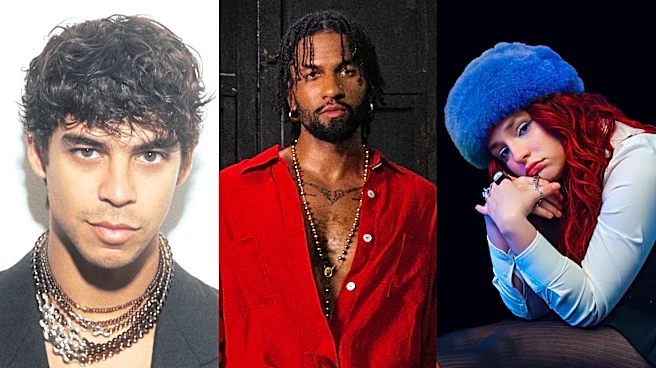





Over the past year, a vibrant new pop movement has emerged in Puerto Rico, surging in popularity thanks to a growing class of young artists. Names like ROBI, Matt Louis, Melodie, and Karina Vélez have burst onto the scene and taken the sound to heights
it hasn’t seen in years.
Puerto Rico’s main musical export of the last three decades has been reggaeton and its various offshoots, resulting in international success. But there was a time when the biggest acts to come out of the archipelago were, in fact, pop artists.
Menudo, one of the most successful boy bands of all time, dominated the market in the 1980s with Beatles-mania-level fervor. Ricky Martin, long considered the outright King of Latin Pop, is a former Menudo member who later became one of the world’s most accomplished solo artists and a staunch ambassador for Puerto Rico. Before him, Chayanne was the face of Puerto Rican pop, selling over a million records in the early Nineties. Kany García has spent the last two decades as a mainstay on Latin pop charts, considered one of the finest songwriters of her generation.
But despite those examples and a handful of others — Luis Fonsi, Tommy Torres— pop artists from Puerto Rico haven’t always reached the same level of widespread recognition as the rest of Latin America. Now, for the first time in over a generation, that might finally start to change.
The 25-year-old singer ROBI first made a name for himself back in 2022 when he collaborated on “Pantysito,” one of the biggest tracks of that year, alongside Alejo and Feid. He dabbled in reggaeton, but never felt entirely comfortable. As he puts it, pop music has always been where his heart is, creatively and emotionally.
“I began making reggaeton mostly to blend in and keep up with what was happening with people my age,” he says. “But there came a point when I said, ‘You know what? I want to be true to myself and do what I do best because it’s the music I’ve spent the most time listening to: pop, romantic music, and songs about love and heartbreak.’”
In 2024, he released the catchy sadboi-pop hit “sorry es que soy bipolarrr,” featuring Young Miko, and hasn’t looked back. In fact, Miko herself began to dabble more in pop after the runaway success of the song.
Collabs with established Latin pop acts like Gale and Sebastián Yatra followed, leading ROBI to this year’s breakout single “BRRREAK!” and his debut album sorry si soy GRRRIS. Since then he’s added tracks with his idol, Wisin, and Spanish pop star Arón Piper to his discography.
ROBI says urbano and pop shouldn’t be pitted against each other, and that the link between the two is necessary for pop to thrive. “I’d like for us not to close the door on collaborating or fusing our sound with the urban genre,” he says. “For me, it’s vital not to compete with [them] — just because ‘we’re something else’ — but coexist with what is happening on the island in that realm, which is also super interesting.”
His love of pop music stems from its timeless appeal and sentimental undertones. “To me, pop music is music that isn’t tied to a specific age, meaning that a 15-year-old and a 75-year-old can both listen to it and enjoy it equally,” says ROBI. “There are two types of people: those who listen to music to tune out, and those who listen to connect with parts of themselves. I fall into that latter category. When I write, I try to create things that allow me to connect with emotions I sometimes overlook because life is moving so fast.”
Similarly, Matt Louis, 29, emerged in 2022, with atmospheric alt-R&B sounds. His 2025 EP, GAMMA, touched on themes of sexuality and race while also offering club-ready bangers like his RaiNao collab “ABA.” The buzz surrounding that project landed him an opening slot at Rauw Alejandro’s Cosa Nuestra: Capítulo 0 release event. Now he’s become a fan favorite, most recently appearing in a dashing Valentino Beauty campaign alongside Raquel Berríos of Buscabulla.
An obstacle many pop fans encounter is defining what exactly “pop music” is. The genre isn’t bound by a specific sound and instead functions as a loose commercial category and a symbol of cultural stardom.
“It’s what’s popular in the culture,” Louis says. “That’s where ‘pop’ comes from. It’s what sparks conversation within the culture. Pop is never defined solely by what musicians say pop is. We’re currently looking at a society that’s very dynamic, multi-layered, and fast-paced — full of crises and questioning. Music has to capture that.”
Pop can tap into the sociocultural interests of younger generations, capture technological and media shifts, or act as an antidote for modern anxieties. “To me, it’s no coincidence that pop music currently features so many maximalist, fragmented, and experimental elements,” says Louis.
He’s also aware of the stereotypes surrounding the genre and how it’s gendered or dismissed as music meant only for teenagers. He calls out the music’s “lack of layers” as its biggest misconception.
“People sometimes focus solely on aesthetics. They don’t actually listen to the music itself or pay attention to the artistic vision,” he says. “That’s one of the things hurting pop music: People focus more on how artists present themselves than on listening to the music. Listening is an act that requires close attention and a moment of pause.”
There’s a long list of young artists in Puerto Rico showing what pop can do. Acts like Karina Vélez, Elia, DEL TORO, Giny, and LaDí have impressed fans with an eclectic output — from bubblegum to dream-pop and everything in between. Krystal, Frido Vargas, Drú, FE7O, Bodine, and Kova Parker have been consistently turning out catchy tracks.
Other acts are leaning into an alt-pop sound. Álvaro Díaz, paopao, RaiNao, and Gyanma were early innovators when it came to blurring the lines between R&B, música urbana, electronic, and pop in ways that appealed to listeners.
Last month, Díaz kicked off his Omakase tour and brought along some fellow pop acts from back home to join him. Among them are Louis himself — who got his first big music break years ago when Díaz introduced him to Venezuelan producing duo Lara Project — as well as Lockward and Melodie.
The former is a fresh-faced crooner whose lyrics reveal a sentimental old soul within, and who recently released his own ROBI collab, “No es tu estilo.” Melodie is a self-proclaimed “anti-popstar” who counts Björk, Britney Spears, Rosalía, and Tim Burton as inspirations and delights fans with her devilish pixie energy and flair for the theatrical.
Those looking for rock styles can look to groups ZTVZ, Taidai, and Dogos, or the rap/rock/pop alchemy of Pink Pablo, whose recent album PINK LEMONADE features some of his most polished work yet. All these hits owe much to the producers who have also become essential to the movement’s rise, led by William Russell, Aris, Brandon Cores, and Rigoazulado — a Nicaraguan musician who relocated to Puerto Rico in 2017.
ROBI has been taking his music overseas, including a well-received performance at this year’s Premios Juventud in Spain, and Louis found himself traveling with Díaz to Mexico. The conversation about how this era of Puerto Rican pop can appeal in other markets is something Louis has been thinking about.
“A Puerto Rican’s taste is largely shaped by what makes you want to dance. Puerto Ricans love to move, and pop music didn’t always get the hips moving the way we like. I think that’s part of it, and reggaeton does what it says on the tin,” he says. “I think the lesson to take from pop is that there are simple elements that let you soak emotions in and just have a good time. Not everything has to be marroneo or the kind of high-intensity vibe we Caribbean people love.”
Louis had to map that idea out as he took on Mexico. “The audience there has different musical tastes and responds to different stimuli, so I’m figuring out how to bridge what they like with what I’m bringing to the table,” he says.
For these artists, staying true to their Puerto Rican identity is still paramount. In ROBI’s case he’s discovered that it’s small details, like a dropped “r” or the tempo in which he sings, show where he comes from.
“Those little things — which might seem like everyday stuff to us Puerto Ricans — really stand out when you export your music, and people hear your accent and that distinct flow. It all carries an urban cadence because we grew up listening to reggaeton,” he says. “I might not explicitly say ‘I’m from Puerto Rico’ in every song, but the way I speak, the way I approach pop and make music makes it clear where I’m from and shows that everything I do comes from a place of deep love for my roots.”
Click here to read the full article.