
The Nvidia scandal seemed, for a moment, to be the straw that broke the back of the AI bubble. The stock valuation of the tech giant — a lynchpin in the wider tech economy — had plummeted, and dragged
down the markets with it. The corporate line of succession was not clear and the allegations of wrongdoing and of a government cover up were already spilling over into the president’s Cabinet. Drastic measures would need to be taken to avoid a calamity.
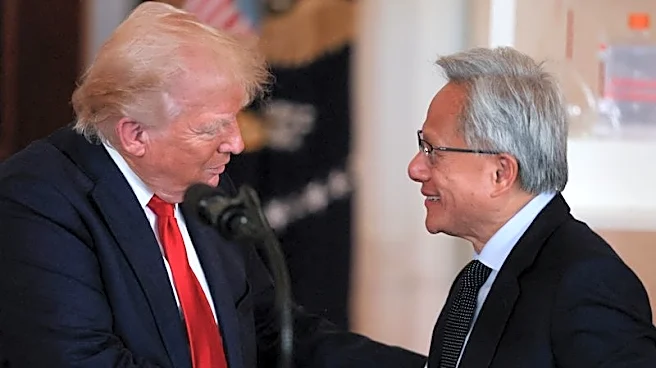
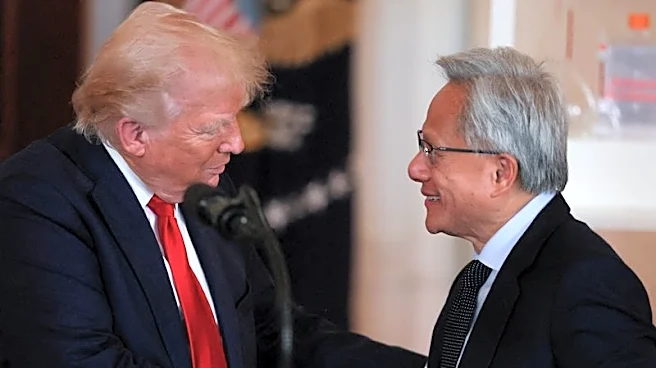
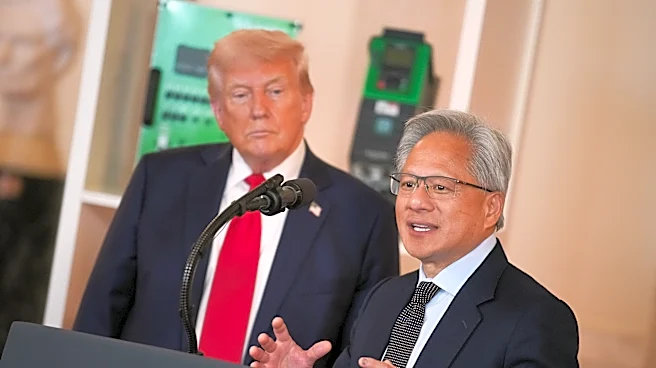
On Monday, Donald Trump announced that he personally had persuaded the board of Nvidia to reinstate disgraced CEO Jensen Huang, who resigned earlier this month after admitting to an affair with an accused Chinese spy, through whom the company is accused of violating anti-China export controls on Nvidia’s hardware. “I believe my intervention was very important,” Trump said Monday, as the chip manufacturer’s stock price soared and major tech figures — now reassured of their control of the American economy and that Trump will shield them from potential corporate and federal oversight — celebrated Huang’s return.
The move is a stunning intervention by an American president in the operations of a private company, and part of a clear effort by the Trump administration to sweep the scandal and its potential fallout under the proverbial rug. While Huang is — at least for now — back in charge at the company he founded, questions remain about his credibility, his and the company’s legal and financial exposure, and what sort of promises were made to secure the board’s approval for the reinstatement.
The scandal feels like it unfolded overnight, but the chaos of the last month has been brewing for over two years, involving multiple government agencies, congressional committees, nations, and public figures.
Here’s how it unfolded.
March 2024:
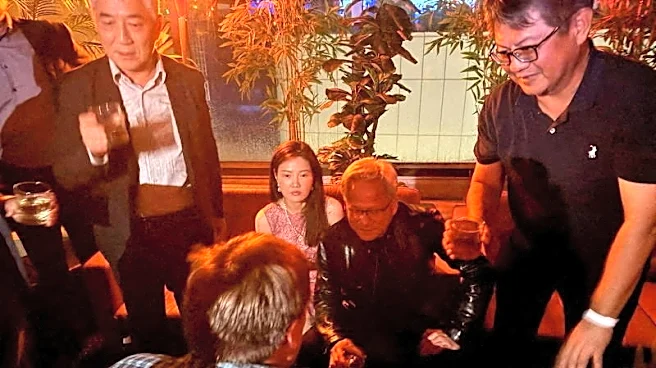
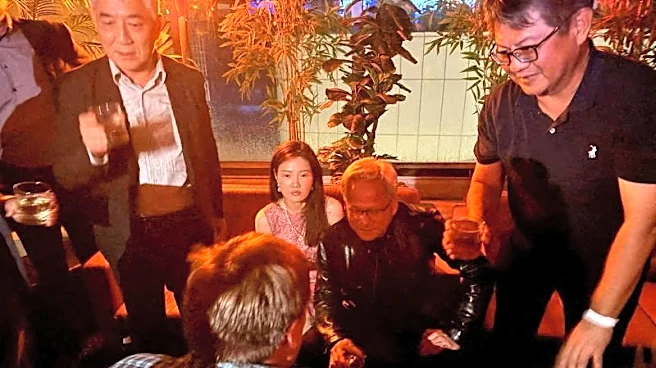
Jensen Huang, according to The Wall Street Journal, meets Alice Huang — executive at the Singapore-based data center company Megaspeed — at an event in California. They are later photographed together at a bar in Taipei.
Per a Trump administration timeline, the U.S. Commerce Department opened an investigation into Megaspeed sometime in 2024, probing allegations that the Singapore-based data center company was violating U.S. export controls by facilitating sales of Nvidia chips to Chinese buyers by diverting them through third-party nations with less-stringent regulations. Customers of Megaspeed include Tencent and Alibaba.
January 13, 2025:
Nvidia — like many other Silicon Valley players — donates $1 million dollars to the inauguration fund of the newly reelected Donald Trump.
January 31, 2025:
The personal relationship between Trump and Huang ostensibly begins a few weeks after the president is sworn in for his second term, when the two men meet in person at the White House. Two days before, Trump made a large purchase of Nvidia stock worth between $1 and $5 million.
February 2025:
Chinese national Ling Mi, a business associate of Alice Huang and her husband Kang Wei, is charged with participating in a scheme to funnel Nvidia chips to China through Malaysia.
April 24, 2025:
Huang attends a fundraising dinner for the MAGA Inc. PAC at Mar-a-Lago. The seat price is $1 million per person.
April 9, 2025:
Trump reverses course on a proposal to restrict the sale and export of Nvidia’s H20 chips to the Chinese market.
April 16, 2025:
The House Select Committee on China, controlled by Republicans, opens an investigation into whether Nvidia had provided the Chinese AI company Deepseek with access to their products in violation of export controls.
May 2025:
The Commerce Department requests records from Nvidia related to direct or indirect sales to Megaspeed.
May 13, 2025:
The Commerce Department, under the supervision of Secretary Howard Lutnick, reverses a Biden-era set of export control protocols that — among other things — sought to restrict the export of high-performance chips and processors to adversarial nations.
The same day Lutnick reversed the Biden era rule, Huang embarked with Trump on a two-day trip to Saudi Arabia — where he committed to selling 18,000 chips to the kingdom as part of a data center development project.
May 22, 2025:
Jensen Huang and Alice Huang are photographed and filmed together at a dinner in Taipei. Alice is seen kissing Huang on the cheek, and the two left the event together.
June 2025:
Nvidia places Megaspeed on its “no-sell list,” according to a timeline provided by the Trump administration. Agents of the Department’s Bureau of Industry and Security conduct an in-person inspection of Megaspeed’s Singapore facilities that same month.
Reporting from Bloomberg later found that while Megaspeed was on the “no-sell” list, the company continued to import thousands of Nvidia chips through the Malaysian market.
June 2025:
Singaporean authorities seize Alice Huang’s passport as their investigation into Megaspeeds compliance with international and national export laws unfolds .
July 10, 2025:
Huang and Trump meet at the White House ahead of a trip to China by the Nvidia CEO. Contemporaneous news reports from the meeting note that the company had been working to negotiate favorable export control policies with the Trump administration. The following week, Huang announces that the company had secured permission to ramp up its production of restriction-compliant H20 chips for the China market — the sale of its most high end products, including the Blackwell and Rubin series, remain barred from export to China.
August 2025:
Nvidia General Counsel Tim Teter contacted Commerce Department investigators seeking details related to the ongoing investigation into Megaspeed’s business dealings. Teter claimed that Jeff Kessler, Under Secretary of Commerce for Industry and Security and a deputy to Lutnick, had given him his blessing to do so. The outreach raised alarm within the investigative unit about what sort of discussions Nvidia was engaging in with administration officials. The case was quickly transferred to the DOJ in order to avoid a suggestion of interference or impropriety.
August 10, 2025:
Nvidia and semiconductor manufacturer Advanced Micro Devices, Inc. (AMD), announce an agreement to hand over 15 percent of revenue gained from AI hardware sales to China to the U.S. government, in exchange for export approval.
Days later, the president purchases between $5 and $25 million in Nvidia stock.
August 30, 2025:
Alice Huang formally leaves Megaspeed. While Megaspeed publicly confirmed her departure, subsequent reporting suggests Huang may have continued to be involved in the operations of Megaspeed, albeit in an informal role.
September 16, 2025:
Huang accompanies Trump on another international trip, this time to the United Kingdom, where the president and former British Prime Minister Keir Starmer sign a deal for a research partnership and standards-development framework for AI models between the two nations.
October 2025:
Nvidia quietly contributes $25 million to Trump’s White House ballroom construction project, becoming one of the largest corporate contributors to the controversial project. The donation was revealed a year later, in documents obtained by The Washington Post.
October 2025:
According to The New York Times, Trump is briefed on the Huang affair by U.S. intelligence officials, who describe Alice Huang as a “Chinese intelligence asset.”
October 9, 2025:
The New York Times publicly reports on the American investigations into Nvidia and Megaspeed, and the alleged connections between Huang and Alice Huang.
October 14, 2025:
Republican Senator Tom Cotton, of Arkansas, calls for an investigation into claims that Megaspeed was diverting Nvidia chips to China through its Singapore-based operations.
November 2025:
A compliance report filed by Nvidia to the U.S. government undercounts the number of chips sold to Megaspeed by over 50,000, according to trade records analyzed by Bloomberg. The total volume of product amounted to billions in trade volume.
November 20, 2025:
Huang appears alongside other AI and Silicon Valley players — including Elon Musk — at a U.S.-Saudi investment forum held in Washington, D.C., pegged to a visit by Saudi Crown Prince Mohammed bin Salman to the White House.
December 4, 2025:
Trump praises Huang as a “smart man” following a meeting in 2026. Trump says Huang “knows” where the administration stands on export controls.
December 9, 2025:
Trump announced that Nvidia will be allowed to sell its H200 AI chips — a newer model of chip that was still a far cry from its most advanced product — to “approved” Chinese customers, in exchange for a 25-percent cut of revenue.
January 14, 2026:
The exemptions granted by Trump the previous month formally go into effect. Nvidia praises the new rules and accuses Trump’s critics of “unintentionally promoting the interests of foreign competitors on U.S. entity lists.”
February 26, 2026:
Alice Huang is expelled from Singapore and barred from reentering the county.
Spring of 2026:
According to reporting from CNN, sometime in the spring of this year, the U.S. intelligence community intercepted communications indicating that an executive at Megaspeed was conducting an affair with a U.S. citizen. By this point, Alice Huang was already a person of interest.
March 30, 2026:
Secretary of State Marco Rubio pens a memo to members of Trump’s Cabinet detailing concerns about Huang, his relationship with Alice Huang, and her alleged connections to Chinese intelligence, per The New York Times.
May 11, 2026:
The White House releases a list of 11 individuals set to accompany Trump on a tech-focused trip to China. Huang is not included. The omission generates news coverage.
May 12, 2026:
In an about face, Huang takes a late-night flight to catch up with Trump at a midterm campaign stop in Alaska. Shortly before Huang is set to join the president aboard Air Force One to fly to China, Rubio reportedly personally briefed Trump on intelligence obtained by the U.S. government suggesting that Huang’s mistress was a Chinese intelligence asset.
“Jensen is currently on Air Force One,” Trump wrote on Truth Social during the flight, “journeying to the Great Country of China where I will be asking President Xi, a Leader of extraordinary distinction, to ‘open up’ China so that these brilliant people can work their magic.”
September 14, 2026:
Huang picks up a call from Trump during a taping of the All-In podcast at an AI summit in Los Angeles, and puts him on speakerphone for the audience. The two gush to each other.
“The robots will not be taking over. The AI will not be taking over the rest of the world. The whole thing is a hoax,” Trump said.
He added that any critics or detractors were “just playing right into the hands of a lot of people that don’t want to see it happen. That could be political people, that could also be China.”
For his part, Huang said that he wouldn’t have picked up “if it wasn’t for you calling,” and that as it turns out “we were talking about you — good job sir.”
September 29, 2026:
Huang is one of the signatories to a Trump-proposed pact among American AI and tech sector companies to “self police” AI development.
October 29, 2026:
The New York Times breaks the news to the public that Huang may have been the target of a Chinese honeypotting scheme, and that American intelligence agencies, members of Trump’s Cabinet, and possibly the president, had been aware of the matter.
That same day, Huang denies any wrongdoing in relation to Nvidia’s relationship with Megaspeed, telling Bloomberg that “our relationship, our interactions, have been related to Megaspeed, and it was all completely normal and not unusual.”
November 8, 2026:
In an email to Nvidia staff, Huang admits to having had an affair outside of his marriage. “Regarding the national security concerns raised in news reports, NVIDIA’s Board of Directors has initiated an independent investigation,” he writes. “I support the investigation and will cooperate fully. I love our country and our company.”
November 11, 2026:
The New York Times reveals another affair with Nvidia Vice President of Health Care Kimberly Powell — one of Huang’s direct reports — and a violation of the company code of conduct.
November 12, 2026:
Reuters reports that Huang had a second affair with an unnamed Nvidia employee.
November 12, 2026:
Huang resigns from his position as Nvidia’s CEO. The company’s stock value falls sharply, shedding roughly half a trillion in market valuation over the course of the day.
November 13, 2026:
When asked by reporters why Megaspeed was not placed on the federal government’s export blacklist — despite support from several agencies — Treasury Secretary Scott Bessent throws Lutnick under the bus, telling reporters that ultimately “Commerce has the pen.”
November 15, 2026:
The Financial Times reports that Huang’s allies in the tech industry have set up a “war room” to lobby for his reinstatement.
November 17, 2026:
In a post on X, Huang addresses the reports that he is considering returning to Nvidia — despite, at that time, a lack of public support from the board.
“If the Board of Directors decides that my return is in the best interest of our shareholders, our employees, the company, and America, I would be honored to answer these calls and return as CEO,” he writes.
November 22, 2026:
“I hope the Board of Nvidia rehires Jensen Huang. It would be the best thing for the Company, and also, for the U.S.A,” Trump writes on Truth Social.
November 22, 2026:
The New York Times reports that Alice Huang had been in contact with an officer from China’s Ministry of State Security — the nation’s premier intelligence body — from between the spring of 2025 to the fall of this year. The time period overlaps with that of the alleged affair with Jensen Huang.
November 23, 2026:
The Nvidia board announces that it has unanimously voted to reinstate Huang to his position as CEO. In a lengthy interview following the announcement, Trump claims that he “convinced” the board to do so.
Trump tells CNBC that Huang had been “exonerated” of any wrongdoing, a claim contradicted by Nvidia’s Monday statement, which said that the independent investigation into Huang’s alleged misconduct and national security vulnerabilities will “proceed to conclusion.”
November 24, 2026:
The Wall Street Journal reports that in order to convince the board to support Huang’s return, Trump had promised the company that the disgraced CEO and Nvidia were not the targets of investigations by the Department of Justice, headed by Trump’s personal lawyer Todd Blanche.
December 3, 2026:
Huang is scheduled to sit for a public hearing before the Senate Banking Committee.
Click here to read the full article.