





Buckling a seat belt is second nature, or it should be. Once the car door is closed, next comes that click of confirmation. But safety belts were introduced long, long, long after 1769, when the first car ever made came into existence. Not that seat belts were an afterthought; they simply weren't thought of at all. Not for cars, anyway.
Early iterations of the seat belt were developed in the 19th century and intended for aircraft. Seat belts weren't added to consumer cars until 1949, when Wisconsin-based
Nash Motors Company introduced them. Still, not until 1968 were seat belts federally mandated for every seating position in passenger cars. This standard was later amended to include buses and trucks; however, this was merely a manufacturing requirement. Actual seat belt usage and enforcement were left to the states. Because of this, there remains one state that doesn't require adults to wear a seat belt: New Hampshire.
In 1984, New York became the first state to make seat belt use mandatory. The exceptions were children who, depending on age and weight, are to be secured either in a child safety seat or booster. Keep in mind that Volvo, the maven of automotive safety, introduced the three-point seat belt in 1959. Despite evidence showing seat belts not only minimize injuries but also save lives, automotive safety systems receive plenty of pushback, at least initially.
Read more: These Were The First Cars Ever Made By The World's Best-Known Automakers
Seat belts and safety are for kids
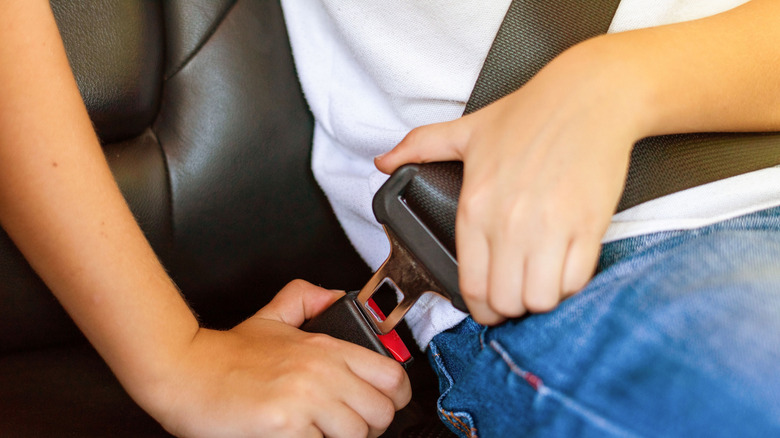
Following New York's lead, other states enacted seat belt laws throughout the '80s and '90s. Maine was the last state to make seat belt use required, putting its law into effect in late 1995. In the decades since, New Hampshire has remained a holdout, though its nonchalance toward seat belts is strictly an adult matter, to be fair.
All other states and the District of Columbia require front-seat occupants to buckle up. For backseat passengers, only 34 states and D.C. say it's a must. And kids being kids have different rules entirely. Some states necessitate seat belt use for front occupants only. Others require that each person be clicked in, regardless of seat location. For children, because standard seat belts cannot properly restrain them during a crash, we've got car seats, booster seats, and other safety equipment to consider.
The rules in New Hampshire do account for minors, requiring occupants younger than 18, including teen drivers, to be properly fastened. There are exceptions, though. Children don't need to be buckled if they're riding in a vehicle built before 1968 (or in a bus or taxi), have a physical condition that prevents seat belt use, or fall under certain special-education conditions. Everyone else? They take the state's motto of "Live Free or Die" to heart.
According to the Centers for Disease Control and Prevention, seat belts reduce serious injuries and deaths by about 50%, and saved nearly 15,000 lives in 2017. Before seat belt use became law, only 14% of people wore them. Usage increased to 59% within a decade. In 2025, 92% of drivers and 90% of front-seat passengers buckled up, according to the Insurance Institute for Highway Safety. But in New Hampshire, less than 80% of travelers bother to buckle.
Living free and dying while unbuckling
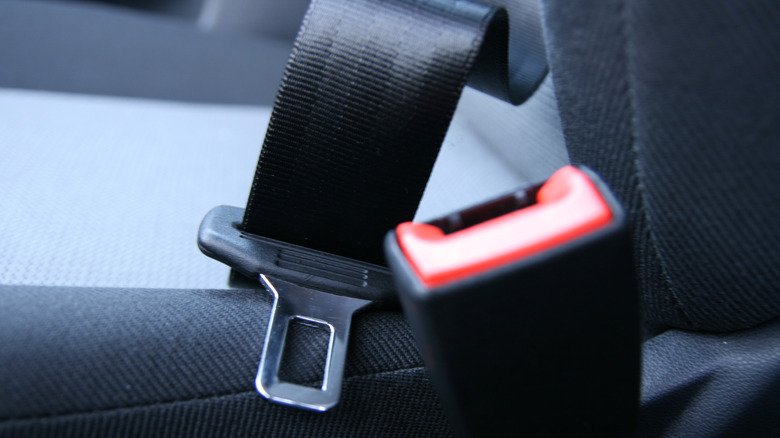
New Hampshire authorities are aware of this less-than-stellar safety record. The New Hampshire Office of Highway Safety (NHOHS) promotes "Join the NH Clique," which coincides with NHTSA's nationwide Click It or Ticket seat belt enforcement campaign. Law enforcement takes a no-excuses approach during the program, but they might as well be yelling at clouds from their front porch because it achieves the same effect. After all, police can't write tickets when a law hasn't been broken.
The state legislature has tried multiple times to introduce bills requiring seat belts for all, but every effort failed. A 2023 attempt was even soft-pitched as a secondary offense. Had the bill passed, actual usage would have depended on whether seat belt violations were treated as primary or secondary offenses. As of November 2026, just 35 states and D.C. have primary enforcement laws, and numbers support that reasoning. Nevertheless, whether old-timey lap belts or innovative multi-adaptive safety belts (another Volvo invention), no amount of safety tech matters unless people are compelled to wear them.
The National Safety Council (NSC) compiled NHTSA data from 2024 that showed seat belt usage at 91.2%, yet unbuckled occupants accounted for 48.4% of passenger vehicle deaths. Among 21- to 34-year-olds, about 60% of occupants killed weren't buckled. The NSC notes that in California — where seat belt use is a primary-enforced law for everyone aged 16 and up – observed usage in the front seats was 97.5% and unrestrained occupants accounted for 43% of occupant deaths. North Dakota, which only switched to primary enforcement in 2023, saw 79.8% usage while unbelted occupants accounted for 53% of deaths. The statistics from New Hampshire are more somber, showing only 78.2% wear their belts, while unbelted occupants accounted for 59% of deaths.
Want more like this? Join the Jalopnik newsletter to get the latest auto news sent straight to your inbox, and follow us or add us as a preferred search source on Google.
Read the original article on Jalopnik.