


The 6.2-liter V8 holds a special place in the hearts of modern muscle-car fans. After all, a motor that size was under the hood of the dearly departed third-generation Dodge Challenger — in which it showed off a horsepower rating well into four-figure territory — and Dodge isn't the only automaker to use a beefy 6.2-liter V8.
True, some V8-powered supercars can top the horsepower output from these 6.2-liter units. The Hennessey Venom F5, for one, touts 1,817 horses from its 6.6-liter twin-turbo V8.
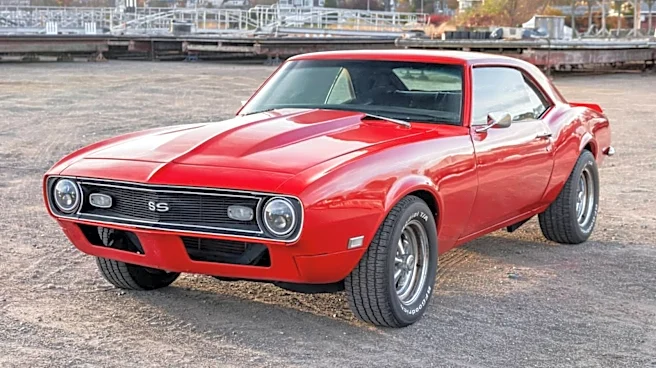
But 6.2-liter V8s, whether they're naturally aspirated, turbocharged, or supercharged, are among some of the most powerful and most well-liked powerplants of all time. We'll get into the details below, but there are all sorts of rides like the Ford F-150 Raptor, the first mid-engine Chevrolet Corvette, the Chevy Camaro ZL-1, and various Mercedes-Benz AMG models ranging from the C 63 to the SLS AMG that use impressive 6.2-liter V8s.
We do have a disclaimer, though. Engine displacement is generally displayed in cubic liters today, but many automakers do their measuring in terms of cubic centimeters. Then they round up to get to liters. For instance, Dodge's 6.2-liter Hemi V8 actually displaces closer to 6,166 cubic centimeters, so the numbers aren't hyper-precise, but we figure it's close enough.
Read more: How The Average MPG In The '70s Compares To The Average MPG Today
7. Ford Boss with 444 hp
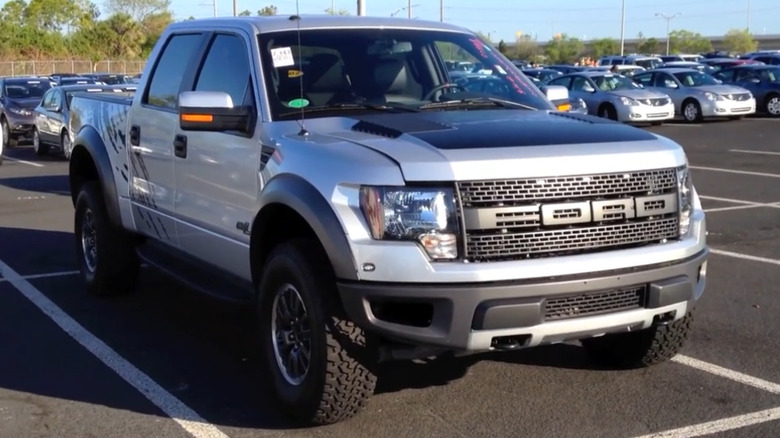
The trail-ready Ford F-150 SVT Raptor hit dealerships in 2010 with an optional 6.2-liter unit capped at 400 hp. Ford then made that engine standard, with 411 ponies, the following year. Known by Blue Oval fans and insiders as "the Boss" – though it was unrelated to the V8s of the Boss Mustangs — it could propel the Raptor from zero to 60 mph in 6.6 seconds.
Ford started the engine's development with a goal of producing a so-called Triple Seven – a 7.0-liter V8 capable of 700 hp with a redline of 7,000 rpm. The single example made, many years later, would find its way into a 2005 Ford Mustang dragster that could get through the quarter mile in under 9 seconds. Who knows what kind of numbers the Raptor would have put up if Ford's 7.0-liter ended up under the hood? Even without it, though, the big-power pickup truck was an impressive rig.
6. Mercedes-AMG M156 with 525 hp
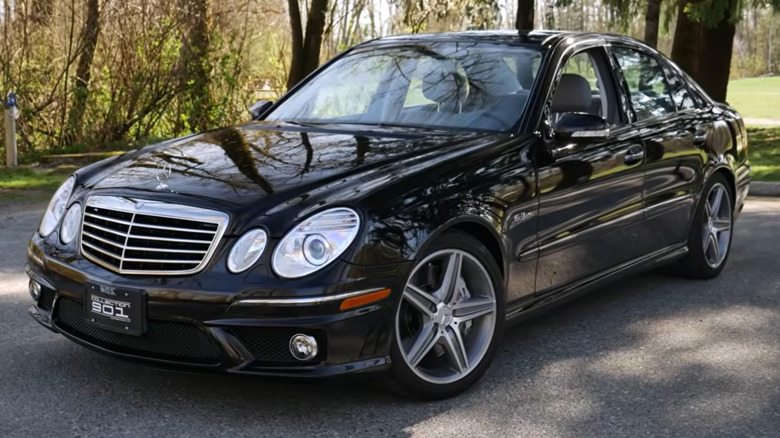
For a certain subset of AMG enthusiasts, this is where it all started. The naturally aspirated 6.2-liter M156 V8 was the first motor ever developed from scratch by MB's in-house performance division. All previous AMG vehicles had relied on modified Mercedes-Benz production engines. Of course, many of those engines were built by hand. The Mercedes-AMG philosophy of "one man, one engine" goes back to at least 1976, when the company had relocated to Affalterbach, Germany.
As for the first car with the M156, that distinction goes to the 2007 Mercedes-AMG E63, which won Car and Driver's German Sports Sedan Comparo that same year. No doubt impacting the decision, the naturally aspirated engine kicked out a healthy 507 hp and 446 pound-feet of torque. When C&D put that output to the test, the car launched to 60 in a mere 4.2 seconds, dispatching the quarter mile in 12.6 seconds at 115 mph. By 2010, the E63's M156 came with 518 hp complemented by 465 lb-ft of torque.
The M156 would end up motivating the likes of the R230 SL 63 AMG, the CLK 63, CL 63, CLS 63, and ML 63, but it's important to note that the "63" attached to these machines was a bit of a misnomer. The M156's displacement remained at 6.2 liters in all these applications.
5. Mercedes-AMG M159 with 622 hp
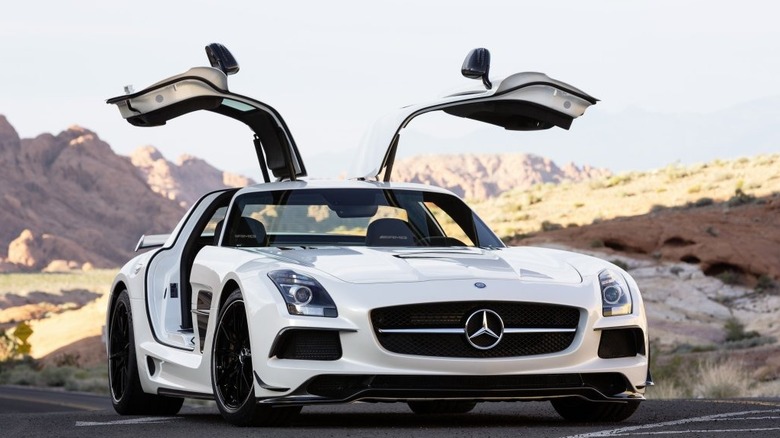
The M159 started out with healthy horsepower, and it increased in output over the years. When the car premiered in 2010, its engine could make 563 horsepower, and the AMG SLS GT could serve up 583 horses from 2013-2015.
The 6.2-liter V8 powering the 2020 Mercedes-AMG SLS Black Series made 622 horsepower, which might seem meager by modern supercar standards, but that power output comes from a naturally aspirated mill. What's more, this engine wasn't simply an updated version of the M156 6.2-liter V8. The significant updates ranged from dry-sump lubrication to redesigned camshafts to the kind of lightweight forged pistons needed by some high-performance rides. In all, some 120 of the M159's components were upgraded compared to the M156.
It's further worth pointing out that Mercedes refers to the engine as having 6.3 liters of displacement. You can chalk that up to marketing, however. To honor Mercedes' first post-war V8, the 6.3-liter M100, the company decided to also call the M156 a 6.3-liter mill — despite it displacing 6,208 cubic centimeters. That, obviously, should be rounded down to 6.2. Anyways, the naming strategy then carried over to the M159.
4. LS9 with 638 hp
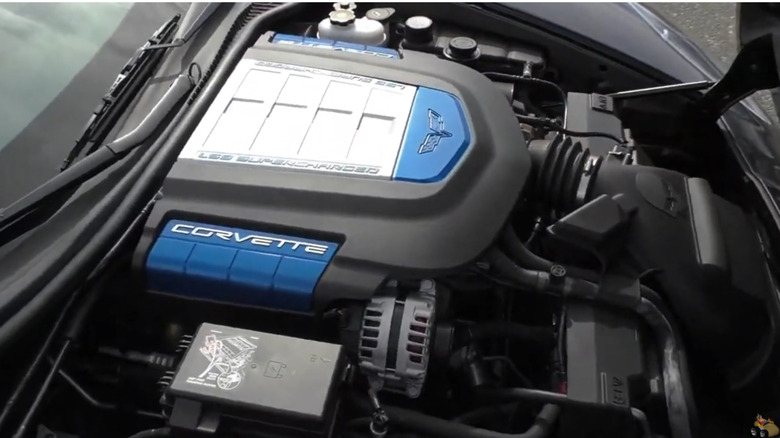
As Chevy's high-performance halo car, it makes sense that the Corvette — especially in its ZR1 variants — has been the showcase for some of the brand's most powerful engines. So we're going to talk about two different versions of the Corvette's 6.2-liter V8: the LT5 from the 2019 ZR1, and the LS9 that came in the 2009 ZR1. First, it's the LS9.
Putting out a stout 638 horsepower, the LS9 is part of GM's long-running LS lineup, which is considered a totally different engine generation than the LT roster. One core practical difference is that the former featured port injection and the latter had direct injection, cylinder deactivation, and variable valve timing. Drilling down into the details shows the LS and LT families are set apart by much more than that — there's practically zero parts interchangeability between the two.
The LS9 proved its performance credibility on the road with zero-to-60 sprints of 3.4 seconds and a top speed of 205 mph. When it debuted, it was Chevy's most powerful production motor.
3. LT5 V8 with 755 hp
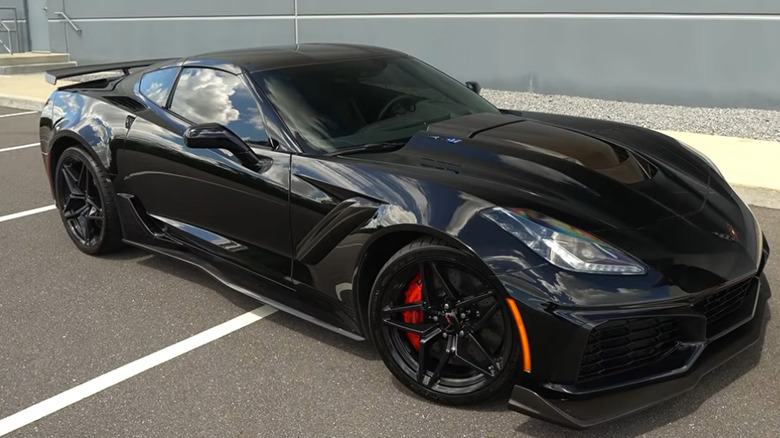
When Chevrolet ended production of the front-engine Corvette, it sent the car out on top: The 2019 Chevrolet Corvette ZR1 debuted as the fastest, most powerful model to ever wear the Crossed Flags badge. Yes, both benchmarks have since been obliterated by the record-setting Corvette ZR1X, but the '19 ZR1 was no slouch. During testing at Car and Driver, the ZR1 covered the quarter mile in 10.7 seconds, reaching 135 mph along the way, and along the way it went from zero to 60 in 2.9 seconds.
The engine backing those results was Chevy's supercharged 6.2-liter LT5 V8. Now, GM has a tendency to re-use its engine codes, so keep in mind that this is a totally different mill from the 5.7-liter LT5 V8 that Lotus developed for the 1990 ZR-1.
Oh, and the hand-built 2019 LT5 also set a record itself. The LT5's 755 hp and 715 lb-ft represented the most output ever offered in any production Chevy up to that point. Another milestone — the premiere of GM's first dual fuel-injection system — was a key contributor to the output. With that on board, the LT5 had both direct and port injection working for it.
2. Dodge Demon with 840 hp
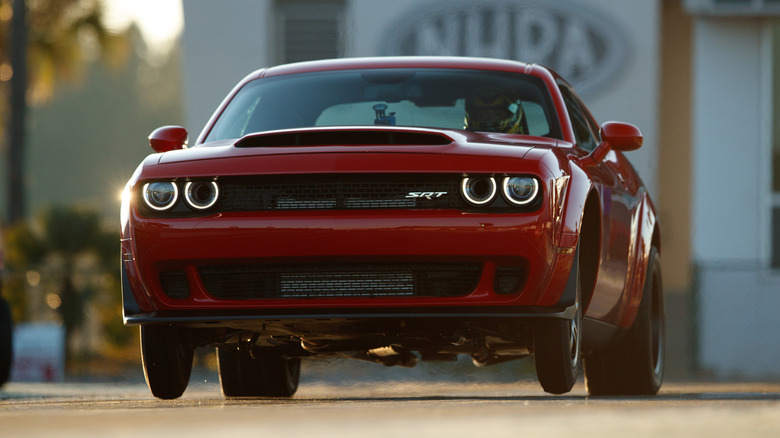
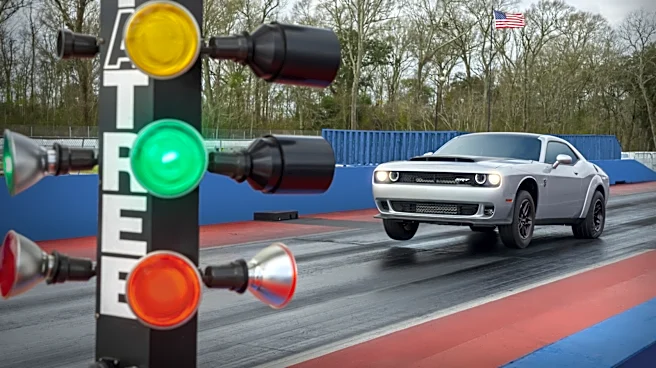
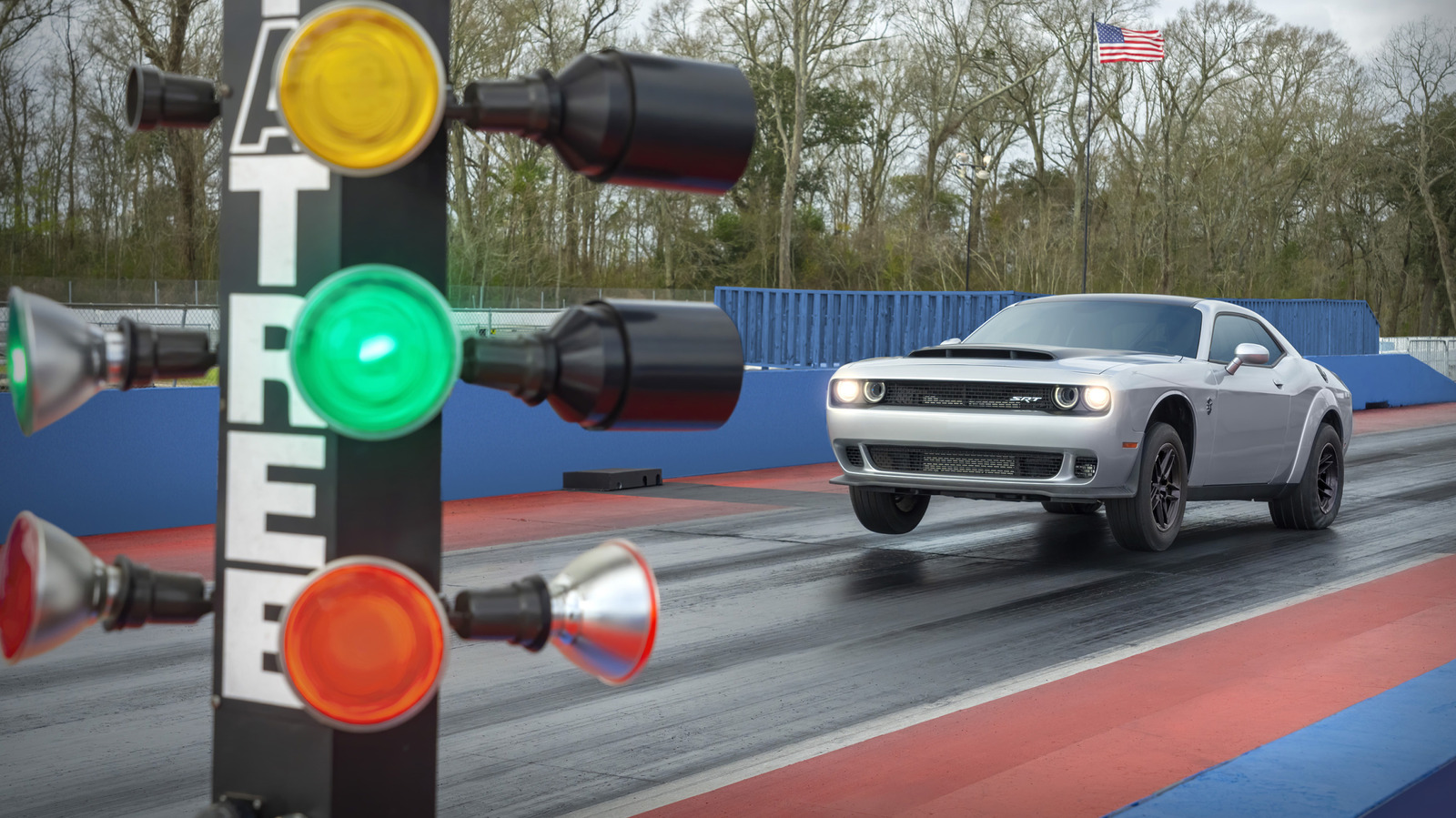
Before it was adapted to be fueled by ethanol and got a huge horsepower bump as a result, the "regular" Demon spent time as the most powerful muscle car in the world. Despite its street-legal status, the Demon was purpose-built for the dragstrip. There, it could make the most of its supercharged 6.2-liter V8 and enter the record books. The Demon tapped into 840 hp to cover the quarter mile in 9.65 seconds at 140 mph, making it the fastest production car in the quarter mile at the time.
The Demon was plenty different from its Hellcat predecessor. To be more specific, while it was technically the same engine, the Demon's V8 shared fewer than 40% of its components with the standard Hellcat. Notable enhancements here extended to a reinforced block with upgraded main caps and deck surfaces, along with a forged alloy crankshaft, forged pistons, and powder-forged connecting rods. Compared to the Demon's 840 hp, the standard Hellcat's 707 hp output seems almost pedestrian.
1. Dodge Demon 170 with 1,250 hp
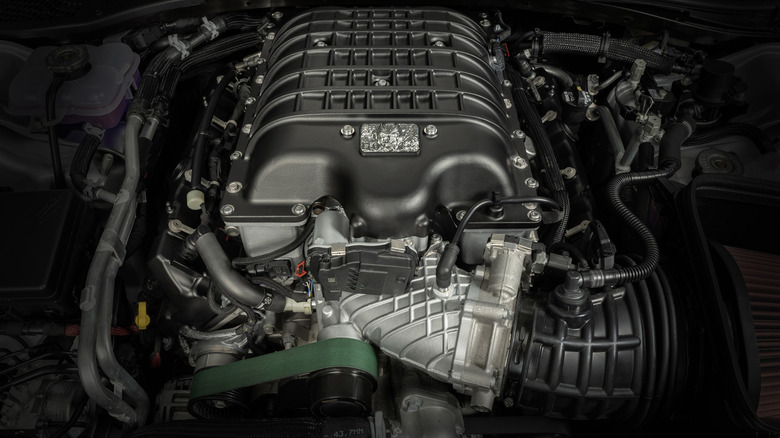
Dodge first debuted a supercharged 6.2-liter Hemi V8 for the 2015 Challenger SRT Hellcat, setting a template for the increasingly insane Dodge V8s that followed. The basic progression was from the Hellcat to the aforementioned Demon, and eventually to the Demon 170, with each set of changes big enough to count as a different engine.
Consider the 2023 Dodge Challenger SRT Demon 170. The most powerful muscle car in the world when it launched — according to Dodge – this street-legal stunner can spit out 1,250 hp and 945 lb-ft when drinking E85 ethanol fuel. On E10, it still offers up a hefty 900 horses. And although its supercharged 6.2-liter V8 shares its displacement with its predecessors, that's about all it shares. With the exception of the camshaft, just about every internal component on the Demon 170 was changed.
For one thing, to maximize its fluid intake, new fuel injectors capable of delivering more than 2.7 gallons of fuel per minute were used. On the air side of the fuel-air mixture, the 3.0-liter supercharger benefited from enhancements to its throttle body, pulley, intake valves, valve guides, bearings, connecting rods, and more. The outcome was a machine that could sprint to 60 in an EV-like 1.66 seconds on a race-prepped surface — just as fast as the Rimac Nevera R that set 24 new performance records in 2025.
Want more like this? Join the Jalopnik newsletter to get the latest auto news sent straight to your inbox, and follow us or add us as a preferred search source on Google.
Read the original article on Jalopnik.