




No single car can deliver everything that every driver will ever want from it, and they all come with at least some compromises. Performance cars often aren't that fuel efficient, huge trucks and SUVs with impressive towing capabilities are not the most nimble for around town, and — as this list will prove — a variety of city and sports cars also need to compromise on trunk space, in order to prioritize other key traits.
That doesn't make them inherently bad cars, they just excel in other areas. The
list includes various city-slick models like the Scion iQ and Renault Twizy – if these cars were equipped with cavernous trunks, then the smallest parking spots and tightest city streets would likely be best avoided. Similarly, sports and supercars, like the Fiat X1/9 and Audi R8 featured below, sport mid-engine layouts, which naturally make incorporating decent trunk space quite a tricky ordeal.
For this list, we've singled out seven cars with laughably small trunks. If you know of smaller, feel free to drop them in the comments below, although it's probably important to point out that we've deliberately avoided models with zero trunk space — so, no BAC Mono or Morgan Plus 4 models to be found here. Likewise, not all trunk capacities are listed by automakers, so any models we could not reliably verify — such as the Veyron Grand Sport Vitesse's supposed 1.3-cubic-foot trunk — have also been avoided. With that aside, here is our selection of seven notoriously impractical trunks and the cars they belong to, listed in size order, with the largest featured first.
Read more: These Are The Worst Current Automotive Trends, According To You
Fiat X1/9
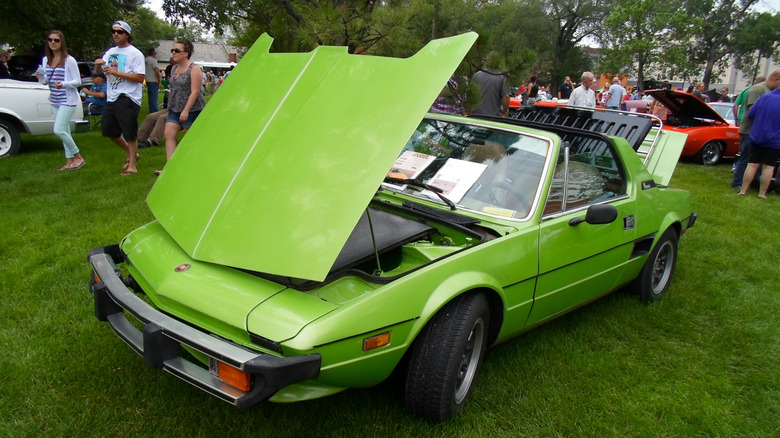
The first entry is an Italian classic that does things differently. Whereas most mid-engine sports cars hailing from Italy boast impressive engines and lofty outputs, the Fiat X1/9 instead makes do with a tiny inline-4. It sports just a 1.3-liter capacity, and power peaks at 67 horses, with 68 pound-feet of torque for good measure. Even with a 2,200-pound curb weight, it still takes around 15 seconds for the little X1/9 to crack 60 mph from a standstill.
As those figures suggest, this is a small car — its wheelbase is just 86.7 inches, which is over 4 inches shorter than that of the Miata below. As a result, there isn't a whole heap of room left for a considerable trunk — the X1/9's frunk provides owners just 5.1 cubic-feet of space.
However, here's where the X1/9 actually impresses, as, despite the diminutive proportions and mid-engine configuration, it actually manages to incorporate a traditional trunk, too. Here lies 4.1 cubic-feet of storage space, so in total, the tiny Fiat actually provides 9.2 cubes — very impressive, considering the space available in other mid-engine efforts. That frunk is typically used as stowage space for the removable targa roof panel, but, of course, with the roof in place or left at home, it could be used for whatever.
Mazda MX-5 Miata
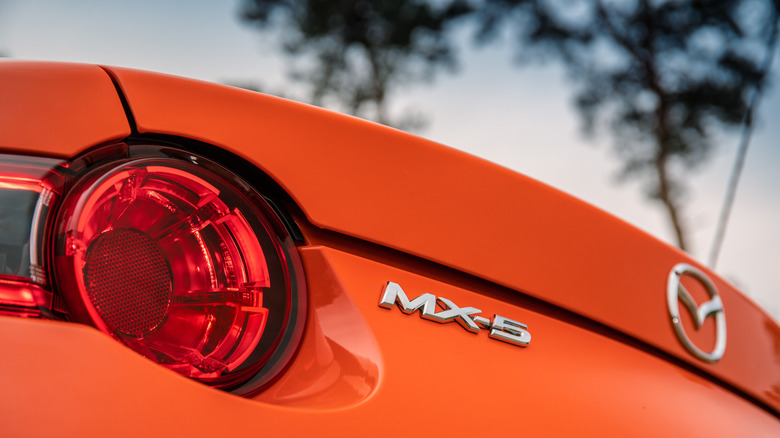
This list covers many city-centric little runabouts and exotic supercars, but here instead, we focus on something that lies somewhere between the two. Mazda's timeless MX-5 Miata is a back-to-basics sports car that refuses to follow the status-quo. While other sports cars have resorted to larger dimensions, heftier curb weights, turbocharged engines, and higher engine outputs, Mazda instead continues to focus on simple driving pleasures.
That's perfect for drivers chasing a fun drop-top to enjoy on a local back road, but it does mean that, once again, trunk space takes a back seat on the priorities list. At least, due to Mazda adopting a traditional front-engine and rear-wheel drive configuration, the Miata sports a proper trunk. It only offers 4.6 cubic-feet of actual space, though, so it's never going to be a great touring companion — at least not without owners having to make some sort of packing compromise or opting for an external luggage rack. The cabin isn't particularly clever in terms of extra storage either, with no door compartments to be seen and no traditional glove box.
Interestingly, the current ND-generation MX-5 Miata sports less luggage space than its predecessor, so Mazda clearly did not feel that trunk space had ever been much of a sticking point with Miata buyers in the past. In fact, we recently advised you all to buy a Miata and said that you'd likely never regret it, so we also feel the sports car's limited storage space is nothing too concerning either.
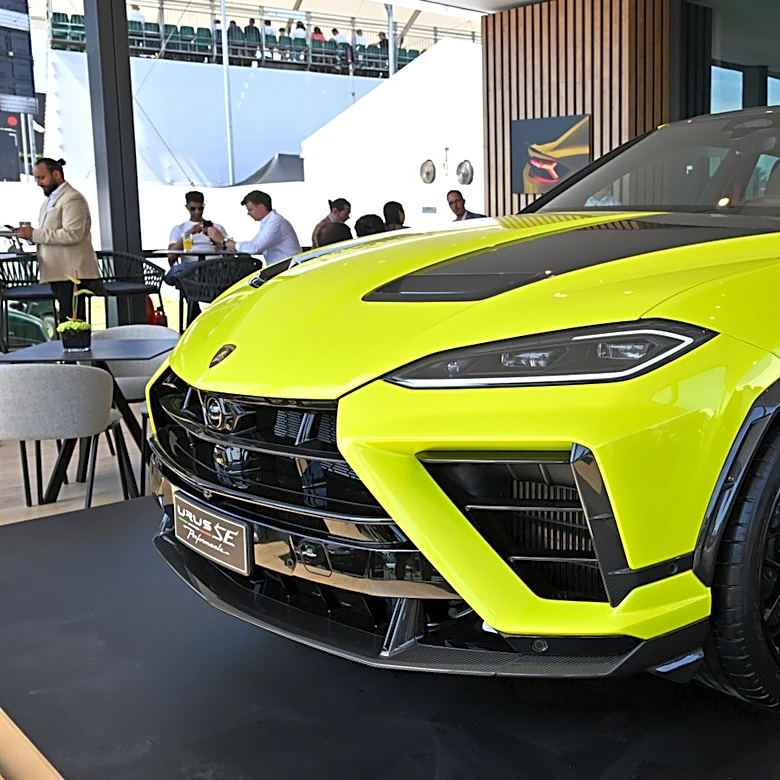
Lamborghini Temerario
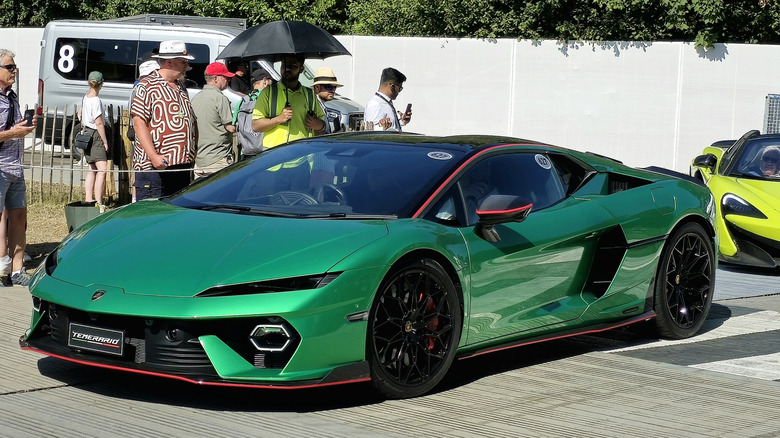
Lamborghini is the only automaker to appear twice on this list, although we doubt being called out for limited cargo space is going to damage the Italian supercar manufacturer's brand image all too much. The Temerario continues the baby supercar bloodline, following on from the Huracan and Gallardo before it, and unlike the Aventador-based Countach further down your page, it's an all-new and fresh design.
There is a pattern emerging here, too, as much like the Countach revival, the Temerario is another mid-engine supercar, and another to sport hybridization technology. Naturally, that leaves no space for a traditional trunk, so it offers a frunk as its primary storage solution. It also matches the capability of later Audi R8 Coupe models, with only 4 cubic-feet of space given at the front end. That's perhaps enough for a few backpacks for a weekend getaway, but certainly not ideal for longer trips that may require multiple larger bags.
It doesn't matter how you spec a Temerario, it's never going to be a great grand-tourer with that little in the way of storage space. An Urus or front-engined model from another exotic brand would be the better bet there, but at least Lamborghini provides owners with enough space to stash away a few essentials for weekends away.
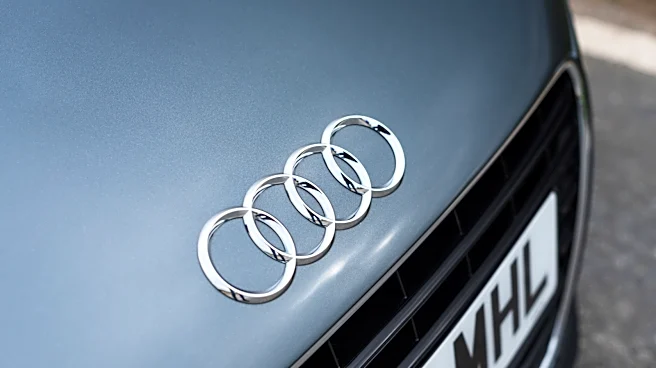
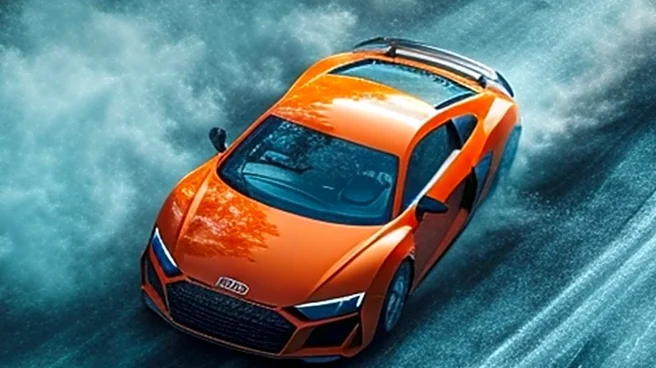
Audi R8
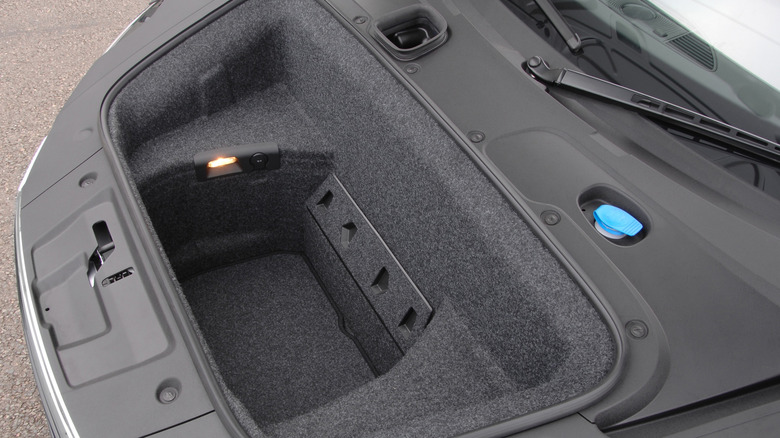
Audi had never made anything that truly verged on being a supercar, so when it pulled up in the late 2000s with a true 911 competitor, with a naturally aspirated and midship 4.2-liter V8, 6-speed manual, and quattro all-wheel drive, the motoring world sat up and paid attention. By all accounts, it was a sublime car, although, thanks to its mid-engine configuration, cargo space has always been at a premium.
Second-generation cars, which ran from the 2016 model year until Audi's supercar became one of the many nameplates that got the axe in 2024, came with a total of 8 cubic-feet of storage space behind the seats, while the physical frunk itself sports 4 cubic-feet. As for those first-gen models, the total frunk space matches that of the Toyota iQ, at only 3.5 cubic-feet. There is no mention of classifying the space behind seats as official stowage space here, so perhaps doing so was just a smart marketing trick of the later cars to make the R8 look like a more complete 911 rival. Either way, there is surely space for a pair of shades or a short novel in the cabin of first-gen models somewhere.
Scion iQ
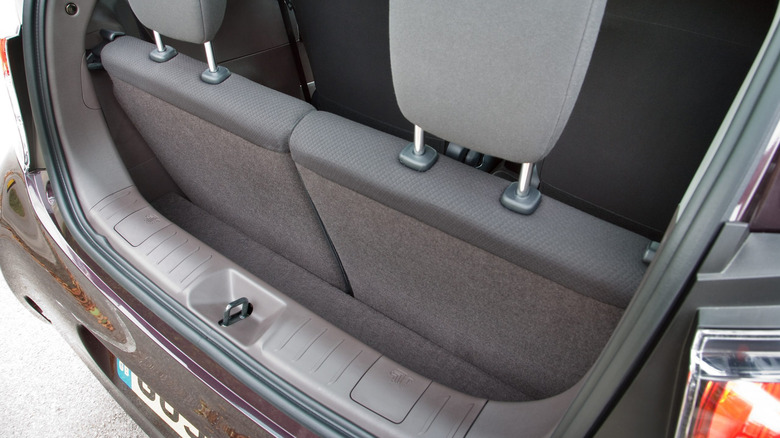
Moving back away from performance cars, the next entry on our list is another cleverly packaged city car. The Scion iQ, or Toyota iQ, as it was known in other markets, was a dinky little four-seater, the first four-seater, in fact, to sit at less than 3 meters (9.8 feet) in length, although it was certainly more conventional in its approach than the tandem-seat Twizy, detailed below. In truth, the Scion iQ was an excellent little car that nobody wanted to buy, produced from the 2012 through 2015 model years, and powered by a naturally aspirated 1.3-liter inline-4 engine.
While it did have the capacity to seat four, those rear seats were particularly restrictive and better treated as an additional storage area. Just as well, as the designated storage space in the trunk was equally as restrictive, at just 3.5 cubic-feet. While the little city car certainly has its fans, not everyone loves it: Consumer Reports called it "slow, noisy, and uncomfortable," in addition to "less-than-enjoyable to drive."
Still, it probably made good sense for those who commuted solely within packed city centers. Furthermore, if those buyers had far deeper pockets and wished for a more upscale ownership experience, they could always opt for the iQ's posher sibling, the Aston Martin Cygnet. The British luxury carmaker took the back-to-basics iQ, furnished it with a sublime interior and refinished the rear end, in addition to many other cosmetic and quality updates. It commanded around three times the price of the iQ, was never offered for sale in the U.S., and, although undoubtedly far nicer to sit in, it likely still made do with the same measly 3.5 cubic-feet of trunk space.
Lamborghini Countach LPI 800-4
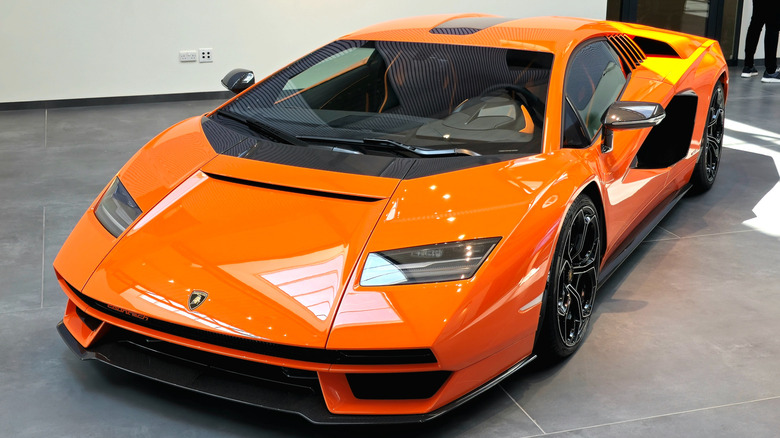
At the complete other end of the spectrum, cargo space isn't far removed from what the city-centric Scion iQ has to offer. To celebrate the initial 1971 release of its Countach, Lamborghini released a modern-day Countach built on the Aventador's chassis. A hybrid V12 powertrain pinched from the Sián FKP37 hybrid hypercar was selected as the motivator, and, as a tribute to the original prototype's LP-112 model designation, just 112 were assembled.
Cargo space likely was not at the forefront of the designer's mind, and neither was it a key priority for buyers either, we can safely assume, as the Countach LPI 800-4 offers just 2.2 cubic-feet of it. That's roughly enough room for two standard milk crates — great news for big milk drinkers, then, but not ideal for road trippers or those who fancy an exotic daily driver.
The Aventador Coupe, on which the Countach is based, manages to boast 5 cubic-feet of cargo space, so more than double, which might make the Countach's lack of available space seem tricky to understand. While Lamborghini (rightfully) doesn't feel the need to explain the Countach's cargo space, which is actually frunk space rather than trunk space, we can assume it's due to the Countach's differing lines and the fact it also boasts a hybrid system, whereas the Aventador is without electrification.
Renault Twizy
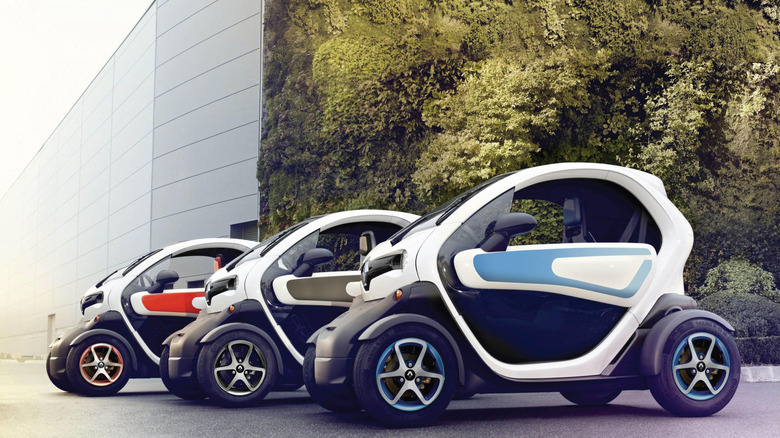
The Renault Twizy was not sold in the U.S., as it likely wouldn't sell well being such a diminutive electrified city runabout, and restrictions would render it pretty difficult to use anyway. And that's if it ever worked its way around the required crash tests in the first place. Having said that, Scoot Networks did temporarily employ a fleet of them around San Francisco for rental use, but that's not why it grabs the spotlight today.
Instead, it impresses — or rather disappoints — with its ludicrously compact trunk capacity. It offers just 31 liters of space, which, for reference, works out to around 1.09 cubic-feet. To put that into perspective, a standard milk crate measures up at 0.9 cubic-feet. So, the Twizy is ideal for grabbing a few gallons of milk, but that's about it.
In truth, it would be rude and missing the point somewhat to blast the Twizy over cargo space. It's designed to be as compact as possible, suitable for two occupants in tandem and, well, nothing else really. So, for city-center commuting and securing the last parking spot that nobody else dares to entertain, this quadricycle is absolutely ideal. Just be careful about the size of your packed lunch before heading out to work.
Want more like this? Join the Jalopnik newsletter to get the latest auto news sent straight to your inbox, and follow us or add us as a preferred search source on Google.
Read the original article on Jalopnik.