


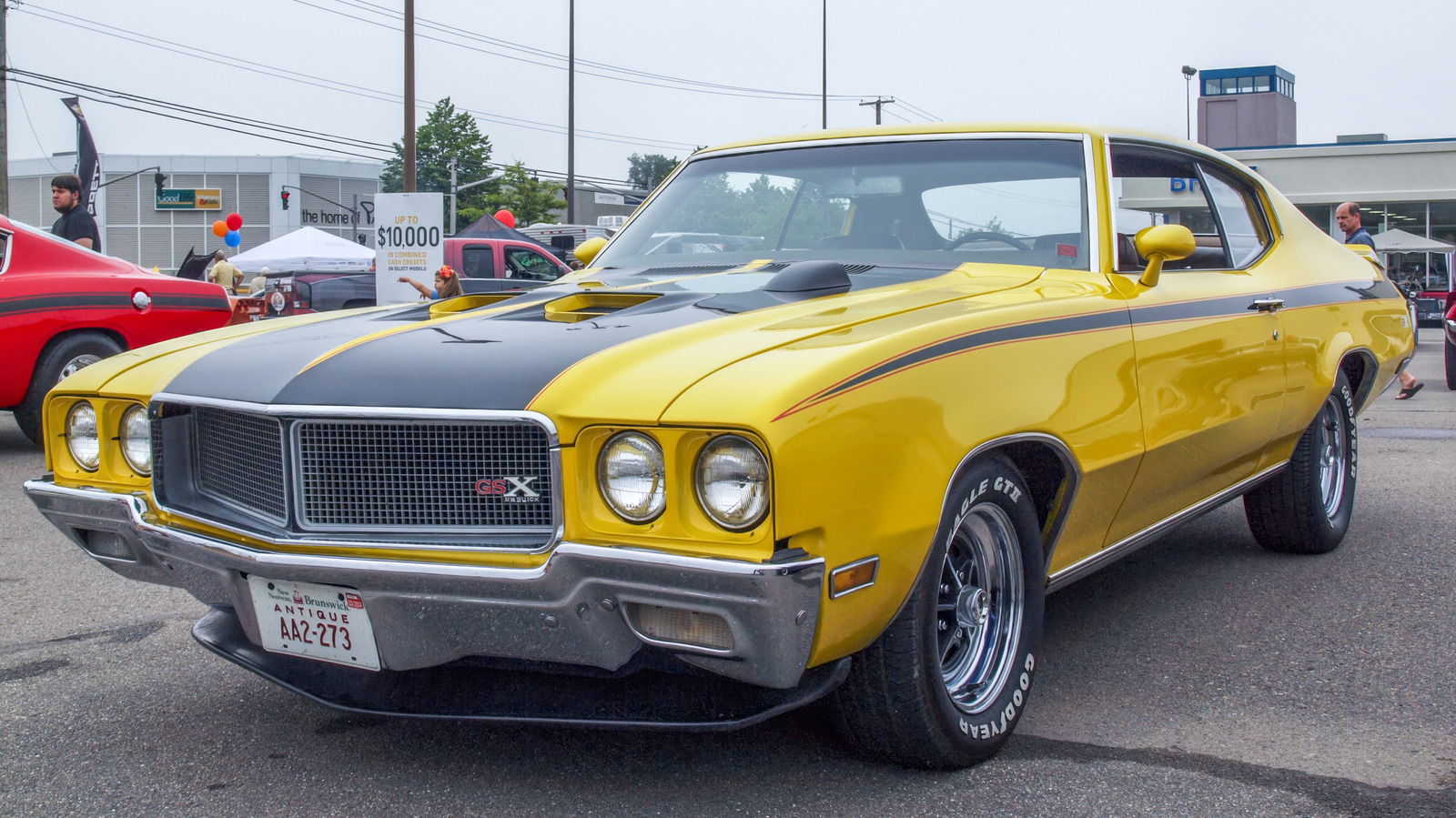
If you take a moment to think of some classic-era American muscle car brands, names like Chevrolet, Pontiac, and Dodge immediately come to mind, but "Buick" doesn't. Buick occupies a market segment just under luxurious Cadillac within the GM hierarchy of automakers, making athleticism something most wouldn't associate the brand with. Regardless, the marque was responsible for building one of the most torque-happy muscle cars of the classic era, with 510 pound-feet of torque on tap alongside 360 horsepower.
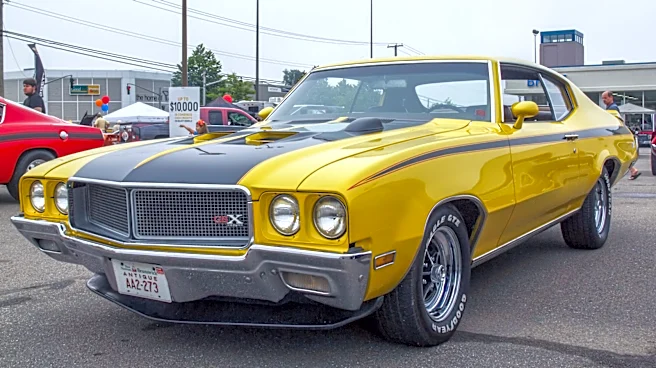
The model responsible is the 1970 Buick GSX Stage 1. At the time, the GSX was locked in direct battle with more well-known adversaries such as the Pontiac GTO and the Dodge Charger, but even when it was new, few knew about it. It was one of the rarest of muscle cars — only about 400 were produced in 1970. To boot, it became even rarer as time went on, with just 24 built in total for the 1972 model year.
However, "Stage 1" was only part of the GSX's performance story. There was also the incredibly fabled "Stage 2" iteration. Only a couple of fully fledged examples were ever produced — making it one of the rarest Buick muscle cars to ever grace the pavement.
Read more: How Fast Were The Fastest Muscle Cars, Really? A Look At 5 Top Speeds From The 1960s
The Stage 2 GSX was more secret than well-known fact
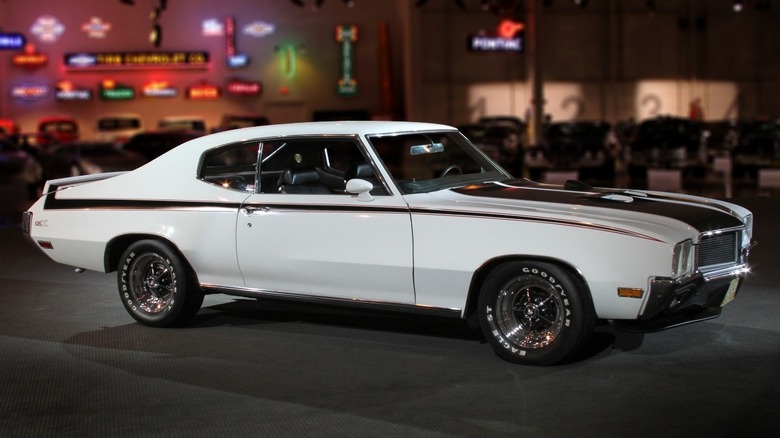
If you fancied a hot Buick muscle car in 1970, you could simply pop down to the dealership and buy something like the GS 350 or GS 455. Your most desirable choice, however, would have been the flagship Buick GSX, carrying a sticker price of about $4,880. It boasted the poise and presence of a tried-and-true muscle car with its black striping and lack of chrome trim — something rarely seen in a Buick of the time. The Stage 1 package was offered for just $199, adding 10 horsepower and things like a higher compression ratio at 10.5:1 versus the GSX's standard 10.0:1, a more aggressive camshaft, and larger valves.
If you took a walk back into the Buick dealer's parts department, though — and also happened to be a drag racer — you could build yourself an even more powerful GSX with Buick-bred components that were off the standard books. This marked the initiation method for procuring a Stage 2 kit, and it needed to be special-ordered through dealers, rather than from Buick itself. The package consisted of a litany of upgrades over the Stage 1 version. Because it wasn't available to the public at first, the Stage 2 upgrade went without an RPO code.
The Stage 2 kit carried things like an 11.0:1 compression ratio and 2-inch circular exhaust ports, allowing the engine to breathe much more efficiently. A gigantic Holley carburetor sporting an 850 cubic-foot-per-minute flow rate sat atop an Edelbrock intake manifold, and a set of high-strength forged pistons handled the engine's combustion.
The factory Stage 2 GSX never came to be
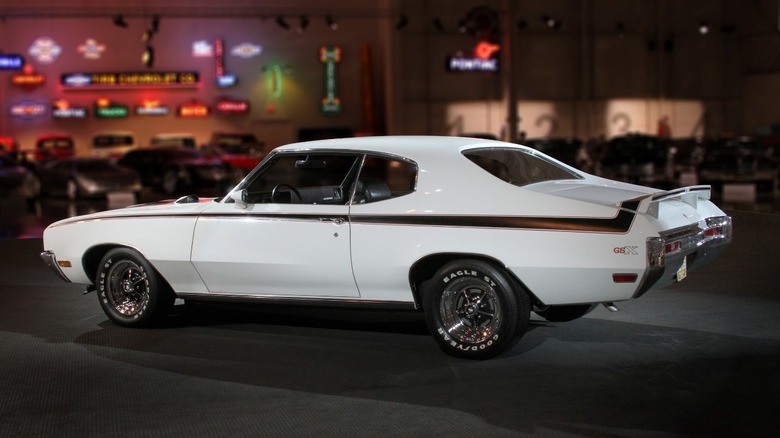
All told, the Stage 2 GSX was thought to have roughly 100 more horsepower than Stage 1 models. To test its Stage 2 creation, Buick drummed up a pair of GSX prototypes outfitted with the complete kit, one of which was sent to Doug Jones and Dave Benisek — a pair of drag racers — for some stress testing, with the duo managing to achieve quarter-mile times under 11.7 seconds at trap speeds nearing 130 mph. Jones and Benisek continued to race their prototypical Stage 2 GSX throughout the 1970s, going undefeated during the National Hot Rod Association's 1972 season.
That very same year, Buick finally made the existence of its Stage 2 project public, letting regular customers special-order parts from the program. As for the rough number of Stage 2 kits built, it's thought to be just about 75 pairs, the vast majority of them produced in 1972. Sadly, looming changes to American emissions standards rendered the factory-sponsored Stage 2 program moot before it could get really off the ground.
1972 was a pivotal year for the classic American muscle car. Horsepower outputs had dropped dramatically by that time, and the GSX Stage 1 was no exception. While the 1970 model boasted 360 ponies, the '72 GSX Stage 1 made just 270. Fitting, then, that Buick's Stage 2 GSX dream would effectively flame out that year — right around the time emissions standards and rising fuel costs began to render the classic American muscle car a thing of the past.
Want more like this? Join the Jalopnik newsletter to get the latest auto news sent straight to your inbox, and follow us or add us as a preferred search source on Google.
Read the original article on Jalopnik.