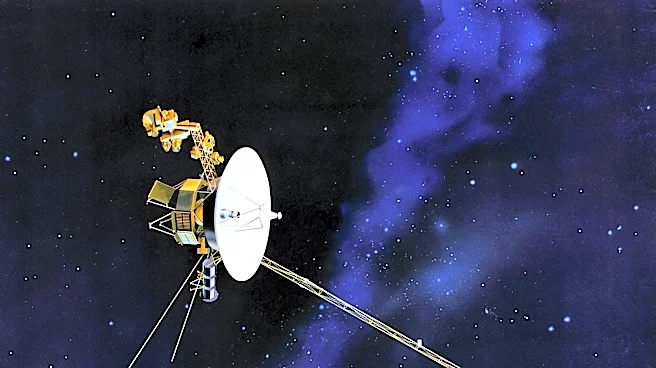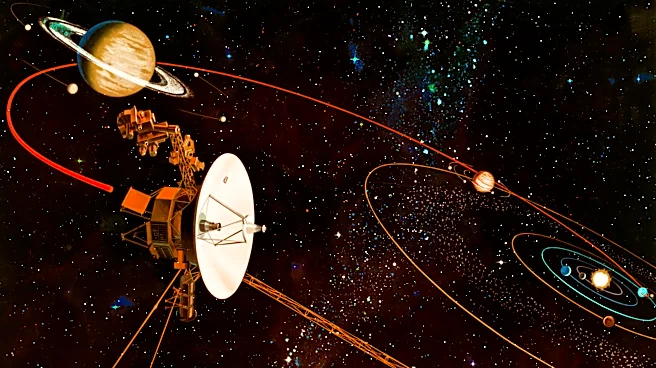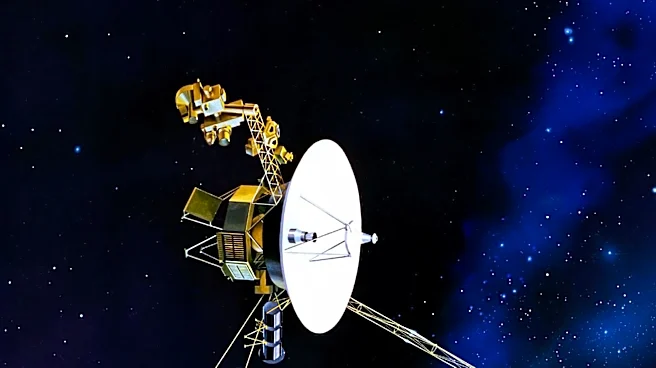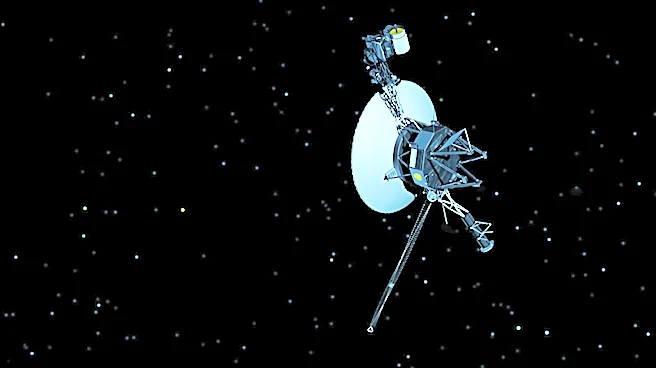





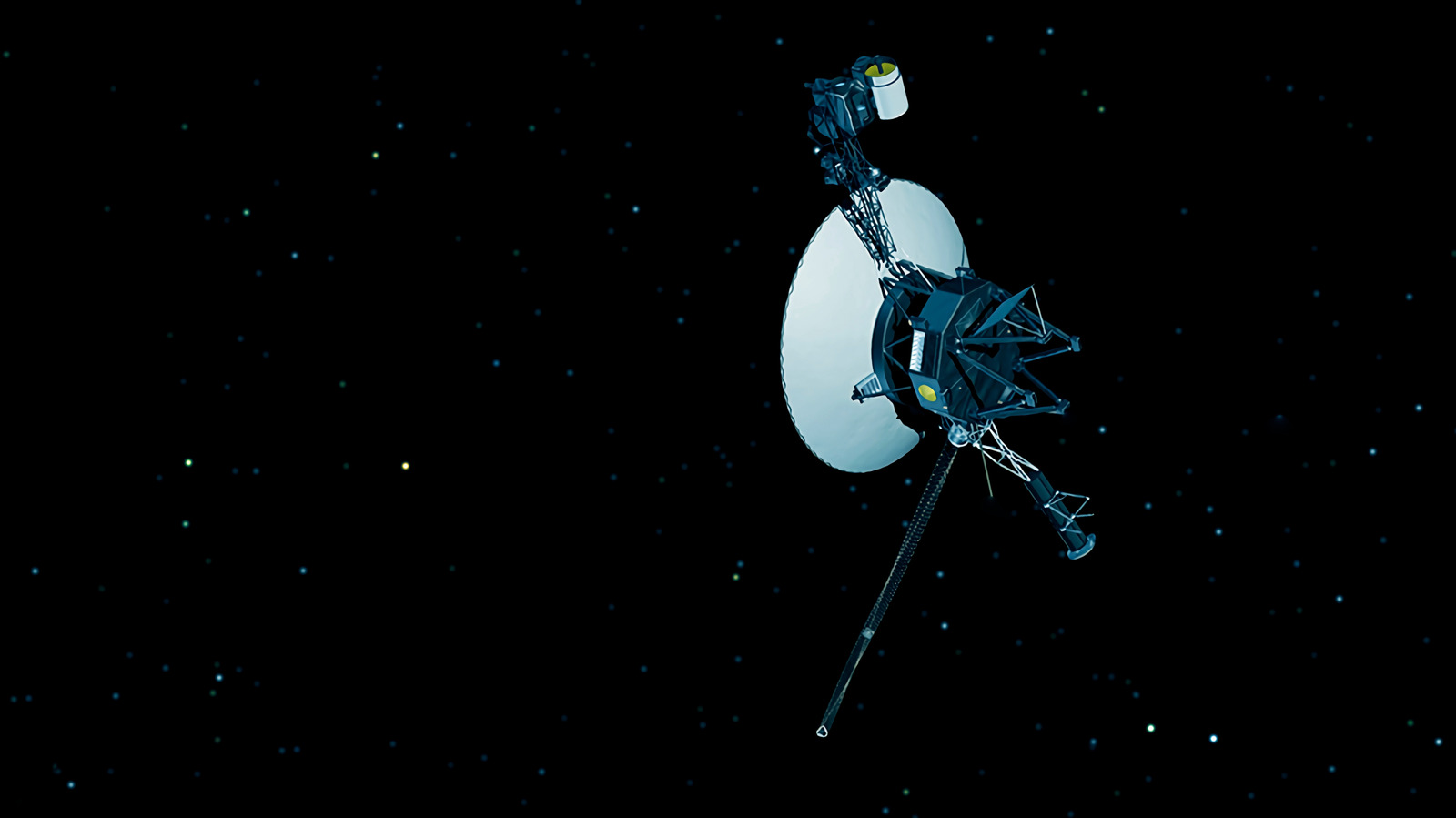
It seems like only yesterday (well, July) I was writing about signals from the Voyager 1 probe taking 23 hours to reach Earth. But as it has for decades, and will continue to do for millennia, the probe that first launched in 1977 has made more progress on its journey beyond our solar system and out to the stars. On November 18, at 5:16:07 a.m. EST, a signal from Voyager 1 will take a full 24 hours to reach Earth — because it will be exactly one light-day from our planet. This is just under 16.1
billion miles, the distance that a photon of light traverses in a single day. If you point a flashlight (a really, really bright one) at just the right patch of sky on November 17, its light will reach Voyager 1 right as it's crossing that point. (At least from the Voyager 1's relative frame of reference; from your reference frame, it will take... well, ask Einstein.)
Nothing man-made has ever gone that far, but of course you knew that, since the Voyager 1 has been the farthest man-made object in the universe since 1998. There is nothing in the works that will overtake it, either. On its journey, it took close-up photographs and readings of Jupiter and Saturn, discovering new rings and moons on both worlds. With its mission completed, it was then granted a second one: to study the edge of the heliosphere, the "wall of fire" that marks the boundary of the Sun's magnetic influence. After itself passing through the heliosphere in 2012, Voyager 1 has been studying the outer cosmos, sending information that takes ever longer to reach home.
Read more: 7 Facts About Zora Arkus-Duntov, The Father Of The Corvette
Messages to Earth and messages to the beyond
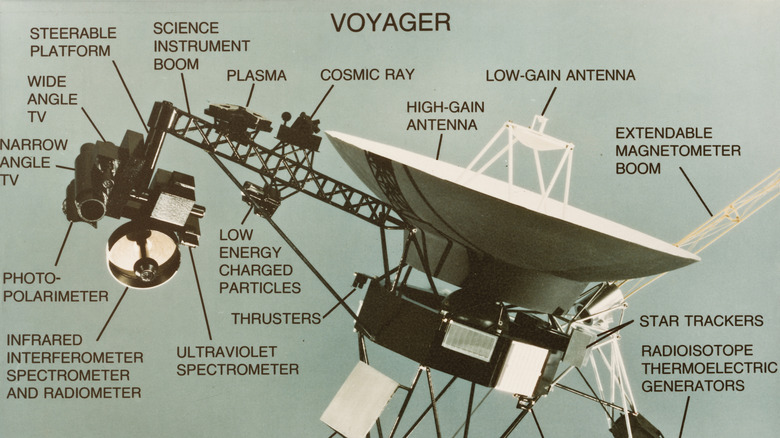
Though it will forever traverse the void of space at 38,000 mph, Voyager 1 will not live for much longer. Its plutonium power generator is slowly decaying away, now producing just 230 watts – less than half of what it had when it was young and vital. These days, only its magnetometer and plasma wave subsystem are still performing science research. NASA does hope to keep Voyager 1 and its 68 KB of computer memory powered up enough to make it to its 50th birthday next year, though, and there are some celebrations planned.
Eventually, however, Voyager 1 will send no signals at all. Its plutonium generator will run out completely in the next 10 or 15 years, per Science News. Even before that, it's very likely that its reaction wheels (which keep it pointed in the right direction) will fail soon. Once that happens, it will drift into a spin, meaning its communications dish will not stay pointed at Earth. It will not speak to us, and we cannot tell it how to keep doing science.
The object itself will persist, reaching ever farther out towards the stars, our planet's ambassador to anyone who might receive it. Physically attached to it is the famous golden record, which carries audio and images of a greeting from our species as well as a celestial map that points the way to Earth. So even if Voyager 1 speaks no longer, it will have a lot to say if anyone out there ever finds it, however many light-days or light-years away they are.
Want more like this? Join the Jalopnik newsletter to get the latest auto news sent straight to your inbox, and follow us or add us as a preferred search source on Google.
Read the original article on Jalopnik.