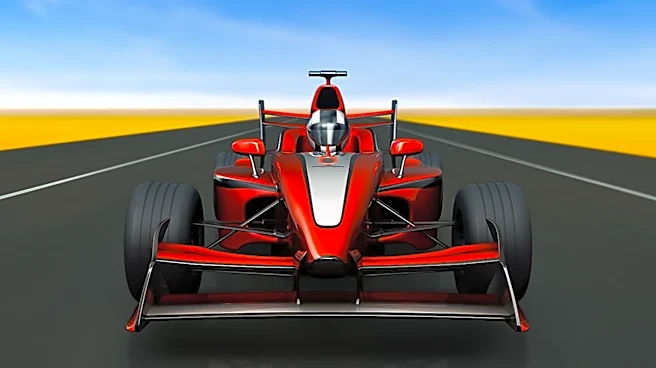






Formula Three, often abbreviated as F3, stands as a pivotal third-tier class in open-wheel formula racing. It has consistently served as a vital stepping stone for aspiring drivers aiming for the pinnacle of motorsport, Formula One. The various championships held across Europe, Australia, South America, and Asia underscore its global importance in driver development. Over the decades, F3 has evolved significantly from its humble beginnings, transforming
into a sophisticated racing category that closely mirrors the more senior formulae, preparing drivers for the intense demands of Grand Prix racing.
The Early Days: 500cc Formula
The origins of Formula Three can be traced back to postwar auto racing, with the FIA officially adopting the formula in 1950. This early iteration, known as the 500cc formula, emerged from low-cost "special" racing organized by enthusiasts in Bristol, England, just before World War II. British motorsport faced challenges after the war, including petrol rationing, making accessible, home-built 500cc cars an attractive option for "impecunious enthusiasts." These early cars featured lightweight tube-frame chassis powered by 500cc motorcycle engines, notably from Norton and JAP speedway. A prime example was the Effyh 500, built in Malmö, Sweden, which utilized a lightweight tube chassis, aluminum bodywork, and a 500cc 1-cylinder JAP engine.
Cooper quickly rose to dominance in this formula, mass-producing cars that generated enough income to allow the company to expand into more senior racing categories. John Cooper, along with many other 500cc car builders, innovatively placed the engine in the middle of the car, driving the rear wheels. This design choice, largely influenced by the practical limitations of chain drive, inadvertently gave these cars exceptionally good handling characteristics. This mid-engine layout eventually sparked a revolution in single-seater racing, influencing designs across all formulae. The 500cc formula was the primary entry point into motor racing throughout the early and mid-1950s, attracting future stars like Stirling Moss, who even competed in selected F3 events during his Grand Prix career. Other notable drivers from this era included Stuart Lewis-Evans, Ivor Bueb, Jim Russell, Peter Collins, Don Parker, Ken Tyrrell, and Bernie Ecclestone. Don Parker, despite starting his motor racing career late at age 41 in 1949, became the most successful F3 driver statistically, winning 126 F3 races and securing the Formula 3 Champion title in 1952, 1953, and again in 1959.
Evolution Through the Decades: From Screamers to Carbon Fiber
The 500cc Formula Three saw a decline at an international level in the late 1950s, though it persisted nationally into the early 1960s, eventually being overshadowed by Formula Junior, which accommodated 1000 or 1100cc cars with varying weights. A significant reintroduction occurred in 1964 with a one-liter Formula Three category for four-cylinder carbureted cars, based on Formula Junior rules and running until 1970. These engines, often heavily tuned production units like the short-stroke Ford Anglia-based unit with a special 2-valve Cosworth or Holbay OHV down-draught head pioneered by Brian Hart, were known for their high revs and were popularly dubbed "screamers." F3 races during this period were characterized by large packs of slipstreaming cars. Brabham, Lotus, and Tecno dominated the "screamer" years, with March joining in 1970. Early one-liter F3 chassis evolved rapidly from their Formula Junior designs.
New regulations in 1971 introduced 1600cc engines with restricted air intakes, which were used until 1973, marking the period when aerodynamics began to play an increasingly important role. By 1974, two-liter engine rules were implemented, still with restricted air intakes, a regulation that has remained largely unchanged in F3, demonstrating remarkable stability in racing regulations. As major constructors like Lotus and Brabham shifted their focus to Formula One, the 1970s saw the rise of F3 constructors such as Alpine, Lola, March, Modus, GRD, Ralt, and Ensign. By the early 1980s, Formula Three had matured significantly, closely resembling its modern form and solidifying its role as the primary training ground for future Formula One drivers. Many drivers began bypassing Formula Two to directly enter Grand Prix racing from F3. Chassis designs became increasingly sophisticated, mirroring advancements in senior formulae. Ground effects were briefly used in the early 1980s but were subsequently banned, aligning with other FIA single-seater formulae. Carbon fiber chassis began to be introduced from the mid-1980s, a technological leap that further enhanced car performance and safety.
Modern Dominance and Technical Specifications
Historically, March, Ralt, and Reynard were the main chassis manufacturers in two-liter F3, with Martini also strong in France. Reynard was a pioneer in using carbon fiber in the mid-1980s, replacing traditional aluminum or steel monocoque structures. However, Dallara, after an unsuccessful Formula One project, shifted its focus to F3 in the early 1990s and quickly became the dominant force with their F393 chassis. Within a few years, a Dallara chassis became almost a prerequisite for competitiveness, and today, Dallara chassis are ubiquitous in the formula. To manage costs, Dallara chassis have typically had a three-year lifecycle with only minor annual updates, though the F308 chassis had its lifecycle extended to four years to assist teams. This was replaced in 2012 by the F312 chassis, intended to run until 2017. Many F3 championships, including the British series, offer a secondary class for cars from the previous lifecycle, providing a more affordable entry point for less-funded teams and drivers. Modern FIA Formula 3 cars are monocoque chassis, utilizing slick racing tires and wings. While Dallara manufactures the vast majority, Mygale, Lola (formerly with Dome), Arttech, and SLC also produce a limited number of F3 cars. Engines in FIA Formula 3 are standardized 3.4-liter, 6-cylinder naturally aspirated spec engines. These cars are capable of reaching speeds up to 300 km/h, accelerating from 0 to 100 km/h in approximately 3 seconds. Their cornering and braking capabilities are exceptional, with peak lateral acceleration reaching 2.6 g and peak deceleration at 1.9 g, far exceeding those of high-end road cars.