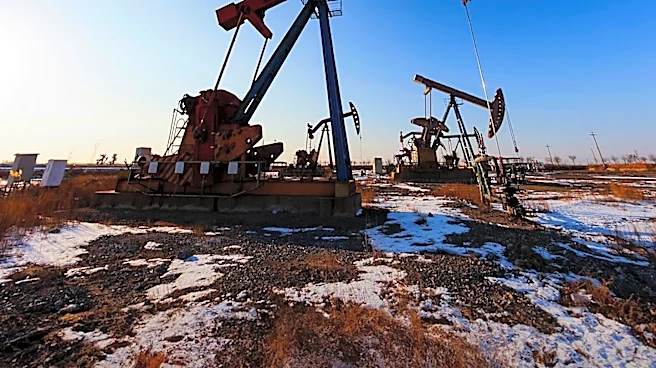




The Drake Well, a 69.5-foot-deep oil well located in Cherrytree Township, Pennsylvania, holds a pivotal place in American history. Drilled by Edwin Drake in 1859 along the banks of Oil Creek, its success ignited the first oil boom in the United States. This single well marked the transition from oil being a mere byproduct or medicinal curiosity to a commercially viable commodity, laying the foundation for the vast oil industry that would shape the nation
and the world. Its historical significance is recognized through its designation as a National Historic Landmark and a National Historic Chemical Landmark.
Early Uses and the Quest for Commercial Extraction
Before the Drake Well, petroleum found in the Oil Creek Valley was known to Native Americans for centuries through natural seeps. Europeans became aware of its existence in the 1600s, primarily using this "mineral-oil" for medicinal purposes, believed to cure ailments like rheumatism and arthritis. Around 1848, Samuel Kier recognized the potential of this medicinal oil as an illuminant. He began distilling the oil to remove odor and impurities, making it more suitable for lamps and creating kerosene. This innovation sparked a new market for lamp oil, offering an alternative to whale oil.
In the early 1850s, samples of oil from the Watson, Brewer and Company Farm on Oil Creek were brought to Dartmouth College and then to Yale University for further investigation. Benjamin Silliman's 1855 report from Yale confirmed the quality of the petroleum and detailed the distillation processes required to produce kerosene. This scientific validation was crucial, as it highlighted the significant economic value of petroleum and spurred investment interest. The Pennsylvania Rock Oil Company was incorporated, and the farm where the oil samples originated was transferred to the company.
Edwin Drake's Vision and Challenges
Edwin Drake, a former conductor for the New York and New Haven Railroad, invested his entire savings of $200 into the Pennsylvania Rock Oil Company. He became more involved and traveled to Titusville, Pennsylvania, in December 1857 to investigate suspected oil deposits. His report prompted George Bissell and Jonathan Eveleth to organize the Seneca Oil Company in Connecticut in March 1858, placing Drake in charge of petroleum production. Although Drake had no military experience, James Townsend, President of Seneca Oil, gave him the title of "Colonel" to impress local townspeople.
Drake decided that drilling, similar to salt wells, would yield more petroleum than conventional digging. He hired William A. Smith, a blacksmith and experienced salt-well driller from Tarentum, Pennsylvania, to assist him. An engine house and derrick were constructed, and Drake purchased a 6-horsepower horizontal steam engine to power the drill. The well was to be dug on an island in Oil Creek. Initial drilling was slow, and the project faced numerous difficulties, leading to it being nicknamed "Drake's Folly" by skeptics.
Overcoming Obstacles and Striking Oil
One of the significant challenges Drake and his team encountered was getting through layers of gravel. At 16 feet, the sides of the hole began to collapse, causing despair among his helpers. Drake, however, devised an innovative solution: the drive pipe. This cast iron pipe, consisting of 10-foot-long joints, was driven down into the ground. At 32 feet, they struck bedrock. The drilling tools were then lowered through the pipe, and steam was used to drill through the bedrock. Progress remained slow, at a rate of just 3 feet per day.
By 1859, Drake was running low on funds, and his colleagues back in Connecticut had given up on finding oil by April, having spent $2,500. Drake took out a $500 loan to continue the operation. His perseverance paid off on August 27, 1859, when his drill bit reached a total depth of 69.5 feet and hit a crevice. The next morning, Drake's driller, Billy Smith, discovered crude oil rising up the well. Drake was summoned, and the oil was brought to the surface using a hand pitcher pump, collected in a bathtub. This moment marked the successful completion of the first commercial oil well in the United States.
The Immediate Aftermath and Lasting Impact
Drake's well initially produced 25 barrels of oil a day. His pioneering method of using a drive pipe to prevent borehole collapse, allowing the drill to penetrate deeper, was a crucial innovation. Previous methods of collecting oil involved gathering it from natural seeps or shallow holes, which failed to produce economically viable amounts. Attempts to dig large shafts also failed due to water seepage and collapse. The principle of driving a pipe into the ground to drill within it is still employed today in hydrocarbon extraction.
Within a day of Drake striking oil, his methods were being imitated by others along Oil Creek and in the immediate area. This led to the rapid establishment of several oil boom towns. By 1872, the entire area was producing 15.9 thousand barrels a day, demonstrating the immense impact of Drake's success. While Drake himself failed to patent his invention and lost his savings in oil speculation, dying impoverished, his determination founded an industry that transformed the world. In 1872, Pennsylvania recognized his contribution by voting him an annuity of $1,500.