


Among the diverse array of postures in modern yoga, the side angle poses, particularly Utthita Parsvakonasana (Extended Side Angle Pose) and Parivrtta Parsvakonasana (Revolved Side Angle Pose), stand out as foundational standing asanas. These poses, while sharing a common root in their Sanskrit names referring to a "side angle," offer distinct physical experiences and benefits. Their emergence in the 20th century, rather than in ancient texts, highlights
the dynamic evolution of hatha yoga practices.
Utthita Parsvakonasana, meaning "extended side angle posture," is a common standing pose in modern yoga. Its name is derived from Sanskrit words: "utthita" meaning "extended," "parsva" meaning "side or flank," "kona" meaning "angle," and "asana" meaning "posture or seat." This pose is not found in medieval hatha yoga texts but gained prominence in the 20th century through the teachings of Krishnamacharya's school in Mysore and his students, including Pattabhi Jois and B. K. S. Iyengar. It is often practiced in conjunction with other standing poses like Warrior I, II, and III, suggesting its role in a flowing sequence.
Utthita Parsvakonasana: The Extended Side Angle
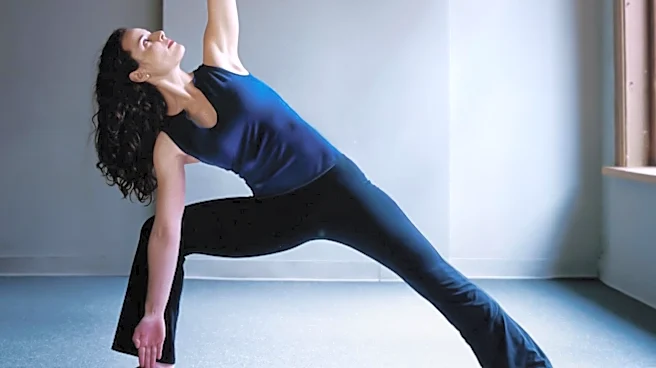
The Extended Side Angle Pose is characterized by its expansive stretch and grounding elements. While specific detailed instructions for Utthita Parsvakonasana are provided in some sources, they generally involve starting from a standing position, stepping out, and turning one foot outwards. The practitioner then extends one arm upwards and forwards at an angle, while the other arm supports the body, often with the hand placed on a block or the ground. The gaze is typically directed upwards along the extended arm.
This pose is known for stretching the sides of the body, opening the hips, and strengthening the legs. It is considered a fundamental posture that builds stability and flexibility, preparing the body for more complex movements. The emphasis on extension and creating a long line from the back foot to the fingertips is a key aspect of its execution, contributing to its name and its physical effects.
Parivrtta Parsvakonasana: The Revolved Side Angle
In contrast to the extended version, Parivrtta Parsvakonasana, or "Revolved Side Angle Pose," introduces a significant twisting element. The Sanskrit term "parivrtta" means "inverted" or "revolved," indicating the rotational aspect of this posture. This pose is specifically designed to stretch the spine through a twist, in addition to lengthening the legs. It is described as an inverted angle pose in Hatha Yoga, emphasizing the spinal rotation.
The execution of Parivrtta Parsvakonasana typically involves starting on the knees with the back horizontal and hands on the ground. The left foot is brought to the outside of the left hand, with the right leg extended backward. As the practitioner exhales, the right hand is placed on the right knee. On an inhale, the right hand is lifted and brought in a wide circle over the head, extending the arm along the axis of the right leg and hip. To release the pose, the right hand returns to the right knee on an exhale, then to the ground, and the left foot moves back to meet the right. The pose is then repeated on the other side of the body.
Origins and Modern Context
Both Utthita and Parivrtta Parsvakonasana are products of modern yoga's development. While Utthita Parsvakonasana is explicitly mentioned as appearing in 20th-century texts and Krishnamacharya's school, Parivrtta Parsvakonasana is noted as being even more recent, not appearing in the first edition of Pattabhi Jois's *Yoga Mala* in 1962. This timeline underscores how contemporary yoga has continuously innovated and expanded its repertoire of asanas, often creating new poses that build upon existing forms to explore different physical dimensions and benefits.