




The Battle of Incheon, a critical amphibious operation during the Korean War, is often celebrated for its strategic brilliance and decisive outcome. However, behind this success lay immense human and logistical challenges that General Douglas MacArthur and his forces had to overcome. From rebuilding depleted units to navigating treacherous natural conditions and overcoming skepticism from military leaders, the path to Incheon was fraught with difficulties
that tested the limits of military planning and resourcefulness.
Rebuilding and Reinforcing Depleted Forces
One of the most significant challenges was the state of the United States Army's 7th Infantry Division, which MacArthur chose for the operation. This division, his last reserve unit in East Asia, was severely understrength, having sent 9,000 of its men to reinforce the Pusan Perimeter, where United Nations (UN) forces were desperately holding a defensive line against the North Korean People's Army (KPA). Re-equipping and bringing the 7th Infantry Division up to wartime strength was a monumental task. This involved not only supplying them with necessary gear but also integrating Korean Augmentation To the United States Army (KATUSA) troops, who were Republic of Korea (ROK) conscripts assigned to U.S. Army units.
Similarly, the United States Marine Corps (USMC), which had been reduced in size following World War II, faced the daunting task of rebuilding the 1st Marine Division for the Incheon operation. This required drawing elements from the 1st Provisional Marine Brigade, which was already engaged in heavy fighting at Pusan, as well as the 1st Marine Regiment and the 7th Marine Regiment. Marines were pulled from as far away as the Mediterranean Sea to be deployed to Korea for this critical mission. The rapid assembly and preparation of these diverse units under wartime conditions presented considerable logistical and organizational hurdles.
Navigating Incheon's Formidable Natural Obstacles
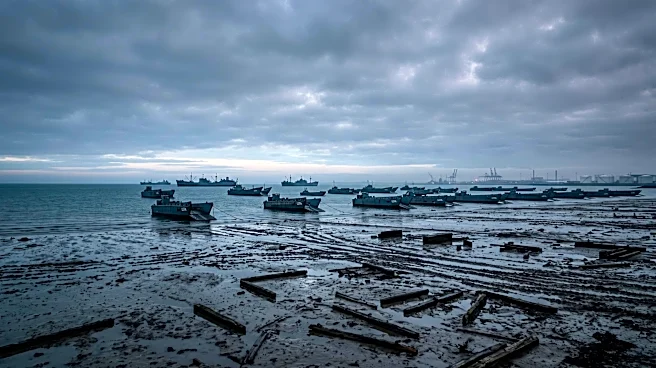
Incheon itself presented a host of natural and geographic handicaps that made an amphibious landing seem almost impossible to many military experts. The approaches to Incheon were restricted to two narrow passages, which could be easily blocked by naval mines. The currents in these channels were exceptionally strong, ranging from 3 to 8 knots (3.5 to 9.2 mph; 5.6 to 14.8 km/h), posing a significant risk to landing craft and ships. Furthermore, the tides were so extreme that they would prevent immediate follow-on landings, requiring precise timing for the operation. The harbor was small, and the landing areas were surrounded by tall seawalls, adding another layer of complexity to the assault. U.S. Navy Commander Arlie G. Capps succinctly summarized these difficulties, stating that the harbor had "every natural and geographic handicap."
Despite these formidable obstacles, MacArthur remained resolute in his choice of Incheon. He argued that precisely because the location was so heavily defended and naturally challenging, the North Koreans would not anticipate an attack there, thus ensuring strategic surprise. This conviction, however, meant that the planning had to be meticulous, accounting for every detail of the tides, currents, and defensive structures. The successful execution of the landing, despite these natural barriers, underscores the extensive preparation and coordination required from the naval forces, including Admiral Arthur Dewey Struble's Joint Task Force 7, which comprised Fast Carrier Task Force 77 for air cover, Task Force 91 for blockade, and Task Force 90 for the invasion itself.
Overcoming Skepticism and Securing Approval
MacArthur's plan faced considerable skepticism from other high-ranking military officials. Many generals, particularly within the Navy, favored a landing at Kunsan, which was closer to the Pusan Perimeter and the KPA's main supply routes. They believed Kunsan offered a less risky and more conventional approach. However, MacArthur dismissed this, arguing that a landing at Kunsan "would be an attempted envelopment that would not envelop" and would merely place more troops in a vulnerable pocket of the Pusan Perimeter. He passionately defended his choice of Incheon during a crucial meeting in Tokyo on August 23, 1950, where he spent 45 minutes explaining his reasoning to top military leaders, including Chief of Staff of the United States Army General Joseph Lawton Collins and Chief of Naval Operations Admiral Forrest Sherman.
MacArthur's persuasive arguments, including his personal appeal to Admiral Sherman by recounting how the Navy had saved him from Corregidor during World War II, ultimately won over the skeptical leaders. Sherman's agreement, despite the initial fury of Admiral James H. Doyle, was a turning point in securing the necessary naval support. Following this, the Joint Chiefs of Staff approved MacArthur's plan on August 28, and President Truman subsequently gave his approval. This process highlighted the significant human challenge of convincing seasoned military professionals to undertake an operation that defied conventional wisdom and appeared to be against overwhelming odds, demonstrating MacArthur's strong leadership and conviction in his strategic vision.