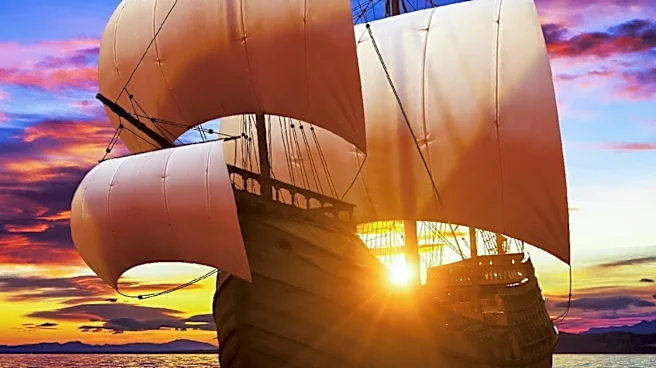




The Mayflower's voyage across the Atlantic in 1620 was a monumental undertaking, fraught with challenges and pivotal for the establishment of Plymouth Colony. This journey, which ultimately brought a diverse group of passengers to the shores of New England, was shaped by the ship's design, the harsh conditions of the North Atlantic, and the sheer determination of those aboard. The vessel, though small by modern standards, carried a heavy cargo: not
just goods, but the aspirations for a new church, a new commonwealth, and a new nation.
The Ship's Design and Its Impact on the Voyage
The Mayflower was a square-rigged vessel, characterized by a beakhead bow and prominent, castle-like structures at both its fore and aft. This design was typical for English merchant ships of the early 17th century. Her stern featured a 30-foot-high, square aft-castle, a design element that unfortunately made it difficult for the ship to sail directly into the wind. This characteristic proved particularly problematic in the North Atlantic, where prevailing westerly winds are common, especially during the fall and winter months of 1620.
These design limitations directly contributed to the extended duration of the voyage from England to America, which stretched over more than two months. In contrast, the return trip to London in April–May 1621 took less than half that time, benefiting from the same strong winds now blowing in the direction of the journey. While the Mayflower's exact dimensions are not precisely known, it is estimated to have measured approximately 100 feet from the beak of its prow to the tip of its stern superstructure, with a width of about 25 feet at its widest point. The bottom of its keel was likely around 12 feet below the waterline. William Bradford, a passenger and later governor, estimated its cargo capacity at 180 tons, and records suggest it could carry 180 casks, each holding hundreds of gallons.
Life Aboard: Passenger Accommodations and Daily Realities
During the arduous journey, passengers primarily resided on the gun deck, a space measuring approximately 50 by 25 feet with a ceiling height of about five feet. This area, while serving as living quarters, was also equipped with gun ports for cannons, highlighting the dual nature of the ship as both transport and potential defense. The gun room, located in the stern area of this deck, stored gunpowder and ammunition, though passengers did not have access to it. It may also have housed stern chasers, small cannons used for firing from the ship's rear.
Life on board was far from comfortable. There were no dedicated toilets, forcing passengers and crew to improvise with buckets as chamber pots, which were likely secured to the deck or bulkheads to prevent movement at sea. The cargo hold, situated below the gun deck, stored most of the passengers' food, supplies, clothing, bedding, personal weapons, and military equipment such as armor, muskets, and bandoliers. Tools and equipment necessary for building settlements and preparing meals in the New World were also stowed here. Some Pilgrims, like Isaac Allerton and William Mullins, even traded goods from the cargo hold during the voyage.
The Mayflower's Armament and Crew
The Mayflower was a heavily armed vessel, a testament to the dangers of sea travel in the 17th century. Its largest weapon was a brass minion cannon, weighing approximately 1,200 pounds, capable of firing a 3.5-pound cannonball almost a mile. Additionally, it carried a saker cannon weighing about 800 pounds and two base cannons, each around 200 pounds, which fired smaller three-to-five-ounce balls. In total, the ship carried at least ten pieces of ordnance on the port and starboard sides of its gun deck: seven long-range cannons and three smaller guns, often fired from the stern at close quarters and loaded with musket balls. Upon arrival, four of these pieces were unloaded to help fortify Plymouth Colony.
The ship's complement included Captain Christopher Jones, four mates, four quartermasters, a surgeon, carpenter, cooper, cooks, boatswains, gunners, and approximately 36 additional seamen, totaling a crew of about 50. This entire crew remained with the Mayflower in Plymouth through the harsh winter of 1620–1621. Tragically, about half of them perished during this period. The surviving crew members eventually returned to England on the Mayflower, which departed for London on April 15, 1621, making excellent time on its return journey thanks to favorable westerly winds.