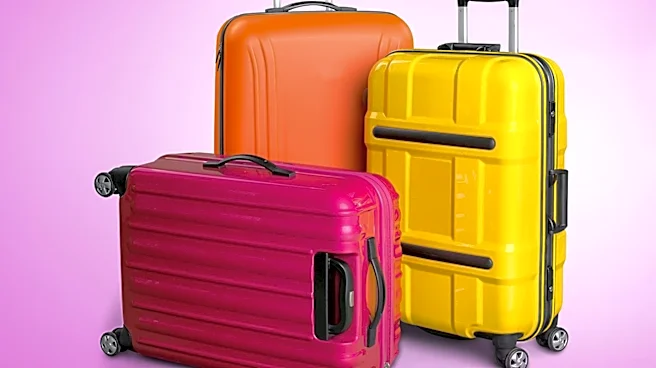








The history of luggage is a fascinating journey that mirrors changes in travel, technology, and societal norms. What began as cumbersome wooden and leather trunks, often requiring servants to carry them, has transformed into the lightweight, wheeled suitcases we know today. This evolution reflects a continuous effort to make travel more convenient and accessible, moving from heavy, rigid containers to more practical and maneuverable designs that cater
to the needs of modern travelers.
Early Forms and Materials
The concept of luggage dates back to the Crusades, with the first wheeled containers for weaponry developed in 1153. The term "luggage" itself, derived from the verb "lug," entered the Oxford English Dictionary in 1596, signifying "inconveniently heavy baggage." Prior to the invention of the suitcase, luggage primarily consisted of wood and leather trunks, often featuring an iron base and waterproofed with canvas or tree sap. These early trunks were substantial and heavy, making them suitable for the wealthy European elites on their Grand Tours in the 18th century, who could afford servants to manage their belongings.
As mass tourism grew with the advent of railways and cruise ships, the demand for more practical luggage increased. The late 19th century saw the emergence of the first items specifically called "suit cases" or "suit-cases." These were designed to transport dress suits without wrinkling them. Other terms like "grip" or "gripsack" were also used for smaller luggage. British businessmen are credited with inventing the earliest models of suitcases, using them for both goods and clothing. These early suitcases were modeled after trunks but featured a key design difference: a handle on their long side, contrasting with trunks which typically had handles on their shorter sides. They were constructed by stretching leather, rubbery cloth, or wicker over a flat, rigid frame made of wood or steel, often reinforced with leather or brass caps on the corners. Internally, they frequently included a compartment for shirts and a hat box.
The Shift to Lighter Materials and Early Wheeled Concepts
Initially, suitcases were considered a lesser alternative to trunks, with North American travel catalogs from the turn of the 20th century advertising trunks much more prominently. However, a significant shift occurred in the 1930s. Originally made from heavier materials like leather or steel, suitcases began to be constructed with lighter materials such as plastic and cardboard. This change was partly driven by the establishment of a 40-pound weight limit for checked bags in the United States in 1938. This regulation led to the heavier leather models being supplanted by lighter plastic and cardboard suitcases throughout the 1930s and 1940s. In 1950, the German luggage company Rimowa introduced the first aluminum suitcase, featuring a grooved design inspired by the Junkers Ju 52 airplane.
While the modern wheeled suitcase gained widespread popularity much later, the concept of wheeled luggage has a longer history. Early patents for a wheeled trunk and a wheeled suitcase were filed in 1887 and 1945, respectively. A design for a "portable porter," a wheeled device attachable to a suitcase, was advertised in British newspapers in the 1940s. However, these early designs did not achieve commercial success. An American artist, Anita Willets-Burnham, is recorded as having made the first wheeled suitcase during her second world tour in 1928, by attaching two baby carriage wheels and a telescoping wooden handle to her luggage. Despite these early innovations, wheeled luggage was largely viewed by the travel industry as a niche invention, primarily for women, until the 1970s.
The Breakthrough of the Modern Wheeled Suitcase
The true commercial breakthrough for wheeled luggage came in 1970 with Bernard D. Sadow, then vice-president of U.S. Luggage. After struggling with heavy suitcases at an airport, Sadow observed a worker moving a heavy machine on a wheeled platform. This inspired him to attach casters to a suitcase, creating a design that could be towed with a strap. Sadow faced initial resistance from department stores, which reportedly believed that men would find rolling luggage "wimpy" and that women travelers would have their husbands carry their bags. However, Macy's eventually began selling Sadow's invention in October 1970, advertising them as "The Luggage That Glides." Sadow secured a patent for "rolling luggage" in 1972, noting that baggage handling had become a major difficulty for air passengers. Although Macy's competitors soon found ways around the patent, Sadow's invention marked a turning point.
Sadow's four-wheeled design, pulled by a loose strap, was later surpassed by a more popular design featuring two wheels and a long handle, allowing the suitcase to be pulled upright. This innovation came in 1987 from U.S. pilot Robert Plath, who initially sold his design to airline crew members. Travelers, observing crew members using these convenient suitcases, soon expressed interest, leading Plath to commercialize them under the brand Travelpro, with the trademark "Rollaboard." While initially designed for carry-on use to navigate large terminals, similar two-wheeled designs are now also used for checked baggage. More recently, four-wheeled luggage with casters, often called "spinner" luggage, has gained popularity, notably since Samsonite introduced them in their Silhouette line in 2004. These designs allow the suitcase to be pushed alongside or in front of the traveler, offering even greater maneuverability. The long delay in the widespread adoption of wheeled luggage is often attributed to a combination of factors, including a perceived "macho thing" against rolling luggage, the abundance of porters in earlier decades, and the smaller size of airports at the time.