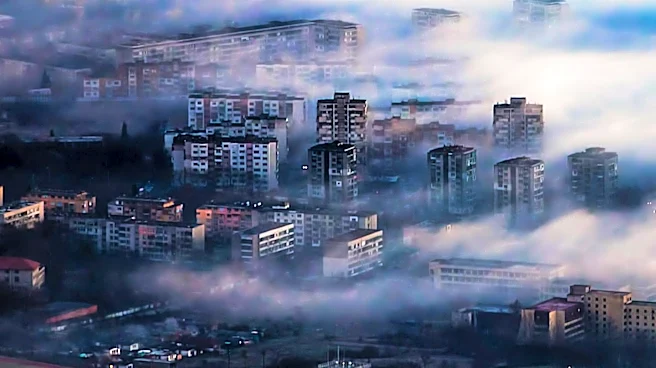






In late October 1948, the small mill town of Donora, Pennsylvania, located on the Monongahela River southeast of Pittsburgh, became the site of one of the United States' most severe air pollution disasters. What began as a typical autumn fog quickly transformed into a deadly, yellowish, acrid smog that enveloped the community for five days. This catastrophic event, later known as the Donora death fog, claimed the lives of 20 residents directly during
the incident and sickened thousands more, leaving a lasting impact on the town and serving as a stark warning about industrial pollution.
The Onset of the "Death Fog"
The fog started to build in Donora on Wednesday, October 27, 1948. By the following day, residents began experiencing severe respiratory distress, including persistent coughing. Initially, many of these illnesses and even some deaths were mistakenly attributed to asthma, masking the true nature of the unfolding crisis. The smog was a toxic mixture of industrial emissions, primarily hydrogen fluoride and sulfur dioxide, from U.S. Steel's Donora Zinc Works and its American Steel & Wire plant. These pollutants, usually dispersed into the atmosphere, were trapped close to the ground by a temperature inversion—a weather phenomenon where warmer air aloft acts as a lid, preventing colder air and pollutants near the surface from rising and scattering. This inversion allowed sulfuric acid, nitrogen dioxide, fluorine, and other poisonous gases to accumulate to lethal levels.
The thick, stagnant air created an increasingly hazardous environment. Driving became extremely dangerous, with some residents resorting to driving on the left side of the street with their heads out the window, steering by scraping the curb, just to navigate. The smog persisted relentlessly until Sunday, October 31, when rain finally arrived, breaking the inversion and clearing the air. By this point, 20 Donora residents had died, and an estimated one-third to one-half of the town's population of 14,000 had fallen ill. The tragedy continued to unfold even after the smog lifted, as another 50 residents succumbed to respiratory causes within a month of the incident.
Heroes in the Haze: Community Response
During the four-day ordeal, local heroes emerged to assist the struggling community. Chief John Volk of the Donora Fire Department and his assistant, Russell Davis, worked tirelessly, responding to calls from Friday night, October 29, until Sunday night, October 31. They rapidly depleted their own supply of 800 cubic feet of oxygen and had to borrow more from neighboring municipalities like McKeesport, Monessen, and Charleroi. Chief Volk reportedly sustained himself with small shots of whiskey upon returning to the station, foregoing oxygen for himself.
The town's eight doctors, members of the Donora Medical Association, also made continuous house calls, often visiting patients who had already been seen by other physicians due to residents desperately calling every doctor in town for faster treatment. The chaotic situation highlighted the lack of a centralized emergency response. It wasn't until midday Saturday, October 30, that Mrs. Cora Vernon, executive director of the American Red Cross, established an emergency center in the town hall, rerouting all calls to doctors' offices there. This coordination was crucial in managing the overwhelming medical crisis.
The Aftermath and Lingering Questions
The severity of the situation eventually prompted action, though perhaps belatedly. It was not until Sunday morning, October 31, that town officials met with plant operators. August Z. Chambon, Donora's burgess (mayor), formally requested that the plants temporarily cease operations. L.J. Westhaver, the superintendent of the plants, stated that shutdowns had already begun around 6:00 that morning. With the arrival of rain and the alleviation of the smog, the plants resumed normal operations the very next morning. However, the long-term health consequences for Donora's residents were significant. Even a decade after the incident, mortality rates in Donora remained notably higher than in nearby communities, underscoring the profound and lasting impact of the 1948 smog disaster. The event is now commemorated by the Donora Smog Museum, serving as a permanent reminder of the tragedy and its lessons.