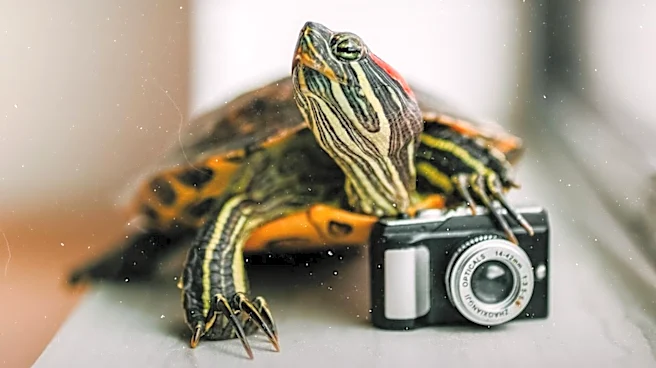









The red-eared slider, a common semi-aquatic turtle, possesses a range of fascinating adaptations that allow it to thrive in its environment. From its unique visual capabilities to its specialized breathing mechanisms and its ability to enter a state of brumation during colder months, these turtles demonstrate remarkable physiological traits. Understanding these aspects provides a deeper appreciation for how the red-eared slider navigates its world,
balancing its aquatic lifestyle with the need for temperature regulation and survival through winter.
Sensory World of the Red-Eared Slider
The red-eared slider has an exceptional visual system, boasting seven types of color-detecting cells in its eyes. This advanced color vision likely plays a crucial role in finding food, identifying mates, avoiding predators, and orienting itself within its habitat. While turtles generally use vision for these purposes, the red-eared slider's specific retinal structure suggests a highly developed ability to perceive its surroundings in detail.
Beyond sight, turtles also possess other senses. They have olfactory (smell) and vomeronasal receptors along their nasal cavity, which are used to detect chemical signals. These signals could be important for navigation or identifying other turtles. Although turtles lack external ear openings, their eardrum is covered with scales and encased by a bony otic capsule. Their hearing thresholds are higher in air compared to other reptiles, but underwater, they are more attuned to lower frequencies, suggesting an adaptation to their aquatic environment.
Brumation: Surviving the Cold
Unlike hibernation, red-eared sliders undergo a process called brumation. While they become less active during this period, they do occasionally rise to the surface for food or air. Brumation can occur to varying degrees depending on the climate. In the wild, red-eared sliders typically brumate over the winter at the bottoms of ponds or shallow lakes. They generally become inactive in October when temperatures drop below 10 °C (50 °F).
During brumation, these terrapins enter a state of sopor, characterized by a lack of eating or defecation, minimal movement, and a reduced breathing frequency. While individuals usually brumate underwater, they have also been found under banks, rocks, and in hollow stumps. In warmer winter climates, they may become active and bask on the surface, but they quickly return to a brumation state when temperatures drop again. Sliders typically emerge from brumation and begin seeking food from early March to as late as the end of April.
Aquatic Lifestyle and Respiration
Red-eared sliders are almost entirely aquatic, spending most of their time in water. However, as cold-blooded animals, they must leave the water to sunbathe, a behavior essential for regulating their body temperature. Despite their aquatic nature, all turtles, including the red-eared slider, breathe air and must surface at regular intervals to refill their lungs. The duration of their underwater immersion can vary between a minute and an hour, depending on the species and activity level.
Turtles have evolved special adaptations for respiration due to their rigid shells, which cannot expand like the rib cages of other amniotes. Their lungs are attached directly to the carapace above, and connective tissue connects them to other organs below. Ventilation is achieved through specific groups of abdominal muscles that pull and push on the organs. For instance, the large liver compresses the lungs, and when it is pulled down, inhalation begins. Conversely, the contraction of the transversus abdominis muscle expels air during exhalation. Some species can even respire through their cloaca, which contains sacs that absorb dissolved oxygen from the water, further aiding their underwater survival.