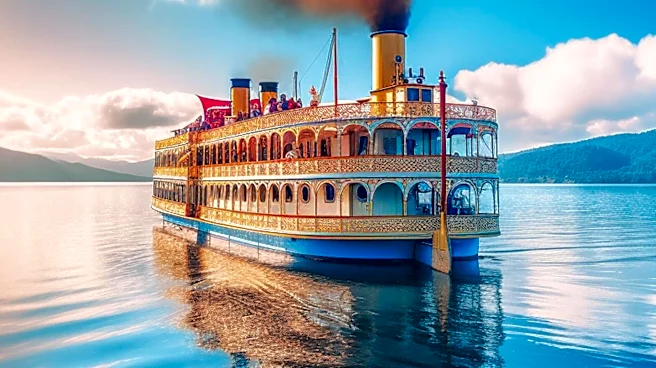




The introduction of the steamboat New Orleans to the western waters of the United States in 1811–1812 marked a pivotal moment, not just for commerce, but for the rapid evolution of maritime technology and river infrastructure. This pioneering vessel, a sidewheeler built by Nicholas Roosevelt, demonstrated the viability of steam power on the Ohio and Mississippi rivers, initiating a period of intense innovation and development that transformed the American
interior. The challenges faced by early steamboats spurred continuous improvements in design, engine efficiency, and navigation safety.
Early Challenges and Technological Responses
Before the New Orleans, river travel upstream was incredibly difficult, relying on manual labor or towlines. The New Orleans itself, while groundbreaking, operated in a challenging environment. The riverbed was fraught with natural hazards like dangerous snags, gravel, and sandbars. Furthermore, the "Falls of the Ohio" at Louisville presented a significant barrier, effectively dividing the river into two navigable sections. These obstacles highlighted the need for both technological advancements in steamboat design and improvements in river infrastructure.
The New Orleans, with its ability to achieve upstream speeds of 3 miles per hour, proved that two-way river traffic was possible. This initial success spurred further development. After the New Orleans, several steamboats were quickly constructed in Pittsburgh, including the Comet (1813), Vesuvius (1814), and Aetna. These subsequent vessels likely incorporated lessons learned from the New Orleans' operation, contributing to a rapid refinement of steamboat technology tailored for the unique conditions of western rivers.
Infrastructure Development and Safety Concerns
As steamboat traffic increased, so did the demand for safer and more efficient navigation. The initial riverbed, dotted with obstructions, gradually underwent clearing efforts. A major infrastructure project, the Louisville and Portland Canal, was eventually constructed to bypass the "Falls of the Ohio." This canal significantly eased the 981-mile passage between Pittsburgh and the junction with the Mississippi River, making the entire route more accessible for steamboats. These infrastructure improvements were crucial for supporting the growing steamboat industry.
Despite these advancements, steamboat operation remained hazardous. The average lifespan of a Western Rivers steamboat was about three years, a pattern tragically exemplified by the New Orleans itself, which sank in July 1814 after hitting a snag. The constant threat of overheated boiler explosions and wrecks from river obstructions was a significant concern. However, the economic benefits and the sheer demand for river transport outweighed these risks for many. By 1817, public skepticism about steam navigation had largely dissipated, and within two years, the number of steamboats on western waters surged from twelve to over sixty. By 1826, 143 steamboats were actively navigating the rivers, demonstrating the industry's resilience and the continuous drive for technological and infrastructural improvements.
The Enduring Legacy of Innovation
The era ushered in by the New Orleans was characterized by a continuous cycle of innovation. The rapid development included not only more efficient steam engines but also improvements in steamboat designs specifically adapted for the western rivers. This period also saw significant lock and canal construction, further integrating the river systems and expanding the reach of steamboat commerce. The initial venture of Fulton, Livingston, and Roosevelt, though marked by challenges and the eventual loss of the pioneering vessel, laid the foundation for a transportation network that profoundly shaped the economic and demographic landscape of the American West. The lessons learned from the early steamboats like the New Orleans directly contributed to the more robust and numerous fleets that followed, solidifying the steamboat's role as a primary engine of progress in the region.