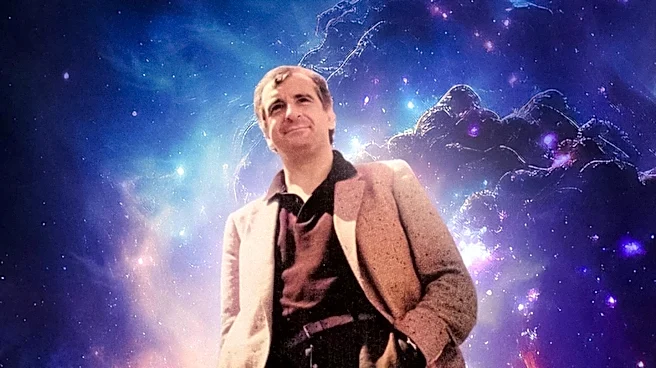






"Cosmos: A Personal Voyage" is a landmark science documentary television series that first aired in 1980. Conceived by Carl Sagan, Ann Druyan, and Steven Soter, with Sagan serving as the presenter, the series aimed to explore a vast array of scientific subjects, particularly cosmology and its intricate connection to the origin of life. Its impact was significant, not only through the television broadcast but also through its bestselling companion
book, also titled "Cosmos," and a popular soundtrack album. While the full title is "Cosmos: A Personal Voyage," the subtitle was often omitted from home video packaging for many years, only becoming more frequently used in the 2010s to distinguish it from subsequent sequel series.
The original series consisted of 13 episodes, each running approximately 60 minutes. It was a collaborative production, executive-produced by Adrian Malone, and produced by David Kennard, Geoffrey Haines-Stiles, and Gregory Andorfer. The directing duties were shared among the producers, David Oyster, Richard Wells, Tom Weidlinger, and others. The series was a United States production, originally broadcast on PBS, with its initial run spanning from September 28 to December 21, 1980. The musical landscape of the series was rich, featuring compositions by Vangelis alongside various other artists, contributing to its distinctive atmosphere.
Production and Creative Team Behind the Vision
The creative force behind "Cosmos: A Personal Voyage" was a trio of talented individuals: Carl Sagan, Ann Druyan, and Steven Soter, who together wrote the series. Carl Sagan, a renowned astronomer and science communicator, also took on the role of presenter, guiding viewers through complex scientific concepts with his characteristic enthusiasm and clarity. Adrian Malone served as the executive producer, overseeing the project's broad vision. The production team also included Gregory Andorfer and Rob McCain as producers, ensuring the series' high quality and ambitious scope.
The series was a joint effort between Carl Sagan Productions and KCET, reflecting a commitment to bringing high-quality science education to a wide audience. The meticulous direction by individuals like David Oyster, Richard Wells, and Tom Weidlinger, among others, helped translate the intricate scripts into compelling visual narratives. This collaborative approach, combining scientific expertise with skilled filmmaking, was crucial to the series' success in making complex scientific ideas accessible and engaging for the general public.
Evolution and Legacy: Special Editions and Sequels
"Cosmos: A Personal Voyage" has seen various iterations and has inspired subsequent works. A notable special edition was released in 1986, featuring new computer-animated sequences and additional filmed segments with Carl Sagan. This edition also included new narration and content derived from Sagan's book "Comet," along with discussions of his theory of nuclear winter. This specific material, however, was not incorporated into later television or home video releases of the original series. The 1986 special edition premiered as a marathon program on the TBS network and was subsequently broadcast in several other countries, including Japan, Germany, Australia, Singapore, and Argentina.
This special edition was significantly shorter than the original, totaling four and a half hours, divided into six 45-minute episodes with titles such as "Other Worlds, Part 1," "Children of the Stars, Part 2," and "Message from the Sky, Part 1." The music for the 1986 version was a blend of tracks from the original series and a unique soundtrack composed by Vangelis specifically for this edition. This new score is often referred to as "Comet," with the track "Comet 16" being prominently used during the opening and closing credits of each episode. While only "Comet 16" has been officially released from this special score, some of the new music did appear in the 2000 remastered DVD release. The enduring legacy of "Cosmos: A Personal Voyage" is further cemented by its sequel series, "Cosmos: A Spacetime Odyssey" in 2014 and "Cosmos: Possible Worlds" in 2020, demonstrating its lasting influence on science communication.