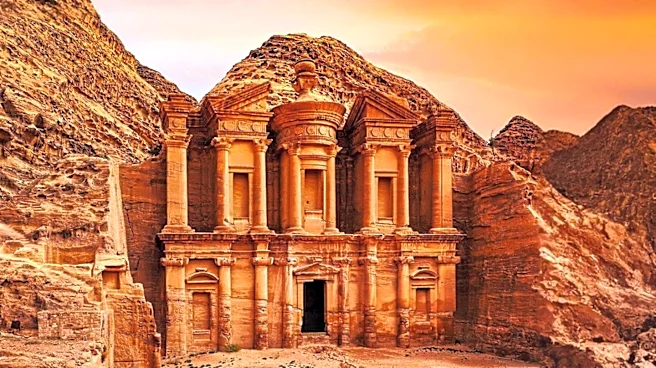








Petra, a city carved into the rose-red cliffs of southern Jordan, represents a remarkable journey through millennia of human history. From its earliest settlements around 9,000 BC to its current status as a UNESCO World Heritage Site and a global tourist magnet, Petra has continuously evolved, bearing witness to various civilizations and their legacies. Once the thriving capital of the Nabataean Kingdom, its architectural marvels and sophisticated
water systems allowed it to flourish in an arid landscape. Today, Petra stands not only as a symbol of Jordan but also as a testament to the enduring power of human ingenuity and cultural heritage, attracting nearly a million visitors each year.
A Deep History: From Neolithic to Iron Age
The story of Petra begins long before the Nabataeans made it their capital. The area around Petra shows evidence of habitation as early as 7000 BC, with early farming communities establishing themselves in Beidha, just north of the future city. This Neolithic presence indicates the region's long-standing appeal for human settlement, likely due to its unique geological features that could support life.
During the Bronze Age, Petra's significance began to emerge on a broader stage, appearing in Egyptian campaign accounts and the Amarna letters under various names such as Pel, Sela, or Seir. This suggests its recognition as an important location in the ancient Near East. Later, the Iron Age, spanning from 1200 to 600 BC, saw the Edomites occupy the Petra area. The natural mountain configuration provided a crucial water reservoir, transforming Petra into a vital stopping point for merchants trading goods like wines, olive oil, and wood. This early period laid the groundwork for Petra's future as a major commercial hub.
The Nabataean Golden Age and Roman Annexation
The true flourishing of Petra began with the arrival of the Nabataeans, a nomadic Arab people, in the 4th century BC. They eventually established Petra as the capital of their kingdom in the second century BC. The Nabataeans strategically leveraged Petra's location near the lucrative incense trade routes, developing it into a major regional trading center. Their mastery of hydraulic technology, including efficient rainwater collection and desert farming techniques, allowed them to thrive in an otherwise inhospitable environment. This period saw Petra's population peak at an estimated 20,000 inhabitants, and iconic structures like Al-Khazneh, possibly the mausoleum of King Aretas IV, were constructed.
However, Petra's independence was eventually challenged. In 106 AD, the Nabataean Kingdom fell to the Romans, who annexed the territory and renamed it Arabia Petraea. While Roman rule brought some changes, Petra's importance gradually declined as sea trade routes emerged, shifting commercial focus away from its overland networks. A significant blow came in 363 AD when a major earthquake destroyed many structures and damaged the city's vital hydraulic system, further contributing to its decline.
Decline, Rediscovery, and Modern Recognition
Following the Roman period, Petra entered an era of gradual decline. During the Byzantine era, several Christian churches were built, indicating a continued, albeit diminished, presence. However, by the early Islamic era, the city was largely abandoned, with only a handful of nomads remaining. For centuries, Petra remained unknown to the Western world, its magnificent ruins hidden from global view.
The city's rediscovery in 1812 by Swiss traveler Johann Ludwig Burckhardt marked a turning point, reintroducing Petra to the world. This event sparked renewed interest in its history and architecture. In recognition of its immense cultural and historical value, Petra was designated a UNESCO World Heritage Site in 1985. This designation acknowledged Petra as "one of the most precious cultural properties of man's cultural heritage." Its global prominence was further cemented in 2007 when it was named one of the New 7 Wonders of the World in a popular poll.
Today, Petra is Jordan's most-visited tourist attraction, drawing over a million visitors in 2019. The Petra Archaeological Park (PAP), established as an autonomous legal entity in 2007, manages the site, ensuring its preservation and accessibility. The city's unique blend of Mesopotamian, Hellenistic, and South Arabian architectural influences, evident in its rock-cut tombs and temples like the Great Temple, continues to captivate and inspire, solidifying Petra's place as an enduring legacy of ancient civilization and a modern wonder.