



Jain meditation, known as dhyana, encompasses a variety of reflective and meditative practices that have evolved significantly over centuries. While Jainism views yoga and dhyana as essential, its meditative tradition was initially more focused on stilling mental and physical activity rather than transforming it. Early Jain teachings often positioned meditation as an adjunct to austerity, a role that persisted until the early medieval period when
it began to gain more theoretical interest. The history of Jaina yoga and meditation can be broadly categorized into five stages, starting from the pre-canonical era before the 6th century BCE, through the canonical and post-canonical ages, the age of tantra and rituals, and finally, the modern age from the 20th century onward.
Early Roots and Mahavira's Practice
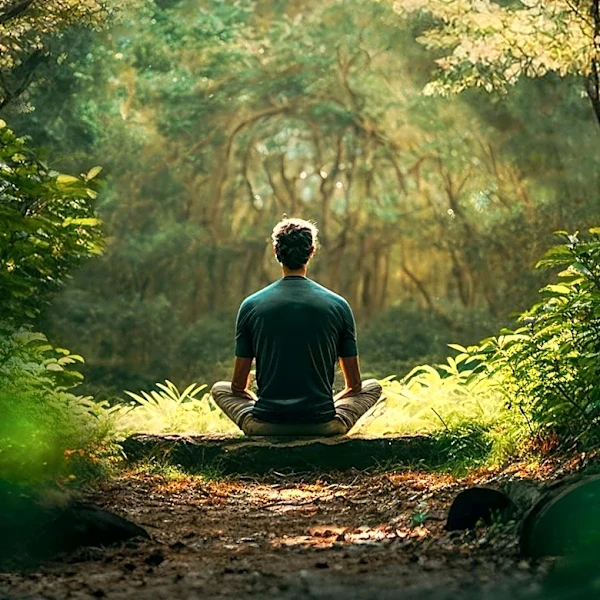
The earliest descriptions of Jain yoga and meditation are found in ancient texts like the Acaranga Sutra, dating back to 300 BCE. This text vividly portrays the solitary ascetic meditation of Mahavira, a central figure in Jainism. It mentions specific techniques such as Trataka, which involves fixed gaze meditation. The Acaranga Sutra also introduces the phrase "kayam vosajjamanagare," meaning "an ascetic who has given up the body," which is believed to be an early reference to Kayotsarga. Kayotsarga, or "giving up the body," is a fundamental Jain meditative practice where one stands motionless, symbolizing the death of the body and aiming for tranquility and purity of mind. This practice is often compared to the dharana, dhyana, and samadhi limbs of Patanjali's eight-limb yoga.
Mahavira's meditation is described as a state of perseverance in a posture without the slightest motion, with mental concentration on things above, below, and beside, free from desires, sin, and attachment to sounds or colors. The Acaranga Sutra recounts that after more than twelve years of austerities and meditation, Mahavira achieved Kevala Jnana, a state of omniscience, while performing "abstract meditation" in a squatting position. This intense meditation, often accompanied by fasting, was seen as an activity leading to motionlessness, an inactivity of body, speech, and mind, crucial for eliminating karma.
Canonical Developments and the Four Dhyanas
During the canonical age, from the 5th century BCE to the 5th century CE, Jain philosophy was systematized, and the Jain canon was recorded. This period saw strong parallels between Jaina yoga and Patanjali Yoga, including concepts similar to yamas and niyamas, though sometimes under different names. The Sthananga Sutra, from around the 2nd century BCE, provides a summary of four main types of dhyana, or concentrated thought. These are Arta-Dhyana, Raudra-Dhyana, Dharma-Dhyana, and Sukla-Dhyana.
Arta-Dhyana is described as a mental state of suffering, agony, and anguish, often triggered by thoughts of desired objects or painful ailments. Raudra-Dhyana is associated with cruelty, aggression, and possessive urges. These first two types are considered mental or psychological states that can lead to bondage. In contrast, Dharma-Dhyana, or "virtuous" meditation, focuses on the destruction of karma, while Sukla-Dhyana, or "pure" meditation, is divided into four stages: Separatory contemplation, Unitary contemplation, Subtle infallible physical activity, and Irreversible stillness of the soul. However, it is believed that the first two stages of Sukla-Dhyana require knowledge of lost Jain scriptures, making them inaccessible to many, and the latter two are said to be only attainable by Kevalins, or enlightened beings. This broad definition of dhyana in early texts signifies any deep concentration, with either positive or negative outcomes.
Post-Canonical and Modern Adaptations
Later texts, such as Umaswati's Tattvarthasutra and Jinabhadra's Dhyana-Sataka (sixth century), further discuss these four dhyanas, solidifying this uniquely Jain system. However, the Tattvartha Sutra also states that pure meditation (sukla-dhyana) is unattainable in the current time-cycle, a problem that the Jain tradition addressed through the concept of Mahavideha, a non-earthly realm where such knowledge is preserved. The post-canonical age, from the 6th to the 12th century CE, saw further assimilation of elements from other Indian traditions. The 8th-century Jain philosopher Haribhadra, for instance, integrated many aspects of Patanjali's Yoga-sutra into his own Jain yoga system.
The 20th century marked the development of new modernist forms of Jain dhyana. One notable example is Samikshana-dhyana, developed by Sthanakavasi Acarya Nanalala in 1981. This practice aims for the experience of higher consciousness within the self and liberation in this life. Samikshana-dhyana is categorized into introspection of passions and samata-samikshana, which includes introspection of the senses, vows, karma, and the Self. Another significant development was Preksha-dhyana, from the Svetambara Terapanth-sect, which sought to rediscover Jain meditation. These modern approaches highlight a continued effort within Jainism to adapt and re-emphasize meditative practices for contemporary practitioners, moving beyond the initial focus on austerity to a more direct engagement with self-realization and liberation.