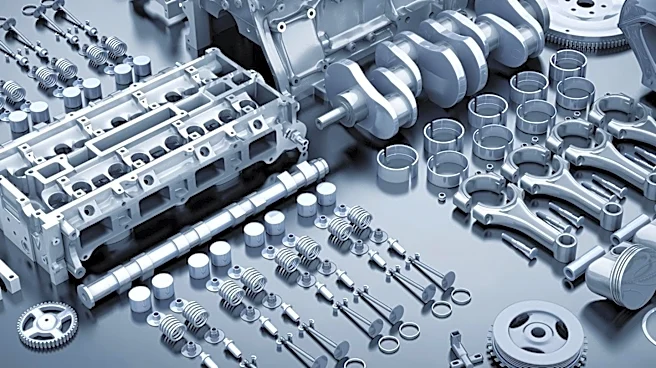








The internal combustion engine, a marvel of engineering, has seen numerous innovations over its history, with the valvetrain mechanism being a critical area of development. Among these advancements, the overhead camshaft (OHC) engine stands out as a significant leap forward, fundamentally altering how an engine's valves are operated. Unlike earlier designs, OHC engines position the camshaft at the top of the engine, directly above the combustion chamber,
leading to a more efficient and performance-oriented design that became increasingly common throughout the 20th century. This design principle laid the groundwork for modern automotive powerplants, offering distinct advantages in performance and flexibility.
Moving Beyond Traditional Valvetrains
Historically, internal combustion engines often employed cam-in-block layouts, such as flathead or overhead valve (OHV) configurations. In these designs, the camshaft was situated lower in the engine block. Flathead engines, for instance, had valves located within the block, with the camshaft acting directly upon them. Overhead valve engines, a later development, used a cam follower to press on a pushrod, which then transferred motion to the top of the engine to open the intake and exhaust valves via rocker arms. While these designs were functional, they introduced complexities and limitations. The pushrods in OHV engines, for example, added reciprocating components and increased valvetrain inertia, which could hinder performance at higher engine speeds.
The advent of the overhead camshaft design directly addressed these limitations. By moving the camshaft to the cylinder head, above the combustion chamber, OHC engines largely eliminated the need for long pushrods. Instead, the camshaft could actuate the valves either directly, using a tappet, or indirectly through a short rocker arm. This direct or near-direct actuation significantly reduced the number of moving parts and the overall inertia of the valvetrain. The result was a system less prone to valve float at high engine speeds, allowing for greater RPM capabilities and, consequently, higher power output.
Advantages and Considerations of OHC Design
The benefits of overhead camshaft engines extend beyond just reduced valvetrain inertia. One major advantage is the increased flexibility in optimizing the size, location, and shape of the intake and exhaust ports. Without pushrods to navigate around, engineers have more freedom to design ports that facilitate better gas flow through the engine. This improved gas flow directly translates to enhanced power output and better fuel efficiency, making OHC engines a preferred choice for performance and economy. The ability to fine-tune these elements allows for more precise control over the engine's breathing, which is crucial for maximizing combustion efficiency.
However, the OHC design also comes with its own set of considerations. The system used to drive the camshaft, typically a timing chain or a toothed timing belt in modern engines, is generally more complex than the drive systems in OHV engines. This complexity can sometimes lead to more intricate maintenance procedures. For instance, during engine repairs that require the removal of the cylinder head, the camshaft engine timing often needs to be reset, adding a step to the repair process. Furthermore, OHC engines tend to have larger cylinder heads to accommodate the camshafts and potentially extra sets of valves, which can make them physically larger, especially in width, compared to OHV engines of the same displacement.
Single vs. Dual Overhead Camshaft Configurations
Within the realm of overhead camshaft engines, two primary configurations exist: single overhead camshaft (SOHC) and dual overhead camshaft (DOHC). A SOHC engine features one camshaft per bank of cylinders. This means that a straight engine, with a single line of cylinders, will have one camshaft in total. A V-engine or flat engine, which has two banks of cylinders, will typically have two camshafts, one for each bank. Most SOHC engines commonly employ two valves per cylinder—one intake and one exhaust valve—though some designs may incorporate three or four valves per cylinder. The camshaft's motion is transferred to the valves either directly via a tappet or indirectly using a rocker arm. SOHC engines gained widespread popularity from the 1960s through the 1990s, offering a balance of performance and relative simplicity compared to DOHC.
Dual overhead camshaft (DOHC) engines, also known as "twin-cam" engines, take the concept a step further by having two camshafts per bank of cylinders. This configuration allows for a camshaft to be seated directly above each row of offset valves, typically with intake valves positioned inboard and exhaust valves outboard. DOHC designs provide optimal crossflow positioning of valves, which is particularly beneficial for higher-RPM operation. While DOHC engines are generally larger in size, especially in width, and may have higher production costs due to more components, their ability to enhance performance and efficiency has led to their widespread adoption in automobile engines since the 1990s. The first production car to use a DOHC engine was built in 1910, and their use gradually increased after World War II, becoming a dominant design by the early 2000s.