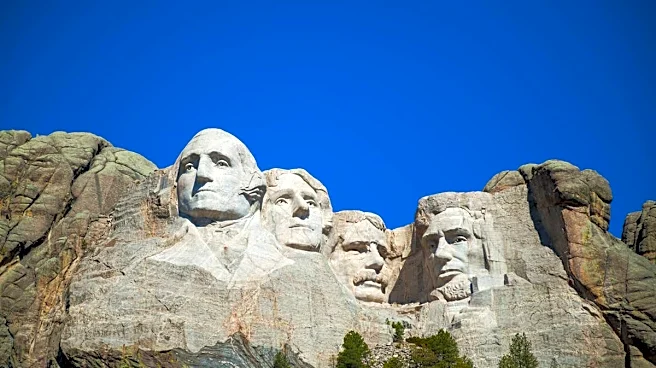

The creation of Mount Rushmore National Memorial was an extraordinary feat of engineering and human endeavor, transforming a natural granite peak in South Dakota's Black Hills into one of the world's most recognizable monuments. From 1927 to 1941, sculptor Gutzon Borglum and a dedicated team of 400 workers faced immense challenges, employing innovative techniques to carve the 60-foot-tall faces of four U.S. presidents into the mountain. This monumental
undertaking required precision, resilience, and a remarkable commitment to safety, resulting in a colossal sculpture that continues to awe millions of visitors each year.
The Scale and Scope of the Project
The sheer scale of Mount Rushmore is difficult to overstate. Each of the four presidential faces—George Washington, Thomas Jefferson, Theodore Roosevelt, and Abraham Lincoln—measures approximately 60 feet (18 meters) in height. The entire Mount Rushmore National Memorial, which encompasses the sculpture, covers an area of 5.17 square kilometers and reaches an altitude of 5,725 feet (1,745 meters) above sea level at its highest point. This massive project was initiated with the goal of commemorating 150 years of United States history, a narrative literally etched into the landscape.
The initial phase of the project involved selecting the ideal site. After rejecting the more friable granite of the Needles formations, Borglum chose Mount Rushmore for its stable rock composition, impressive height, and optimal sun exposure. Once the site was secured, the arduous process of carving began on October 4, 1927. The work continued for 14 years, concluding on October 31, 1941, a testament to the sustained effort required to bring such a grand vision to life.
Techniques and Workforce
The primary method for removing large sections of granite involved the use of dynamite. This powerful explosive was carefully employed to blast away significant portions of rock, shaping the mountain face into the rough outlines of the presidential portraits. Following the initial blasting, workers used pneumatic drills, hammers, and chisels to refine the features, adding the intricate details that define each president's likeness. The precision required for such work, especially at heights, was immense.
A workforce of 400 individuals, often referred to as "carvers," labored on the mountain. These skilled workers operated in challenging conditions, suspended by cables and harnesses hundreds of feet above the ground. Their dedication was critical to the project's success. Remarkably, despite the dangerous nature of the work, which involved explosives and working at extreme heights, no worker fatalities occurred during the entire construction period. This safety record is particularly noteworthy for an undertaking of this magnitude and era.
Overcoming Challenges and Infrastructure Support
The construction was not without its difficulties. One notable challenge arose during the carving of Thomas Jefferson's face. Borglum's first attempt, positioned to the right of George Washington, encountered a significant defect in the granite. This flaw necessitated the complete removal of the initial carving, which was blasted away in 1934. A second, successful portrait of Jefferson was then carved to the left of Washington, demonstrating the adaptability and problem-solving required on such a large-scale project.
Support for the project extended beyond the immediate carving team. In 1933, the National Park Service assumed jurisdiction over the memorial, playing a crucial role in improving the site's infrastructure. This included enhancing a railway system to make the mountain's summit more accessible for workers and materials, thereby streamlining the construction process. The sculptor's studio, built in 1939 under Borglum's direction, served as a vital operational center, housing plaster molds and tools that guided the carvers in their work. These infrastructural improvements and the ability to adapt to unforeseen geological issues were essential in allowing the colossal sculpture to take its final form.