








Bread pudding, a dish typically made from bread, eggs, and milk or cream, has a rich and varied history that spans across continents. While often associated with British cuisine, where it is traditionally a sweet dish made with buttered bread and an egg custard, its fundamental concept has been adapted and embraced by diverse cultures worldwide. This global appeal has led to a fascinating array of regional variations, each reflecting local ingredients
and culinary traditions, transforming the simple bread pudding into a truly international comfort food.
European Roots and British Traditions
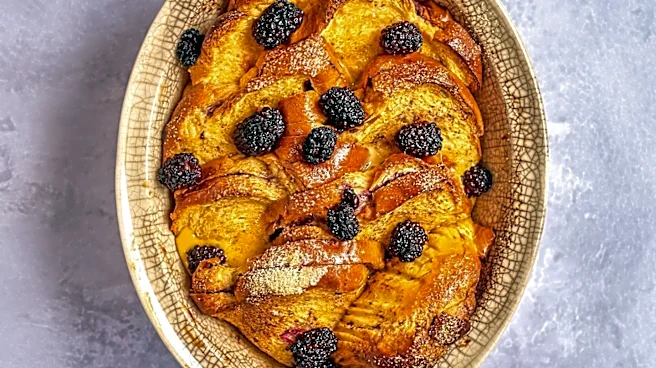
In British cuisine, bread and butter pudding is a classic sweet dish. It involves layering slices of buttered bread, often scattered with raisins, in an oven dish. This is then covered with an egg custard mixture, which can be seasoned with nutmeg, vanilla, cinnamon, or other spices, before being baked. After baking, it may be served with additional custard or cream. Some modern variations include spreading jam, marmalade, or other sweet preserves on the bread, or incorporating fresh grapes between the layers. Unusual breads like brioche can also be used, though stale bread is a common choice.The history of this British staple dates back to earlier forms known as "whitepot," which could use either bone marrow or butter. Interestingly, whitepots could also be made with rice, leading to the development of rice pudding in British cuisine. One of the earliest published recipes for a bread and butter pudding appeared in Eliza Smith's "The Compleat Housewife" in 1728. Her recipe detailed using a two-penny loaf, fresh butter, raisins, currants, and a cream-based custard thickened with egg yolks, nutmeg, salt, sugar, and orange flower-water, poured over a puff-paste base.
American Adaptations and Unique Names
Across the Atlantic, American cuisine features its own take on bread pudding, sometimes referred to as "Cold Bread Pudding." In the United States, particularly in Louisiana, bread puddings are typically sweet and served as a dessert, often accompanied by a sweet sauce such as whiskey, rum, or caramel sauce. This highlights a common thread of sweet indulgence in many Western variations of the dish.Beyond the general American context, other countries in the Americas have developed their distinct versions. In Brazil, it's known as "pudim de pão." This version involves blending bread, eggs, milk, condensed milk, butter, vanilla extract, and optionally cinnamon, then baking it in a bundt-like mold lined with caramelized sugar syrup in a water bath. The result is a creamy, dense flan-like dessert. Panama calls its bread pudding "mamallena," while in Aruba, it's known as "pan bolo." Cuban "pudín de pan" is often served with guava marmalade, and in Chile, it can be called "colegial" or "budín de pan." Mexico's "budín" typically uses bolillo leftovers and often includes raisins and pecans.
Asian and Middle Eastern Interpretations
Bread pudding also finds a place in Asian and Middle Eastern culinary traditions, showcasing further adaptations. In the Philippines, stale unsold bread is commonly used by bakeries to create the characteristically bright-red filling for "pan de regla." This filling, a bread pudding itself, is made from torn stale bread mixed with milk, eggs, sugar, vanilla extract, and red food dye, then cooked into a paste and used in a folded dough.Southeast Asian regions like Malaysia, Singapore, and Indonesia feature bread pudding in local dessert shops, often incorporating ingredients tailored to regional tastes. These can include coconut milk, pandan leaves, palm sugar, and tropical fruits, adding unique flavors to the traditional base. In Turkey, "ekmek kadayıfı" is a bread pudding served with kaymak or ice cream, garnished with ground pistachio or shredded coconut. The Levant offers "Aish as-Saraya," a popular bread pudding flavored with rose water, demonstrating the wide-ranging appeal and adaptability of this humble dish.