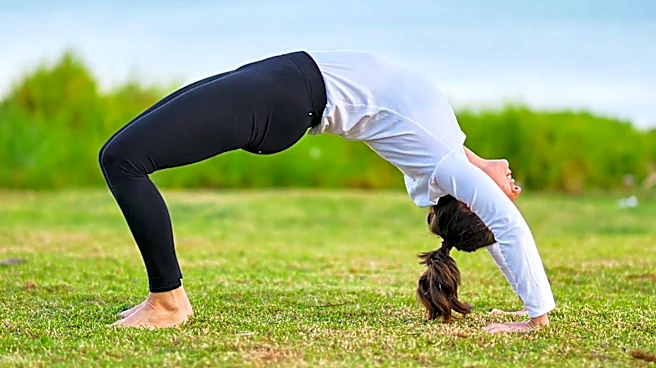




Chakrasana, also known as Urdhva Dhanurasana or the Upward-Facing Bow Pose, is a prominent backbending asana in yoga as exercise. This pose, whose name translates to "Wheel Pose" from Sanskrit, involves the practitioner supporting themselves on their hands and feet, with the abdomen arched upwards towards the sky. It is a foundational backbend that can be approached in various ways, from entering it from a supine position to more advanced transitions,
and it is often a key component in developing flexibility and strength for other complex yoga postures.
The historical roots of Chakrasana can be traced back to the 19th century, where it was illustrated in the Sritattvanidhi. Interestingly, in this historical text, it was depicted as Paryaṅkāsana, or Couch Pose, indicating a long-standing presence of similar backbending forms within yoga traditions. The dual naming of the pose, Chakrasana (Wheel Pose) and Urdhva Dhanurasana (Upward-Facing Bow Pose), highlights its visual resemblance to both a wheel and an upward-facing archer's bow, reflecting the deep connection between Sanskrit terminology and the physical form of the asanas.
Entering and Exiting the Wheel Pose
Practitioners can enter Chakrasana from a supine position, lying on their back. Another common method involves transitioning from a less rigorous supine backbend, such as Setu Bandha Sarvangasana, commonly known as Bridge Pose. For those with more advanced practice, the pose can be entered by "dropping back" from Tadasana, or Mountain Pose, which requires significant flexibility and control. Alternatively, advanced practitioners might stand with their back to a wall, reach their arms overhead, and walk their hands down the wall towards the floor to enter the pose.
Exiting the Wheel Pose also offers various options. Advanced practitioners may follow Chakrasana with one of its many variations or transition into other backbends, such as Dwi Pada Viparita Dandasana. Another advanced exit involves pushing back up to stand in Tadasana, demonstrating a seamless flow between postures. The ability to move gracefully and safely into and out of Chakrasana is a hallmark of a developed yoga practice.
Preparatory and Counter Poses
To prepare the body for Chakrasana, several backbending poses are recommended. These preparatory asanas help to warm up and increase flexibility in the spine and shoulders, making the Wheel Pose more accessible and safer to perform. Examples of such preparatory poses include Salabhasana (Locust Pose), various forms of Bhujangasana (Cobra Pose and Sphinx Pose), and Dhanurasana (Bow Pose). These poses gradually open the front of the body and strengthen the back muscles, which are crucial for a stable and deep Wheel Pose.
After performing intense backbends like Chakrasana, it is important to practice counter poses to neutralize the spine and bring the body back to a balanced state. Forward bends are typically used as counter poses. Paschimottanasana (Seated Forward Bend) and Balasana (Child's Pose) are commonly recommended counter poses after Chakrasana. These poses help to gently stretch the back of the body and calm the nervous system, providing a soothing release after the invigorating backbend.
Variations and Assistance in Practice
Chakrasana has several variations, including a one-legged variant, which is sometimes chosen by yoga practitioners to showcase their skill. For those who find the full pose challenging due to tight shoulders or hips, various supports can be utilized. Yoga bricks, for instance, can be placed against a wall under the hands or feet to provide stability and reduce strain. A mat can be spread over the bricks to prevent slipping, ensuring a secure foundation. Angled blocks may also offer more comfort for the hands by reducing wrist strain, or bricks can be propped up on a wall's skirting board.
In a classroom setting, an assistant can provide support by standing near the practitioner's head. The practitioner can then hold the assistant's ankles, while the assistant holds the practitioner's shoulders, offering a safe way to explore the pose. Practicing against a wall is another effective method: standing a pace away from the wall, facing away from it, with feet hip-width apart, the practitioner can bend their knees, reach their arms up and back to the wall, and lean their head back. If comfortable, they can walk their hands further down the wall and straighten their arms and knees, gradually deepening the backbend.