
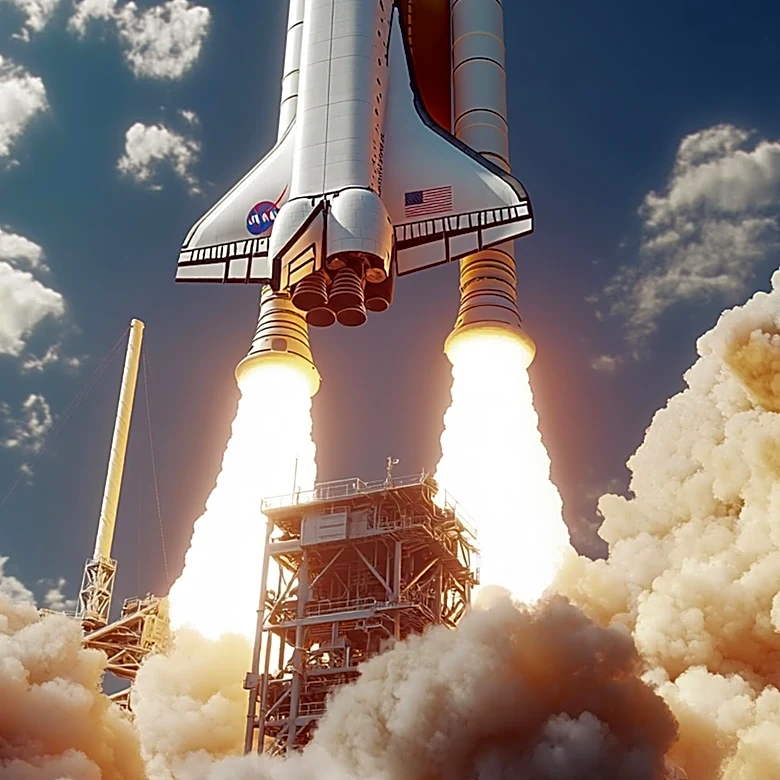







Space Shuttle Atlantis, designated Orbiter Vehicle OV-104, stands as a significant artifact in the history of U.S. space exploration. Manufactured by Rockwell International, it was the fourth operational and second-to-last Space Shuttle built. Delivered to the Kennedy Space Center in April 1985, Atlantis embarked on its maiden flight, STS-51-J, from October 3 to 7, 1985. Over its operational life, Atlantis completed 33 missions, culminating in STS-135,
the final mission of the entire Space Shuttle program, which launched on July 8, 2011, and landed on July 21, 2011. This orbiter played a crucial role in various scientific and strategic endeavors, leaving behind a remarkable legacy before its retirement and display at the Kennedy Space Center Visitor Complex.
Early Flights and Interplanetary Deployments
Atlantis's initial missions quickly established its capabilities. Its maiden voyage, STS-51-J, was a dedicated Department of Defense mission. Following this, it flew STS-61-B in November 1985, marking the second shuttle night launch and achieving the shortest turnaround time between missions for any Space Shuttle, launching just 50 days after its previous flight. This early period demonstrated Atlantis's efficiency and readiness for diverse operations. Notably, Atlantis was one of only two orbiters, along with Challenger, equipped to carry the Shuttle-Centaur booster, enhancing its payload capabilities.
After the Challenger disaster temporarily grounded the fleet in 1986, Atlantis returned to service, undertaking ten flights between 1988 and 1992. During this time, it made history by deploying two significant planetary probes in 1989. On STS-30, Atlantis launched the Magellan probe to Venus, and on STS-34, it deployed the Galileo probe to Jupiter. With STS-30, Atlantis became the first Space Shuttle to launch an interplanetary probe, a testament to its advanced capabilities and the ambition of the space program.
Challenges and International Cooperation
Not all missions were without incident. During the launch of STS-27 in 1988, a piece of insulation from the right solid rocket booster struck Atlantis's underside, severely damaging over 700 tiles and completely removing one. Despite the crew's survey revealing substantial tile damage, mission control, due to the classified nature of the mission and poor image quality, deemed the damage "lights and shadows" and instructed the crew to proceed. Upon landing, Atlantis was the most damaged shuttle to successfully return, with the crew's survival attributed to a steel L-band antenna plate positioned directly under the missing tile. This incident highlighted critical vulnerabilities in the shuttle's thermal protection system, a lesson tragically underscored by the Columbia disaster years later.
Atlantis also played a pivotal role in international space cooperation. Beginning in 1995 with STS-71, it made seven consecutive flights to the Russian space station Mir as part of the Shuttle–Mir program. STS-71 was particularly historic, marking the 100th U.S. crewed space flight, the first U.S. Shuttle-Russian Space Station Mir docking, and the first on-orbit change-out of a shuttle crew. When docked, Atlantis and Mir together formed the largest spacecraft in orbit at the time, symbolizing a new era of collaboration in space. In 1991, during STS-37, Atlantis successfully deployed the Compton Gamma Ray Observatory, further contributing to scientific research.
The Final Chapter and Retirement
By the end of its operational life, Atlantis had orbited the Earth a total of 4,848 times, traveling nearly 126,000,000 miles (203,000,000 km). This distance is more than 525 times the distance from the Earth to the Moon, showcasing the immense scope of its travels. The decision to fly STS-135 as the final Space Shuttle mission, with Atlantis as the orbiter, was made in September 2010. This mission took advantage of the processing for the STS-335 Launch on Need mission, which would have been necessary if STS-134's crew became stranded in orbit. The final flight launched on July 8, 2011, and Atlantis landed for the last time at the Kennedy Space Center on July 21, 2011.
After its final mission, Atlantis underwent processing to make it safe for public display. This involved removing most components of its Orbital Maneuvering System (OMS) and Reaction Control System (RCS) due to the toxic hypergolic propellants they used, preventing dangerous outgassing. Today, Space Shuttle Atlantis is a centerpiece exhibit at the Kennedy Space Center Visitor Complex in Florida, allowing visitors to witness a tangible piece of space history and reflect on its extensive contributions to human spaceflight.