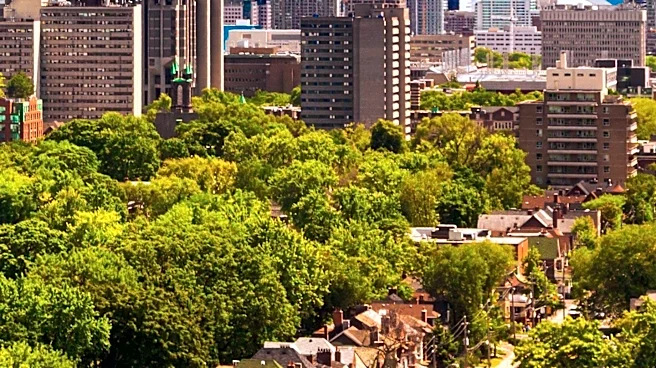






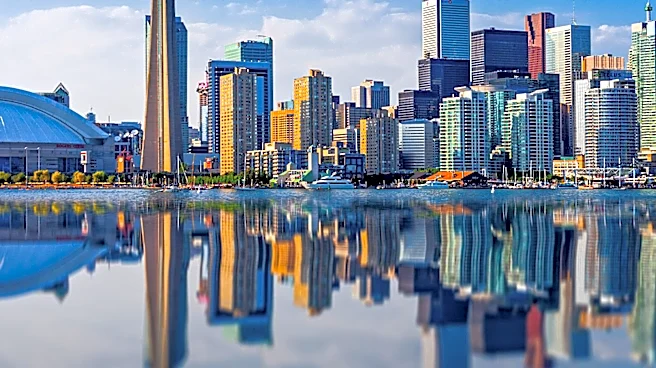
Toronto, the capital city of Ontario, Canada, boasts a rich history that traces its origins from Indigenous lands to its current status as a bustling metropolis. The city's name itself, derived from the Mohawk word "tkaronto," meaning "tree in the water there," points to its deep historical connection to the land and its original inhabitants. This journey through time reveals significant shifts in governance, population, and economic focus, shaping
Toronto into the diverse urban center it is today.
Early Settlements and Colonial Influence
The area now known as Toronto was initially inhabited by Indigenous peoples. French traders established Fort Rouillé in 1750, though they abandoned it in 1759 during the Seven Years' War. Following the British victory in the war, the region became part of the British colony of Quebec in 1763. A pivotal moment in the area's colonial history was the Toronto Purchase in 1787, when British Lord Dorchester arranged with the Mississaugas of the New Credit First Nation to secure over a quarter of a million acres of land. Dorchester intended for this location to be named Toronto, laying the groundwork for future British settlement.
During the American Revolutionary War, an influx of British settlers, known as United Empire Loyalists, arrived in the British-controlled lands north of Lake Ontario. The Crown granted them land to compensate for their losses in the Thirteen Colonies. This period saw the creation of the new province of Upper Canada, which required a capital. The early years after the Toronto Purchase were relatively quiet, marked by occasional independent fur traders.
War, Incorporation, and Growth in the 19th Century
The War of 1812 brought conflict to the nascent settlement. In 1813, the Battle of York resulted in the town's capture and plunder by United States forces. During their five-day occupation, American soldiers destroyed much of the garrison and set fire to the parliament buildings. John Strachan negotiated the town's surrender. This sacking of York later prompted British troops to retaliate with the burning of Washington, D.C.
York was officially incorporated as the "City of Toronto" on March 6, 1834, adopting its Indigenous name. William Lyon Mackenzie, a reformist politician, became Toronto's first mayor. Mackenzie would later lead the unsuccessful Upper Canada Rebellion of 1837 against the British colonial government. By 1834, Toronto's population of 9,000 included African-American slaves, some brought by Loyalists, and Black Loyalists who had been freed by the Crown. Refugee slaves from America's South also immigrated to Toronto seeking freedom. Slavery was banned throughout the British Empire, including Upper Canada, in 1834, and Torontonians integrated people of color into their society, as evidenced by a black man named Bloxom operating an eating house in the mercantile center of the city in the 1840s.
Toronto experienced rapid growth in the latter half of the 19th century, becoming a major destination for immigrants to Canada. The Great Irish Famine led to a significant wave of Irish immigrants, mostly Catholic, making the Irish-born population the largest single ethnic group by 1851. Smaller numbers of Protestant Irish immigrants, some from what is now Northern Ireland, also arrived, contributing to the significant and long-lasting influence of the Orange Order in Toronto society. This influence was so profound that almost every mayor of Toronto between 1850 and 1950 was a member of the Orange Order, leading to the city sometimes being called the "Belfast of Canada."
Capital Status, Infrastructure, and Industrial Development
For brief periods, Toronto served as the capital of the united Province of Canada twice: from 1849 to 1851, following unrest in Montreal, and again from 1855 to 1859. After 1859, Quebec was designated as the capital until 1865, two years before Canadian Confederation. Since then, Ottawa, Ontario, has remained the capital of Canada. Toronto became the capital of the province of Ontario upon its official creation in 1867. The seat of government briefly returned to the building that had served as the Third Parliament Building of Upper Canada before moving to the Ontario Legislative Building at Queen's Park in 1893. As a provincial capital, Toronto also housed Government House, the residence of the viceregal representative of the Crown in right of Ontario.
Infrastructure development was crucial to Toronto's expansion. In the 19th century, the city built an extensive sewage system and illuminated its streets with gas lighting. Long-distance railway lines were constructed, including a route completed in 1854 linking Toronto with the Upper Great Lakes. The Grand Trunk Railway and the Northern Railway of Canada collaborated on the first Union Station downtown. The advent of the railway, along with Lake Ontario steamers and schooners, dramatically increased immigration, commerce, and industry, establishing Toronto as a major gateway connecting the world to the North American interior. Expanding port and rail facilities facilitated the export of northern timber and the import of Pennsylvania coal, leading to industry dominating the waterfront for a century. During the late 19th century, Toronto became North America's largest alcohol distillation center, with the Gooderham and Worts distillery becoming the country's largest whisky factory. Though the factory has closed, its buildings are now a National Historic Site known as the Distillery District.
Horse-drawn streetcars were replaced by electric streetcars in 1891, operated by the Toronto Railway Company. The public transit system transitioned to public ownership in 1921 as the Toronto Transportation Commission, later renamed the Toronto Transit Commission, which now boasts the third-highest ridership of any city public transportation system in North America.
Challenges and Continued Growth into the 20th Century
The Great Toronto Fire of 1904 devastated a large section of downtown Toronto, destroying over 100 buildings and causing CA$10,387,000 in damage. The fire claimed one victim, John Croft, an explosive expert clearing the ruins. Despite this setback, the city continued to attract new European immigrant groups from the late 19th into the early 20th century, including Germans, French, Italians, and Jews, followed by Russians, Poles, other Eastern Europeans, and Chinese immigrants. Many of these migrants initially lived in overcrowded shanty-type slums, such as "the Ward," centered on Bay Street, which is now the heart of Canada's Financial District. As these new migrants prospered, they moved to better housing, illustrating a pattern of settlement succession.
Despite its rapid growth, Toronto's population and economic importance remained second to Montreal, Quebec, until the 1920s. However, by 1934, the Toronto Stock Exchange had become the largest in the country, signaling a shift in economic prominence. This continuous evolution, marked by periods of growth, challenge, and diversification, has cemented Toronto's place as a significant urban center in Canada and North America.