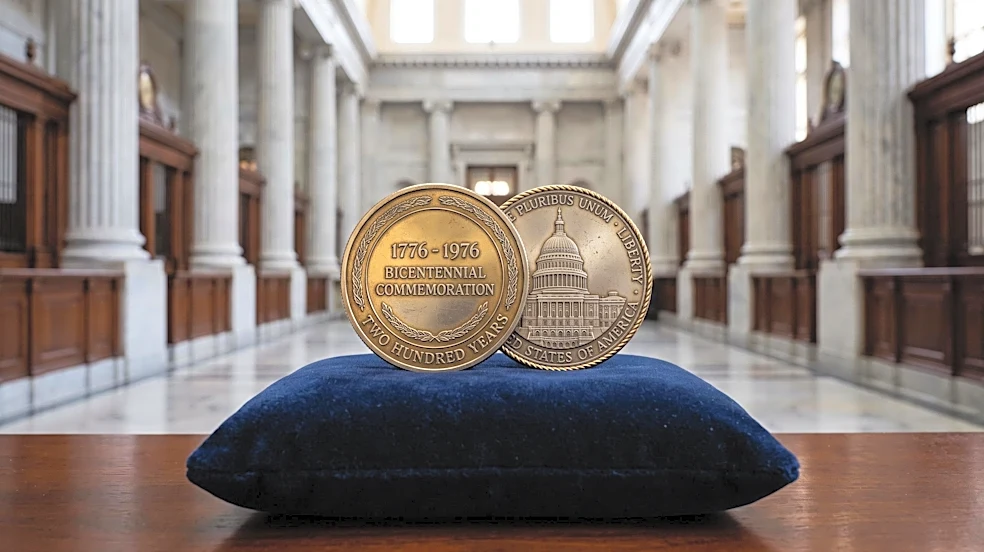







The United States Bicentennial coinage, issued to commemorate the nation's 200th anniversary in 1976, underwent a complex journey from initial opposition to eventual presidential approval. The concept of commemorative coins had a troubled past, leading the U.S. Mint to advocate against their issuance for decades. However, as the Bicentennial approached, a growing desire to mark this significant national milestone led to a shift in policy and a collaborative
effort between Congress and the Treasury Department to create a unique set of circulating coins.
Early Resistance and Shifting Stances
Since 1892, the United States Mint had produced commemorative coins for various events and anniversaries. However, the system had been plagued by abuses, particularly with the final issues of half dollars honoring Booker T. Washington and George Washington Carver, which were struck over many years and often sold at a discount, with many entering general circulation. The promoter of these issues, S.J. Phillips, mishandled their distribution, resulting in a significant financial loss and negative publicity. This history led the Department of the Treasury, which oversees the Mint, to oppose subsequent commemorative coin proposals, a stance that held until the 1970s.
Despite this long-standing opposition, the idea of Bicentennial coins began to gain traction. In 1966, Congress established the American Revolutionary Bicentennial Commission (ARBC) to coordinate activities for the 1976 Bicentennial. By February 1970, the ARBC formed a Coins and Medals Advisory Committee, which initially recommended a commemorative half dollar. By December 1970, this committee expanded its recommendation to include special designs for all denominations of U.S. coinage for the Bicentennial, a position endorsed by the ARBC the following month. The Treasury, however, maintained its opposition.
Legislative Efforts and Mint Director's Influence
Throughout 1971 and 1972, several proposals for Bicentennial coins were introduced in Congress but failed to pass. Mint Director Mary Brooks, who had attended the Advisory Committee meetings, initially expressed reservations. She supported the idea of a 1776–1976 double date on circulating coins to mark the anniversary, despite the production difficulties it would entail. However, she publicly called the idea of changing all six circulating coins (from the cent to the dollar) "a disaster." Brooks initially believed that any Bicentennial coin should be non-circulating, perhaps a half cent or a gold piece, to avoid disrupting the Mint's production of coins for circulation.
By late 1972, Brooks's position began to evolve. She successfully persuaded Treasury Secretary George Shultz to support a Bicentennial coin bill. This shift was crucial, as the Treasury's support was essential for any legislative success. In January 1973, Representative Richard C. White of Texas introduced legislation for commemorative dollars and half dollars, while Senator Mark Hatfield of Oregon proposed a $25 gold piece. On March 2, 1973, the Treasury officially announced its support for Bicentennial coin legislation, specifically for design changes to the reverses of the circulating dollars and half dollars, and submitted proposed legislation to Congress three days later.
Congressional Hearings and Final Authorization
Hearings on the proposed legislation were held in the House of Representatives on May 2, 1973. Director Brooks testified, advocating for the limited redesign outlined in the bill but opposing more extensive changes. She also used the opportunity to request authority to strike U.S. coins at the West Point Bullion Depository, citing available space for older coinage presses. Brooks also expressed concerns about Hatfield's gold coin proposal, suggesting it would need to be of lower purity to prevent hoarding.
Following these hearings, additional bills were introduced, leading to further hearings before a Senate subcommittee on June 6. Brooks testified again, and in response to criticism that only the two least popular denominations were being considered for change, she indicated her support for a Bicentennial quarter as well. On June 13, a bill, S. 1141, was favorably reported by the Senate Banking Committee. This bill provided for a circulating Bicentennial quarter, half dollar, and dollar, granted permission for coins to be struck at West Point, and authorized 40% silver clad versions of the new coins for collectors. The Senate passed this bill on July 13, though it included amendments allowing U.S. citizens to own gold and to implement the Hatfield proposal.
A similar bill passed the House of Representatives on September 12, differing from the Senate version by lacking any gold provisions and not authorizing silver versions of the new coins. A conference committee met on September 19 to reconcile the two bills. The session was described as "fairly hot and heavy." The resulting compromise bill excluded the gold provisions but authorized changes to the reverses of the quarter, half dollar, and dollar for the Bicentennial. The obverses of these three coins would remain unchanged but would bear the double date 1776–1976. The statute stipulated that all coins minted and issued between July 4, 1975, and January 1, 1977, would feature these Bicentennial dates and designs. Congress also directed the Mint to strike 45,000,000 silver clad coins (15,000,000 sets) and granted the Mint the requested authority to strike coins at West Point. The silver clad coins would have an outer layer of 80% silver and 20% copper bonded to an inner layer of 21% silver and 79% copper, while circulation coins would continue to be copper-nickel clad. The modified bill passed both houses of Congress on October 4, 1973, and was signed into law by President Richard Nixon on October 18. This legislative journey ultimately paved the way for the iconic Bicentennial coinage that would soon enter circulation.