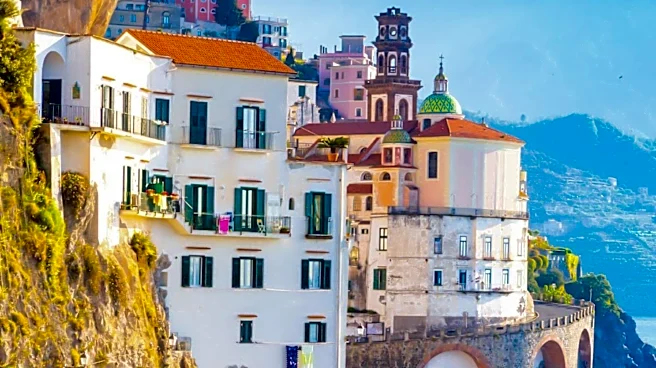









Amalfi, a town nestled in Italy's Campania region on the Gulf of Salerno, boasts a rich and complex history as a significant maritime republic. From its origins as an independent entity in the 7th century, Amalfi grew to become a formidable trading power in the Mediterranean, rivaling cities like Pisa and Genoa. Its strategic location at the mouth of a deep ravine, surrounded by dramatic cliffs, contributed to its unique development and eventual decline,
leaving behind a legacy that influenced European mercantile capitalism and maritime law.
Early Maritime Power and Trade Networks
Amalfi's journey to prominence began with its role as a maritime power, engaging in extensive trade across the Mediterranean. Early on, Amalfi traders facilitated the exchange of grain from neighboring regions, salt from Sardinia, and even slaves from the interior. These goods were traded for gold dinars minted in Egypt and Syria, which were then used to acquire Byzantine silks for resale in the West. This intricate network highlights Amalfi's crucial position in connecting diverse economies.
Amalfi's traders enjoyed privileged access in Islamic ports, a testament to their established commercial relationships. The city's influence extended to maritime law, with the "Amalfi tables" (Tavole amalfitane) providing a widely adopted code for Christian port cities. The use of gold coins by Amalfi merchants to purchase land as early as the 9th century, at a time when much of Italy still relied on a barter economy, underscores their advanced economic practices. This period also saw a revival of long-distance trade between Amalfi, Gaeta, and Byzantium, further benefiting from flourishing trade networks with Arab regions. Karl Marx even acknowledged Amalfi's role in the very beginnings of European mercantile capitalism.
Peak of Independence and Influence
Amalfi maintained its independence as a republic from the 7th century until 1073, successfully extracting itself from Byzantine vassalage in 839. The city first elected a duke in 958, marking a significant step in its self-governance. During its peak, particularly around the turn of the millennium under the reign of Duke Manso (966–1004), Amalfi's population reached an impressive 70,000 to 80,000 inhabitants. This period saw Amalfi rivaling other major Italian maritime powers in both domestic prosperity and maritime importance.
Under the line of dukes, Amalfi largely remained independent, with only a brief period of dependency under Salernitan rule. Beyond its economic and political achievements, Amalfi was also renowned in medieval culture for its flourishing schools of law and mathematics. Flavio Gioia, traditionally credited with introducing the mariner's compass to Europe, is said to have been a native of Amalfi, further cementing the city's reputation for innovation and intellectual advancement.
Decline and Lasting Legacy
The republic's independence came to an end in 1073 when it fell to the Norman countship of Apulia, though it was initially granted many rights. As the Normans established their presence in southern Italy, Amalfi became one of their principal strongholds. However, its fortunes continued to wane, and in 1131, it was reduced by Roger II of Sicily after he was refused access to its citadel. Further devastation occurred in 1133 when the Holy Roman Emperor Lothair, supported by forty-six Pisan ships, took Roger prisoner. The Pisans, commercial rivals of Amalfi, sacked the city, claiming a copy of the Pandects of Justinian as part of their spoils.
Amalfi was again taken by the Pisans in 1135 and 1137, leading to a rapid decline in its importance. Despite this, the Amalfian Laws continued to be recognized across the Mediterranean until 1570. A catastrophic tsunami in 1343 destroyed the port and the lower town, a blow from which Amalfi never fully recovered, reducing it to a place of only local significance. Despite its decline, Amalfi's historical impact on trade, law, and navigation remains a significant chapter in European history.