






Rio de Janeiro, a name synonymous with vibrant culture and stunning landscapes, boasts a rich and complex history that has shaped its identity as both a city and a state within Brazil. Its journey began with European discovery in the early 16th century and progressed through various administrative transformations, ultimately leading to its current status as a major Brazilian and South American center. Understanding this evolution requires tracing
its path from a colonial outpost to a federal capital, and finally, to the bustling metropolis it is today, while also examining the shifting definitions of its inhabitants.
Early European Encounters and Naming
The story of Rio de Janeiro begins on January 1, 1502, when Portuguese explorers Gaspar de Lemos and Gonçalo Coelho first arrived at Guanabara Bay. This initial encounter led to the bay being named, though with some historical debate. According to some historians, the exploration team originally called it "Ria de Janeiro," meaning "January Ria." However, a confusion between the Portuguese words "ria" (an inlet or estuary) and "rio" (river) led to the name being fixed as Rio de Janeiro, or "January River." This early naming convention laid the groundwork for the region's future identity.
Shifting Administrative Status and Demonyms
Over centuries, the administrative status of Rio de Janeiro underwent significant changes, directly influencing the official and unofficial terms used to describe its residents. While "carioca" is an older term, first attested in 1502, it was "fluminense," derived from the Latin "flumen" meaning "river," that was officially sanctioned in 1783. This occurred twenty years after the city had become the capital of the Brazilian colonies, establishing "fluminense" as the official demonym for the Royal Captaincy of Rio de Janeiro and later the Province of Rio de Janeiro. During the Imperial Regime, "carioca" remained an unofficial term, often used by other Brazilians to refer to inhabitants of both the city and the province.
From Federal District to State Capital
The 20th century brought further transformations to Rio de Janeiro's political and demographic landscape. When the city lost its status as the Federal District to Brasília in 1960, it became the State of Guanabara. At this point, "carioca" finally gained official recognition as a demonym, alongside "guanabarino." This marked a significant shift, as "carioca" had previously been associated with those living in the city's slums or used pejoratively for the bureaucratic elite of the Federal District. The final major change occurred in 1975 when Guanabara State was incorporated into Rio de Janeiro State, leading to the present-day City of Rio de Janeiro. With this incorporation, "carioca" became the official demonym specifically for the city's inhabitants, while "fluminense" continued to be used for the state as a whole. This distinction highlights the enduring legacy of its historical administrative changes.
Rio de Janeiro: A Center of Brazil
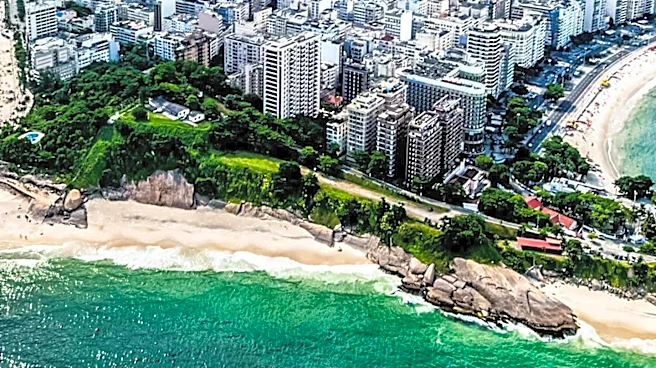
Beyond its historical administrative shifts, Rio de Janeiro has consistently held a prominent position in Brazil. As the capital and most populous city of the state of Rio de Janeiro, it was also the capital city of Brazil until 1960. The metropolitan area, known as Greater Rio de Janeiro, is recognized as a historical, cultural, and economic center of the country. This metropolitan area is the second largest in Brazil and the third largest in South America, encompassing 22 municipalities and a total population of 12 million inhabitants. The city itself has a population of 7,456,682 and covers an area of 1,221 square kilometers. Its enduring significance is further underscored by its cultural riches, including Carnival, samba, bossa nova, famous beaches like Copacabana and Ipanema, and the iconic Christ the Redeemer statue, all of which contribute to its global recognition.