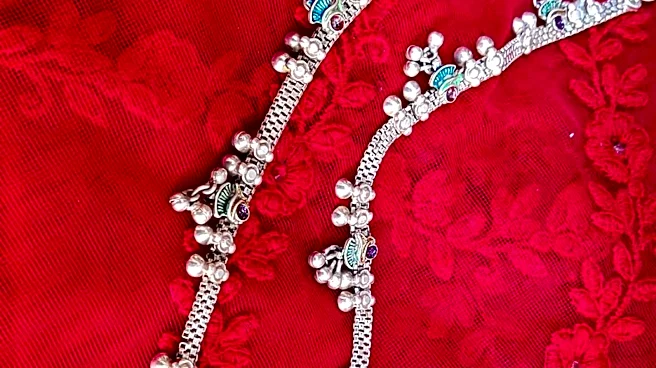







Anklets, also known as ankle chains, ankle bracelets, or ankle strings, are ornaments worn around the ankle that boast a rich and diverse history spanning thousands of years. Far from being a mere fashion accessory, these pieces of jewelry have held significant cultural, social, and even practical meanings across various civilizations. From their early appearance in predynastic Egypt to their role in traditional Indian weddings and their resurgence
in Western fashion, anklets offer a fascinating glimpse into human adornment and cultural practices throughout history.
Ancient Origins in Egypt and the Indus Valley
The history of anklets stretches back to ancient times, with evidence of their use found in both the Indus Valley and ancient Egypt. In the Indus Valley, located in the Indian subcontinent, barefoot anklets and toe rings have been worn by girls and women for at least over 8,000 years. Here, they are commonly known by names such as pattilu, payal, golusu, and sometimes nupur, indicating their deep roots in the region's cultural heritage. These early forms of adornment suggest a long-standing tradition of decorating the feet and ankles.
Similarly, anklets were an everyday ornament for Egyptian women of all social classes from as early as predynastic times. The Egyptian name for anklets, menefret (mnfrt), was closely related to that of bracelets, distinguished only by an added phrase indicating their connection to the feet. This suggests that while the location of wear differed, the cultural significance or perception of these ornaments might have been similar to those worn on the wrists. The materials used varied according to social standing, with wealthier individuals favoring more expensive metals like gold, while silver and iron were more common among lower social classes. During the fourth, fifth, and sixth dynasties, Egyptian anklets were often crafted from beads threaded in multiple rows, held together by spacer-bars, showcasing early craftsmanship and design.
European Bronze Age and Classical Antiquity
The use of anklets was not confined to Eastern cultures; evidence of their presence in Europe dates back to the Bronze Age. Bronze anklets have been discovered in temperate Europe, particularly in areas along the Danube, in the Alpine foreland, up the Rhine to the Atlantic, and down the Rhône. These findings are often part of hoards containing other bronze items characteristic of the period, starting around 1800 BCE, and are attributed to the Tumulus culture that spread across this region. This indicates that the practice of wearing anklets was a widespread phenomenon, not limited to specific geographical or cultural pockets.
In ancient Greece and Rome, women also wore anklets, known as periscelis (Ancient Greek: περισκελίς). Social distinctions were evident in the materials used, much like in ancient Egypt. Plebeian women, who belonged to the common class, typically wore anklets made of silver, while patricians, members of the aristocratic class, adorned themselves with gold anklets. This practice highlights how jewelry, including anklets, served as a visible marker of social status and wealth in classical societies. The continuity of this practice across different ancient civilizations underscores the universal appeal and symbolic power of anklets.
Anklets in Indian Culture and Modern Trends
In Eastern cultures, particularly India, anklets continue to hold significant cultural importance. They are worn on either or both ankles and are an essential piece of jewelry in Indian marriages, often worn alongside saris. The eastern Indian state of Odisha, known for its traditional jewelry, features varieties of anklets such as Paunji Nupur. Another elaborate variety, known as "padapadma," covers the entire foot. Traditionally, gold anklets were reserved for Kshatriya (royal/warrior caste) persons, while other castes wore silver anklets, further illustrating the social stratification reflected in jewelry choices. The words "payal" (payalak) and "jhanjar" are common terms for anklets in Hindi and Punjabi, respectively, while in Bengali, they are called "nupur" and are widely worn in the Bengal region, including the eastern Indian state of West Bengal and Bangladesh.
In the United States, both casual and more formal anklets gained popularity from the 1930s to the late 20th century. While younger men and women might wear casual leather anklets, formal anklets made of silver, gold, or beads are primarily used by women as fashion jewelry. Occasionally, anklets on both ankles are joined by a chain to limit the step, a practice once prevalent in Southeast Asia to create a "feminine" short tripping step. Today, a few Western women adopt this practice, though rarely in public. More rarely still, some individuals wear "permanent" (e.g., soldered) ankle chains and even connecting chains, showcasing the diverse and evolving ways in which anklets are incorporated into personal style and cultural expression.
Decline and Resurgence in Egypt
While anklets were once a common sight in early 20th-century Egypt, particularly among women in inner cities, their public display has seen a decline. Known as kholkhal (plural: khalakheel), they were most commonly worn by women of Alexandria, often paired with a traditional dress covered by a one-piece black cloth called melaya leff. However, due to increased Islamic conservatism that has spread in Egypt, wearing anklets in public is now generally perceived as immodest. Consequently, they are not as commonly worn by Egyptian women in public today. Despite this, anklets are still frequently worn by dancers at public events, preserving a connection to their historical and artistic roots. This shift highlights how cultural and religious changes can influence fashion and the public display of traditional ornaments.