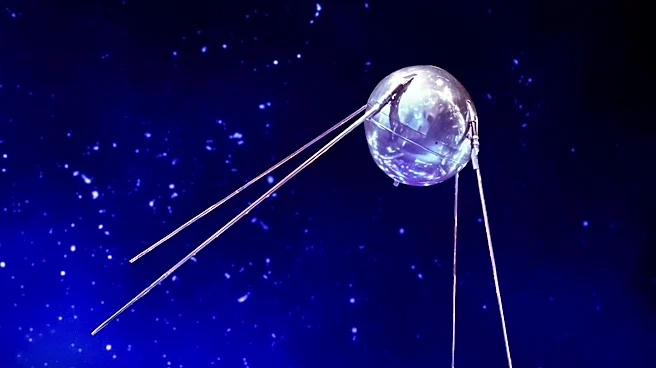




On October 4, 1957, the Soviet Union launched Sputnik 1, the first artificial Earth satellite, into an elliptical low Earth orbit. This event, originating from Site No.1/5 at the 5th Tyuratam range in Kazakh SSR (now the Baikonur Cosmodrome), marked a pivotal moment in human history. Sputnik 1, a simple spherical metal object with a diameter of 58 cm and equipped with a radio transmitter, orbited Earth for three months, completing 1,440 orbits before
re-entering the atmosphere and burning up on January 4, 1958. Its launch not only initiated the Space Race but also triggered what became known as the American Sputnik crisis, fundamentally altering the course of political, military, technological, and scientific developments worldwide.
The Genesis of a New Era
The concept of an orbital satellite was seen as an inevitable progression in rocket technology, a view emphasized by Tikhonravov. Initially, a more ambitious satellite, *Object D*, was planned for completion in 1957–58. This satellite was designed to be significantly larger, with a mass of 1,000 to 1,400 kg and carrying 200 to 300 kg of scientific instruments. The data collected by *Object D* would have been crucial for the development of future artificial satellites, necessitating a system of ground stations for data collection, orbit observation, and command transmission. However, concerns arose within the Soviet Union that the United States might launch its own satellite first.
This apprehension led OKB-1 to propose the creation and launch of a simpler satellite in April–May 1957, ahead of the International Geophysical Year (IGY) which began in July 1957. The R-7 rocket, initially developed for military purposes, was deemed suitable for satellite launches. Korolev successfully convinced the State Commission to allow the use of the next R-7 rocket to launch PS-1 (Sputnik 1) and PS-2, even if it meant delaying the rocket's military deployment. This strategic decision underscored the Soviet Union's determination to be the first in space, setting the stage for the historic launch.
Design and Mission Parameters
Sputnik 1 was designed with simplicity and reliability in mind, characteristics that could be adapted for future projects. Its spherical body was chosen to help determine atmospheric density based on its orbital lifetime, while its radio equipment facilitated tracking and provided data on radio wave propagation through the atmosphere. The satellite also served to verify its pressurization scheme. The chief constructor of Sputnik 1 at OKB-1 was Mikhail S. Khomyakov.
The satellite itself was a 585-millimeter (23.0 in) diameter sphere, constructed from two hemispheres hermetically sealed with O-rings and secured by 36 bolts. It weighed 83.6 kilograms (184 lb). The hemispheres were 2 mm thick and covered with a highly polished 1 mm-thick heat shield made of an aluminum–magnesium–titanium alloy, AMG6T. Two pairs of whip-like antennas, designed by Mikhail V. Krayushkin's Antenna Laboratory of OKB-1, extended from the sphere, measuring 2.4 and 2.9 meters (7.9 and 9.5 ft) in length, providing an almost spherical radiation pattern for its signals.
The Sputnik Crisis and Its Aftermath
The launch of Sputnik 1 had profound implications, particularly in the United States. It precipitated the "Sputnik crisis," a period of intense public concern and self-reflection regarding American scientific and technological superiority. This crisis spurred America into action, accelerating the Space Race. It directly led to the creation of the Advanced Research Projects Agency (later DARPA) and NASA, established through the National Aeronautics and Space Act. Furthermore, the U.S. government significantly increased spending on scientific research and education through the National Defense Education Act. The event also fostered a new emphasis on science and technology in American schools. A University of Michigan poll conducted after the launch revealed that 26% of Americans surveyed believed Russian sciences and engineering were superior to that of the United States. Harrison Storms, a key figure in American aerospace design, was inspired by Sputnik's launch to view space as the next frontier for America, influencing his work on projects like the X-15 rocket plane and the Apollo command and service module. The launch of Sputnik also laid the groundwork for the development of modern satellite navigation, demonstrating the potential for orbital objects to serve practical applications on Earth.
Operational Details and Scientific Contributions
Sputnik 1's power supply, weighing 51 kg, was shaped like an octagonal nut with the radio transmitter housed within its core. It comprised three silver-zinc batteries, developed under Nikolai S. Lidorenko. Two batteries powered the radio transmitter, while one managed the temperature regulation system. These batteries, with an expected two-week lifespan, operated for 22 days. The power supply activated automatically upon the satellite's separation from the rocket's second stage. The satellite contained a one-watt, 3.5 kg radio transmitting unit, developed by Vyacheslav I. Lappo, which operated on two frequencies: 20.005 and 40.002 MHz. Signals on the first frequency were transmitted in 0.3-second pulses, interspersed with pulses on the second frequency. Analysis of these radio signals provided valuable data on the ionosphere's electron density, while temperature and pressure conditions inside the satellite were encoded in the duration of the radio beeps. A temperature regulation system, including a fan and thermal switches, maintained internal conditions, activating the fan if the temperature exceeded 36 °C (97 °F) and deactivating it below 20 °C (68 °F). Extreme temperature deviations (above 50 °C or below 0 °C) would alter the radio signal pulse duration. Sputnik 1 was filled with dry nitrogen, pressurized to 1.3 atm (130 kPa), and a barometric switch would have indicated a pressure vessel failure or meteor puncture by changing the radio signal impulse duration. During launch, Sputnik 1 was protected by an 80 cm (31.5 in) cone-shaped payload fairing, which separated simultaneously with the satellite's ejection from the R-7 second stage. Tests of the satellite were conducted under Oleg G. Ivanovsky's leadership at OKB-1.