





Supermoto, also known as Supermotard or Motard, stands out as a distinctive form of motorcycle racing that ingeniously combines elements from various motorcycling disciplines. Conceived in 1979, this sport brings together the hard-packed dirt of flat track racing, the challenging jumps and obstacles of motocross, and the smooth paved tarmac of road racing. This unique blend creates a demanding environment where rider skill and adaptability are paramount,
making Supermoto a thrilling spectacle for both participants and fans.
Genesis of a Hybrid Sport
The concept of Supermoto was originally envisioned by Gavin Trippe in 1979 as a segment for the popular television show, "Wide World of Sports." Trippe's idea was to create an "all-star game" for motorcycle racing, where top riders from the three distinct genres—flat track, motocross, and road racing—could temporarily set aside their usual competitive classes. The goal was to bring these diverse talents together to compete for the ultimate title of the best all-around racer, testing their versatility across different terrains.
Over time, Supermoto evolved beyond this initial "all-star game" concept to become a distinct genre of its own. While it originated as a crossover event, today, riders typically specialize in Supermoto, and it's less common for competitors from other classes to routinely cross over. This evolution highlights the sport's unique demands and the specialized skills required to excel in its hybrid format.
The Unique Supermoto Racecourse
A defining characteristic of Supermoto is its specialized racecourse, which is designed to challenge riders with a mix of surfaces. These courses are commonly set up on existing road racing tracks or medium-sized go-kart tracks, with a crucial addition: an off-road section integrated into the infield. The typical layout features a significant portion of tarmac, usually ranging from 50% to 75% of the course, with the remaining percentage dedicated to off-road elements.
The dirt sections are typically constructed from packed clay and incorporate obstacles familiar to motocross, such as bermed corners and various jumps. For instance, in the AMA Supermoto Championship, racecourses were designed with approximately 80% pavement and 20% dirt, including jumps, whoop sections, and a flat-track-style turn. These courses typically spanned between 0.6 and 1.1 miles in length. Specialized tabletop and kicker "Urbancross" jumps were designed, fabricated, and built on-site by ASD, a subsidiary of All-Access Staging and Productions, adding an extra motocross dimension to the paved portions of the tracks. This type of racing is also remarkably portable, allowing an entire track to be constructed wherever there is a large area of open asphalt and available dirt, even successfully holding races in busy urban centers by utilizing closed city streets and vacant lots for the dirt sections.
Specialized Machines and Rider Skill
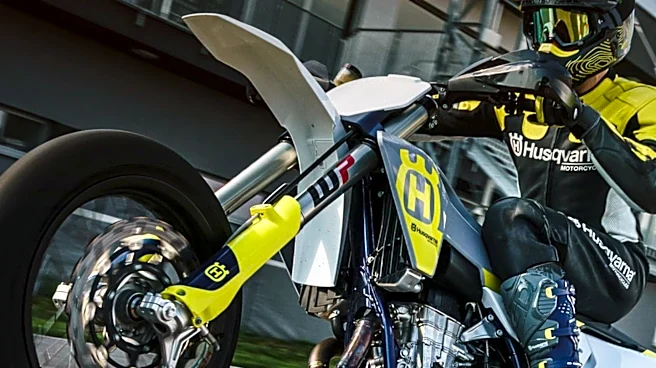
The motorcycles used in Supermoto are as unique as the sport itself, frequently being custom-created combinations of off-road motorcycles fitted with road-racing wheels and tires. These specialized bikes are often referred to as 'supermotard' machines. Riders also adopt a hybrid approach to their gear, typically wearing road racing leathers for protection on the tarmac sections, combined with motocross helmets and boots for the dirt elements and jumps.
Unlike traditional motorcycle racing where high speeds and flat-out acceleration are often emphasized, Supermoto places its focus on slower speeds, typically less than 100 mph or 160 km/h, on short, technical tracks. In this environment, rider skill can more easily overcome disparities in machine performance. The bikes are further adapted with features like oversize front brake rotors and calipers to improve braking power. Hand guards are frequently added to Supermoto bikes, despite the absence of trees on the courses, due to the extreme cornering angles achieved by riders. These hand guards also significantly improve the survivability of the brake and clutch levers during a fall, making Supermoto bikes highly crash-resistant and often allowing riders to quickly re-enter the race after a crash.