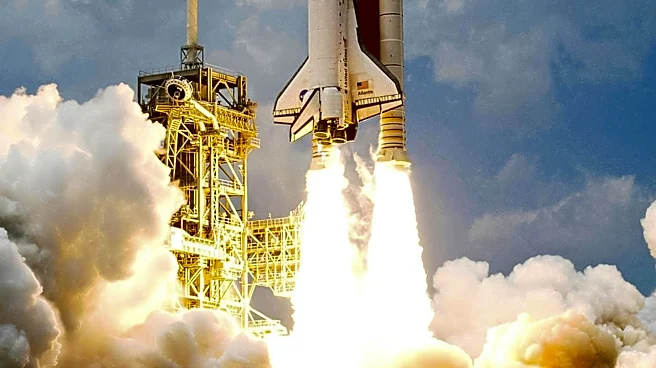



The STS-9 mission was not only a technological milestone but also a testament to human endeavor and international cooperation in space. Launched on November 28, 1983, this mission featured a groundbreaking six-person crew, the largest ever assembled for a human space mission at that time. This diverse crew included the first non-American astronaut to fly on a Space Shuttle, marking a significant step towards broader international participation in space exploration.
The mission's success was deeply intertwined with the dedication and collaboration of its crew members, who worked tirelessly to achieve its ambitious scientific objectives.
A Crew of Firsts and Veterans
The STS-9 crew was a remarkable assembly of experienced astronauts and pioneering specialists. Commander John W. Young, on his sixth and final spaceflight, was a legendary figure, having flown twice each in Project Gemini, Apollo, and the Space Shuttle, including two journeys to the Moon. He was also the first person to command the same space vehicle, Columbia, into orbit more than once. The mission marked the only time two pre-Shuttle era astronaut veterans, Young and Owen K. Garriott, flew together on a Space Shuttle mission, and it was the first Space Shuttle mission to include more than one veteran astronaut. The crew also included Brewster H. Shaw as pilot, and Robert A. Parker as a mission specialist. Crucially, STS-9 introduced the first two non-NASA astronauts to fly on the Space Shuttle: Ulf Merbold, a citizen of West Germany and the first foreign citizen to participate in a Space Shuttle flight, and Byron K. Lichtenberg, a researcher from the Massachusetts Institute of Technology (MIT). These payload specialists represented a new era of scientific involvement in spaceflight.
Life and Work Aboard Spacelab 1
The mission was entirely devoted to Spacelab 1, a joint program between NASA and the European Space Agency (ESA), designed to demonstrate the ability to conduct advanced scientific research in space. To maximize productivity, the six-member crew was divided into two teams: the Red Team (Young, Parker, and Merbold) and the Blue Team (Shaw, Garriott, and Lichtenberg). Each team worked 12-hour shifts for the duration of the mission. While Young and Shaw typically managed the flight deck, the mission and payload specialists worked inside the Spacelab module. Over the ten-day mission, which was extended due to its success, 72 scientific experiments were carried out across various disciplines. This collaborative effort extended beyond the orbiter, with the crew coordinating closely with scientists at the Marshall Space Flight Center (MSFC) Payload Operations Control Center (POCC) on the ground. The success of Spacelab 1 proved the feasibility of integrating non-NASA personnel, trained as payload specialists, into complex space missions.
Pioneering Communications and Lasting Impact
Beyond the scientific experiments, the human element of STS-9 also extended to pioneering new forms of communication from space. During the flight, Owen Garriott made the first ham radio transmissions by an amateur radio operator in space. This innovative use of amateur radio paved the way for its inclusion in many subsequent space flights, serving as both an educational tool and a backup communication method. The presence of Ulf Merbold as the first non-American astronaut on a Space Shuttle mission underscored the growing international nature of space exploration, fostering collaboration that would become increasingly vital in future endeavors. The human achievements and cooperative spirit of STS-9 laid important groundwork for the future of space science and international partnerships.