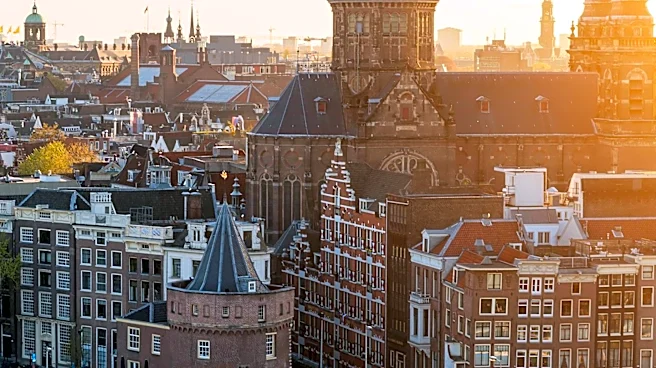









Amsterdam, the official capital of the Netherlands, boasts a rich and complex history that has shaped it into a globally recognized city. Its very name, a combination of "dam" (meaning barrage in Dutch) and "Amstel" (the river flowing through it), points to its origins. From a modest settlement founded on a dam in the 13th century, Amsterdam evolved through periods of significant trade, religious shifts, and industrial revolution, ultimately becoming
a major financial and cultural center. This journey involved overcoming challenges like wars and economic downturns, demonstrating the city's resilience and adaptability.
Early Foundations and Medieval Flourishing
The earliest documented mention of Amsterdam dates back to October 27, 1275, in a document issued by Count Floris V of Holland and Zeeland. While the exact date Amsterdam received city rights remains uncertain, it is most likely that Guy de Avesnes, the Bishop of Utrecht, granted these rights in 1306. This early period saw the city's strategic location at the mouth of the Amstel River, which had become an open connection to the Zuiderzee and other waterways after the All Saint's Flood of 1170, proving crucial for its development.
From the 14th century onward, Amsterdam began to flourish, largely due to its trade relationships with cities in the Hanseatic League. The city also established an independent trade route with the Baltic Sea for grain and timber, effectively bypassing the Hanseatic League as middlemen. This made Amsterdam Europe's staple market for bulk cargo. A significant event in 1345, a Eucharistic miracle near Kalverstraat, transformed Amsterdam into an important pilgrimage site until the population's conversion to Protestantism. The herring industry, with innovations like on-board gibbing and the haringbuis in 1415, also contributed significantly to Amsterdam's wealth, enabling Dutch fishermen to dominate the industry and setting the stage for transcontinental trade.
The Golden Age and Subsequent Decline
The 17th century is widely regarded as Amsterdam's Golden Age. During this period, Amsterdam emerged as one of the wealthiest cities in the world. Its port became a bustling hub, with commercial vessels sailing to destinations across the Baltic Sea, North America, Africa, Indonesia, and Brazil, laying the groundwork for a global trade network. The city's Calvinist population was known for its tolerance, earning Amsterdam the moniker "city of dissidents," a characteristic attributed to their belief in predestination and a commercial spirit that fostered a benign indifference to others' religious affiliations.
However, the prosperity of the Golden Age was not to last indefinitely. The 18th and 19th centuries marked a period of decline for Amsterdam. Wars with England and France took a heavy toll on the city's economy. During the Napoleonic Wars, Amsterdam's wealth reached its lowest point. Nevertheless, with the formation of the Kingdom of the Netherlands in 1815, conditions gradually began to improve, signaling a slow recovery for the city.
A Second Golden Age and Modern Transformations
The late 19th century is often referred to as Amsterdam's second Golden Age. This era saw significant urban development and infrastructure projects. New museums were constructed, a railway station was built, and the Concertgebouw, a concert hall considered among the top three in the world, was erected. The Industrial Revolution also reached Amsterdam during this time, leading to further advancements. The Amsterdam-Rhine Canal was dug to provide the city with a direct connection to the Rhine River, and the North Sea Canal was created to offer the port a shorter route to the North Sea. These two canals dramatically improved the city's communication and trade with the rest of Europe and the world.
The 20th century brought both expansion and challenges. Before World War I, new suburbs were built as the city expanded. Despite the Netherlands' neutrality in the war, Amsterdam faced food shortages and a scarcity of heating fuel, leading to the "Potato Rebellion" riots. During World War II, Nazi Germany occupied the Netherlands, and Amsterdam's Jewish population suffered immense persecution, with over 60,000 Jewish inhabitants, including refugees, living in the city at the time of occupation. The city was liberated by Canadian forces in May 1945. Post-war, Amsterdam saw the construction of many new suburbs and urban regeneration efforts, including the controversial metro line and the preservation of its historic city center, which has since been recognized as a UNESCO World Heritage site. In the 21st century, Amsterdam continues to evolve, grappling with the impacts of tourism and ongoing urban renewal projects.