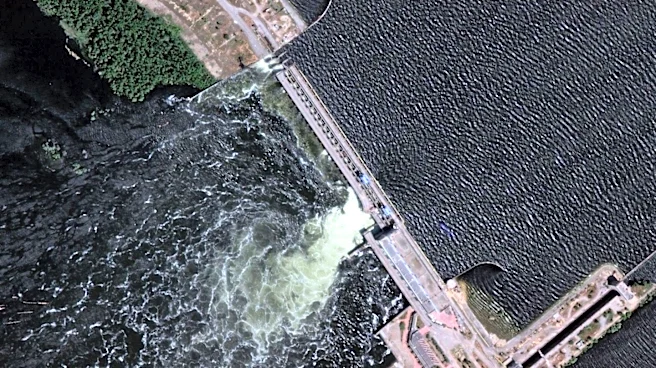







The Bonneville Lock and Dam complex, situated on the Columbia River between Oregon and Washington, plays a crucial role in facilitating river navigation. Its construction in the 1930s marked a significant advancement in managing the powerful Columbia River, transforming it into a more navigable waterway. The dam is located approximately 40 miles east of Portland, Oregon, within the Columbia River Gorge, and is managed by the United States Army Corps
of Engineers. Beyond its function in electrical power generation, the dam's lock systems have been instrumental in enabling the passage of vessels upstream and downstream, profoundly impacting regional commerce and transportation.
Early Efforts and the Original Lock
Long before the Bonneville Dam was conceived, efforts were made to improve navigation on the Columbia River. In 1896, the Cascade Locks and Canal were constructed several miles upstream of the future dam site. These early structures allowed ships to bypass the challenging Cascades Rapids, which posed a significant barrier to river traffic. However, the landscape of river navigation was dramatically altered with the construction of the Bonneville Dam during the New Deal era.
The dam's construction led to the creation of the Bonneville Reservoir, also known as Lake Bonneville. This reservoir submerged both the Cascades Rapids and the original 1896 lock structure. To maintain and enhance navigation, a new lock was an integral part of the Bonneville Dam project. The original navigation lock at Bonneville opened in 1938. At the time of its inauguration, it was recognized as the highest single-lift lock in the world, capable of a vertical lift of 60 feet. This engineering feat allowed for the efficient passage of vessels, connecting different sections of the Columbia River and supporting economic activities in the Pacific Northwest.
Expansion and Modernization of Lock Systems
Over the decades, as river traffic and vessel sizes evolved, the need for updated navigation infrastructure became apparent. Despite its world-record size in 1938, the original Bonneville Lock eventually became the smallest among a series of eight locks, with seven others subsequently built at various locations upstream on the Columbia and Snake rivers. This development highlighted the continuous demand for improved navigation capabilities along the extensive Columbia-Snake Inland Waterway.
Recognizing this need, a new lock was constructed at Bonneville. This modern structure was built on the Oregon shore and commenced operations for ship and barge traffic in 1993. The new lock significantly enhanced the capacity and efficiency of river navigation at the dam. While the old lock from 1938 is still physically present, it is no longer actively used for navigation. The construction of the new lock was a substantial undertaking, costing 341 million U.S. dollars. It measures 206 meters in length and 26 meters in width, and a single lockage operation typically takes about 30 minutes. This continuous investment in navigation infrastructure underscores the enduring importance of the Bonneville Dam in maintaining the Columbia River as a vital artery for commerce and transportation.