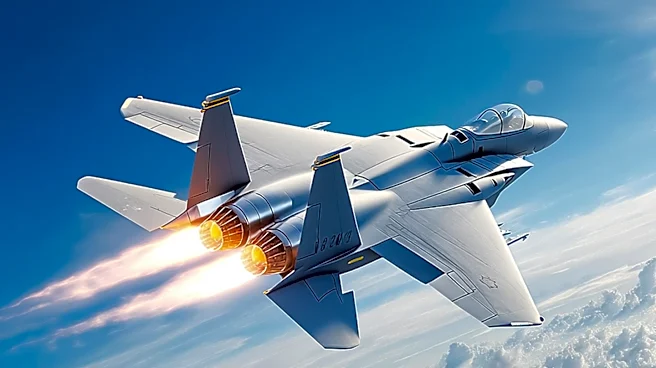






The Grumman F-14 Tomcat is instantly recognizable by its distinctive variable-sweep wings, a feature that was central to its design as a supersonic, twin-engine, two-seat fighter aircraft. This innovative wing geometry allowed the F-14 to optimize its aerodynamic profile across a wide range of speeds, from slow carrier approaches to high-speed interception missions. The engineering behind these wings was a critical factor in the F-14's performance
and its ability to fulfill its diverse roles for the United States Navy from 1974 to 2006.
The Mechanics of Variable Geometry
The core of the F-14's variable-sweep wing system was its ability to pivot the wings in flight. Depending on flight conditions, the wings could sweep between 20 and 68 degrees. This adjustment was primarily managed by the Central Air Data Computer (CADC), which automatically determined the optimal wing sweep angle to achieve the best lift-to-drag ratio. Pilots, however, retained the ability to manually override the computer if necessary. For ground operations, particularly on crowded aircraft carriers, the wings could be swept back even further, to 75 degrees, to conserve space.
The wings themselves were constructed as a two-spar structure, incorporating integral fuel tanks. The torsion box, pivot joints, and the upper and lower outer skins of the wings were made from a titanium alloy, chosen for its strength and light weight. Unlike conventional aircraft, the F-14 did not use ailerons for roll control at higher speeds and greater sweep angles. Instead, these functions were handled by the tailerons, which are control surfaces on the horizontal stabilizers. At lower speeds, spoilers assisted with roll control. Additionally, the F-14 featured high-lift devices along the entire leading and trailing edges of the wings, such as leading-edge slats and trailing-edge flaps, which further enhanced lift during landing or in air combat. For instance, leading-edge slats would adjust to 17 degrees for landing and 7 degrees for combat, while trailing-edge flaps would set to 35 degrees for landing and 10 degrees for air combat.
Aerodynamic Stability and Maneuverability
One of the challenges of variable-sweep wings is managing changes in pitching moment, especially during supersonic flight. To address this, the F-14A was equipped with small, automatically extending triangular leading-edge extensions, known as "glove vanes," located at the junction between the cockpit and the wing root. These glove vanes were crucial for maintaining maneuverability at high speeds. The aircraft was inherently aerodynamically stable, meaning its center of pressure was always behind its center of gravity. As the wings swept back, the center of pressure moved further aft, and this shift was exacerbated during transonic flight.
To counteract an excessively high stability margin and improve supersonic maneuverability, the glove vanes would deploy automatically at speeds above Mach 1.4. This deployment shifted the center of pressure forward, making the Tomcat more agile in supersonic flight and allowing it to perform 7.5g maneuvers even at Mach 2. This ingenious solution, attributed to lead engineer Bob Kress, was vital for the F-14's performance as an interceptor. The F-14's twin vertical stabilizers also contributed to yaw stability, particularly at high angles of attack, without requiring an unnecessarily tall aircraft design. The large area between the engines, forming part of the fuselage, also generated a significant portion of the total lift, contributing 40-60 percent depending on the wing sweep angle.