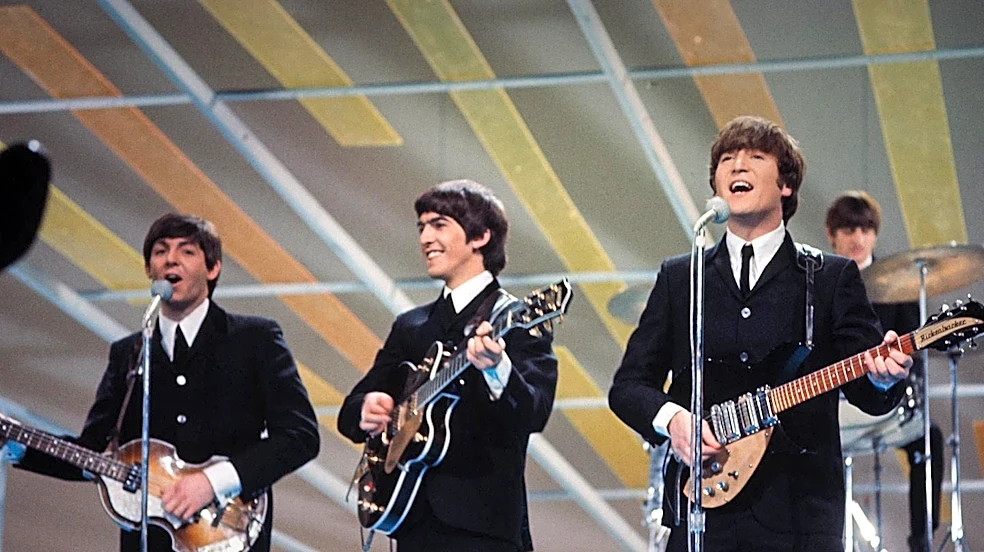









"I Want to Hold Your Hand," a pivotal song by the English rock band the Beatles, was a product of specific circumstances and a unique collaborative writing process between John Lennon and Paul McCartney. Recorded on October 17, 1963, and released in the United Kingdom on November 29, 1963, this track marked a significant technological step for the band as it was their first record to utilize four-track recording equipment. Its creation was partly
driven by a strategic push to conquer the American market, which had previously been resistant to the Beatles' music.
Crafting a Song for America
Brian Epstein, the Beatles' manager, was particularly concerned about Capitol Records' repeated rejection of the group's recordings in the United States. He actively encouraged Lennon and McCartney to compose a song specifically designed to appeal to the American audience. While Epstein's recollection emphasized this strategic intent, George Martin, the band's producer, had a slightly different perspective. Martin believed that the increasing demand for the Beatles' music would eventually leave Capitol with no choice but to release "I Want to Hold Your Hand," regardless of a targeted composition effort.
At the time of its creation, Paul McCartney had recently moved into 57 Wimpole Street in London, where he was staying as a guest of Dr. Richard and Margaret Asher. Their daughter, actress Jane Asher, had become McCartney's girlfriend earlier that year. This residence temporarily became the new songwriting hub for Lennon and McCartney, taking over from McCartney's childhood home on Forthlin Road in Liverpool. Margaret Asher, an oboe teacher, had a "small, rather stuffy music room" in the basement. It was in this intimate setting, seated at the piano, that Lennon and McCartney composed "I Want to Hold Your Hand."
The "Eyeball to Eyeball" Collaboration
John Lennon vividly recalled the songwriting process in a September 1980 interview with Playboy magazine. He described their collaboration as intensely personal and direct: "We wrote a lot of stuff together, one on one, eyeball to eyeball." He specifically remembered the moment they found the crucial chord for "I Want to Hold Your Hand." Lennon recounted being in Jane Asher's house, downstairs in the cellar, both playing the piano simultaneously. They had the lyrical fragment, "Oh you-u-u/ got that something..." when Paul struck a particular chord. Lennon immediately recognized its significance, turning to McCartney and exclaiming, "That's it! Do that again!" He emphasized that in those days, their writing was truly a joint effort, with both musicians actively contributing and influencing each other.
Paul McCartney corroborated Lennon's account in 1994, agreeing that "'Eyeball to eyeball' is a very good description of it. That's exactly how it was. 'I Want to Hold Your Hand' was very co-written." This collaborative style meant that lyrical phrases, often bland and random, were called out by either Lennon or McCartney. If these phrases fit the overall sound and rhythm of the developing song, they would be incorporated. The song's title itself was likely a variation or evolution of "I Wanna Be Your Man," a track the Beatles had recently recorded at EMI Studios, showcasing how their creative ideas often built upon previous works.
Musical Structure and Early Production
Musically, "I Want to Hold Your Hand" draws inspiration from Tin Pan Alley and Brill Building techniques, presenting an example of a modified 32-bar form. It is structured around a two-bridge model, connected by an intervening verse. The song notably lacks a single "lead" singer, with Lennon and McCartney alternating between singing in unison and in harmony. The composition is set in the key of G major. Lyrically, it begins two beats early with the line "Oh yeah, I'll tell you something," featuring a D-B, B-D melody note drop and rise over a G chord. The specific "landmark chord" Lennon mentioned McCartney hitting during composition has been a point of discussion among musicologists. Wolf Marshall and Walter Everett identify it as the minor vi (Em) chord within a G-D7-Em progression. However, Dominic Pedler suggests that the more surprising element is the melody note drop from B to F# against a III7 (B7) chord on the word "understand," highlighting the song's subtle yet effective musical complexities.