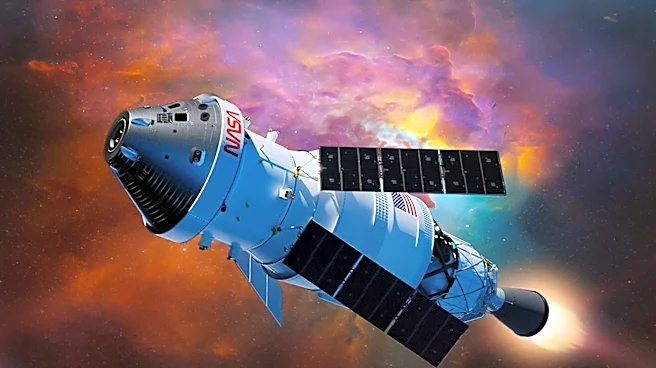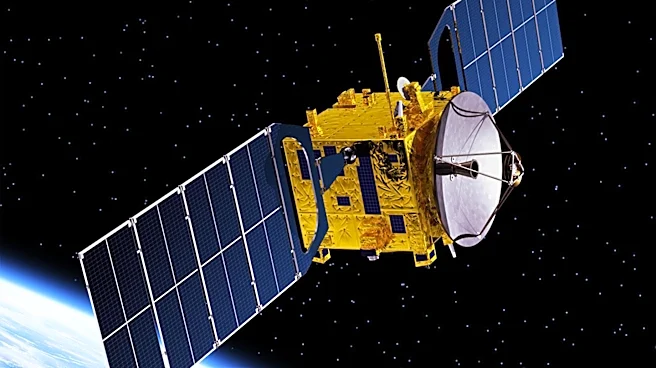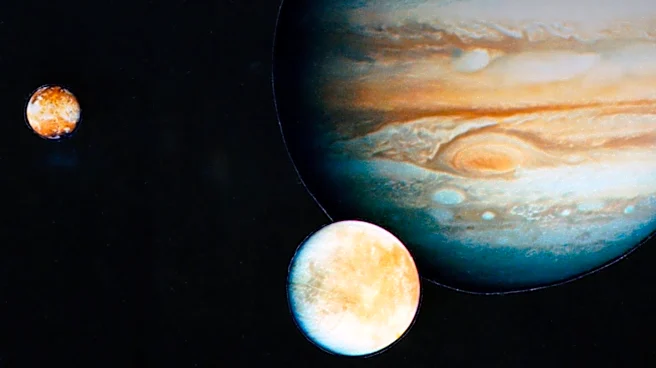





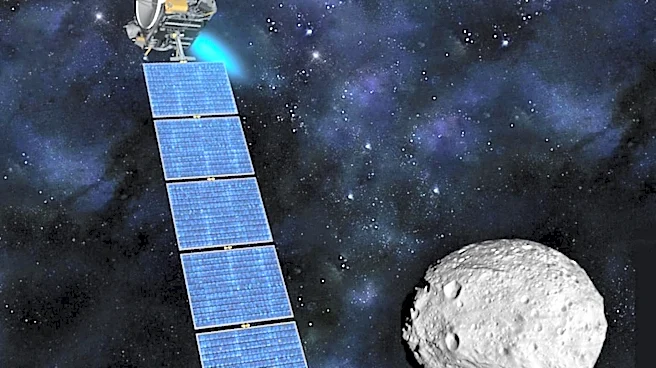

The Galileo spacecraft embarked on an ambitious mission to study Jupiter and its moons, a journey that began on October 18, 1989, with its launch aboard the Space Shuttle Atlantis. This American unmanned NASA mission was managed by the Jet Propulsion Laboratory, with significant contributions from West Germany's Messerschmitt-Bölkow-Blohm for the propulsion module and NASA's Ames Research Center for the atmospheric probe. The spacecraft, consisting
of an orbiter and an atmospheric entry probe, had a combined mass of 2,562 kg and stood 6.15 m tall. Its path to Jupiter was far from direct, involving a series of gravity-assist flybys that transformed a potential two-year trip into a six-year odyssey, ultimately arriving at Jupiter on December 7, 1995.
Overcoming Launch Challenges and Charting a New Course
Initially, the Galileo mission faced significant hurdles, particularly after the Space Shuttle Challenger disaster in 1986. This tragedy grounded the Space Shuttle fleet and led to the cancellation of the Shuttle-Centaur project, which was originally intended to launch Galileo directly to Jupiter. The Centaur upper stage offered a powerful, gentle, and flexible launch option, allowing for a two-year flight time and potential asteroid flybys. However, safety concerns regarding liquid-fueled rockets after the Challenger incident led to its removal from the mission plan. Without the Centaur, engineers at JPL had to devise an alternative. Robert Mitchell, the Galileo Mission Design Manager, and his team, including Dennis Byrnes, Louis D'Amario, and Roger Diehl, conceived the Venus-Earth-Earth Gravity Assist (VEEGA) trajectory. This innovative plan involved flying past Venus once and Earth twice to gain the necessary velocity to reach Jupiter, extending the travel time from thirty to sixty months.
The VEEGA trajectory, while solving the propulsion problem, introduced new challenges. The second encounter with Earth, for instance, would not provide additional energy but merely change the spacecraft's direction towards Jupiter. Furthermore, this roundabout route meant Galileo would arrive at Jupiter when it was at its maximum range from Earth, resulting in minimum signal strength for communication. This necessitated reliance on the Canberra Deep Space Communication Complex in Australia, with its 70-meter antenna, to track the spacecraft. Despite these complexities, the launch proceeded. After a couple of delays due to a faulty engine controller and inclement weather, Atlantis successfully lifted off on October 18, 1989. Galileo was deployed the following day and began its journey towards Venus, traveling at over 14,000 km/h.
Early Interplanetary Encounters and Unexpected Discoveries
Galileo's first major encounter was with Venus on February 10, 1990. Although not designed for Venus observations, the spacecraft's instruments, such as the near-infrared mapping spectrometer (NIMS), provided unique data. NIMS was able to view Venus's clouds and map the equatorial and mid-latitudes of its night side with significantly higher resolution than Earth-based telescopes. The ultraviolet spectrometer (UVS) also observed Venusian clouds and their movements. A key challenge during this flyby was protecting the spacecraft from thermal damage due to Venus's proximity to the Sun. The high-gain antenna (HGA) was kept folded and pointed away from the Sun, forcing the use of smaller S-band low-gain antennas (LGAs) with significantly reduced data transmission rates.
Following the Venus flyby, Galileo performed two Earth gravity assists. The first occurred on December 8, 1990, at a range of 960 km, marking the first time a deep space probe returned to Earth from interplanetary space. During this flyby, experiments were conducted, including a study of Earth's bow shock and magnetic tail. Planetary scientist Carl Sagan also devised experiments using Galileo's remote sensing instruments to search for signs of life on Earth, leading to the identification of the "Sagan criteria for life." The second Earth flyby on December 8, 1992, was even closer, passing within 304 km of the planet. This precision allowed for the cancellation of a scheduled course correction, saving valuable propellant. En route to this second Earth encounter, Galileo also flew over the Moon's north pole, providing new information about its mineralogical diversity and evidence of earlier volcanic activity.
Asteroid Belt Crossings and the High-Gain Antenna Anomaly
After its second Earth encounter, Galileo ventured into the asteroid belt, making history with the first asteroid flyby by a spacecraft. On October 29, 1991, it passed 951 Gaspra, an S-type asteroid, at a distance of 1,604 km. Fifty-seven images were captured, revealing a cratered and irregular body. Two years later, on August 28, 1993, Galileo flew past another asteroid, 243 Ida, at a range of 2,410 km. This flyby led to the groundbreaking discovery of Dactyl, the first asteroid moon ever observed, challenging previous assumptions about the rarity of such celestial bodies. The images of Ida and Dactyl, though limited by data transmission rates, provided invaluable insights into asteroid composition and formation.
However, a significant setback occurred on April 11, 1991, when the high-gain antenna (HGA) failed to unfurl as commanded. This umbrella-like antenna, crucial for high-bandwidth data transmission, remained partially closed. Investigations later suggested that lubricants between the ribs and cup had eroded during the spacecraft's prolonged storage and cross-country transport, leading to cold welding in the vacuum of space. Despite numerous attempts to free the antenna, it remained stuck, forcing the mission to rely on the low-gain antennas. This drastically reduced the data transmission rate from an anticipated 134 kilobits per second to a mere 8 to 16 bits per second, and eventually to as low as 10 bits per second. This antenna anomaly profoundly impacted the mission's ability to send back images and scientific data, requiring innovative data compression techniques and extensive use of the Deep Space Network's large antennas to salvage as much information as possible.